Showing posts sorted by relevance for query ghost signs. Sort by date Show all posts

Rue de la Rouselle, which connects cours d’Alsace-et-Lorraine and cours Victor-Hugo, is one of the prettiest little side-streets of old...

Rue de la Rouselle, which connects cours d’Alsace-et-Lorraine and cours Victor-Hugo, is one of the prettiest little side-streets of old Bordeaux. In fact, it is so picturesque that it has provided the setting for a number of films made in the city, including recent offerings such as 2 Automnes 3 Hivers (released in 2013), Compte tes blessures (2016) and Le vice caché des Navajos (also 2016).

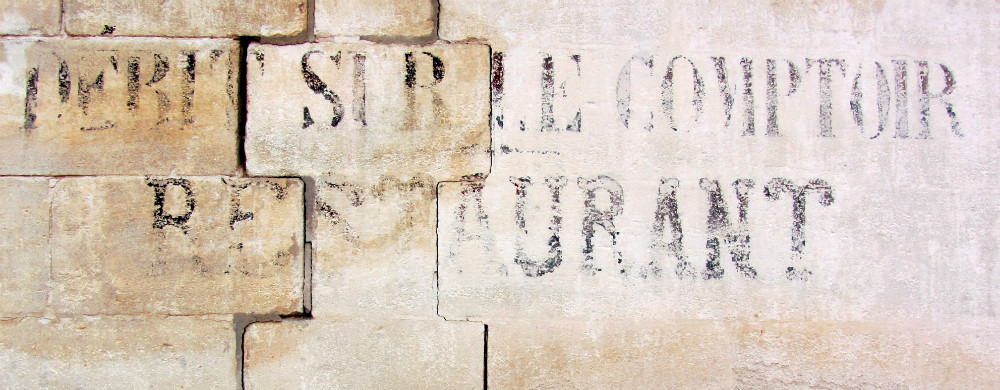
Rue de la Rousselle also happens to boast one of the highest concentrations of ghost signs, those faded hand-painted signs and advertisements that have been a favourite recurring subject on the Invisible Bordeaux blog. But how many of the signs are the real thing, and how many are leftovers from period film sets?

The starting point behind this enigma was after spotting the painted sign for “Steenvoorde” above what appears to be a garage. With a little help from correspondents on social media, it was quickly established that Steenvoorde was a real-world firm (as well as being a town in northern France), more precisely a dairy company founded in 1911, which changed its name to Stenval in the 1960s ahead of being taken over by the Gervais/Danone conglomerate. Although most of the company’s activities gradually merged into Danone’s output, the original facility has gone on to produce baby milk under the Blédina brand. 


Thanks to a chance encounter on site, it was confirmed to me by the owner of the building himself that the sign was very much the real thing, and that when he acquired the building a number of years ago, the ground floor area was in fact a milk and cheese storage depot. He also mentioned that visitors from northern France were usually delighted to spot the Steenvoorde name above the door, as it reminded them “of home and of a bygone era”. 

My new friend was confident that one of Bordeaux’s most famous ghost signs, announcing “Dépôt des biscuits Léon” was also genuine, while believing the sign had been restored in recent years. (Cross-referencing with a previous appearance on the blog confirms this.) Running “Biscuits Léon” through Google failed to throw up any results whatsoever, but once again social media correspondents were on hand to clear things up. Biscuits Léon was indeed a real-world company, proclaiming to be from Paris but in fact operating out of Maisons-Alfort, a suburb to the south-east of France's capital city, and was apparently renowned for its "petits-beurres" and its "gaufrettes vanille". And this would therefore have been the company's Bordeaux storage depot. 

Punctuation pedants may have noticed that inverted commas have been positioned before the word Léon, but are missing after it.
Upon closer inspection, the paint job does appear to be relatively recent.
A Biscuits Leon advertisement, source: delcampe.net (thank you Rosine)

A little further up the street, there is every chance that this next ghost sign is very much the real thing, given how worn and lived-in it all looks. The faded letters above the windows read “Entrepôts J-E Bonnel & Cie” while two vertical signs refer to “Transit” and “Camionnage”, suggesting Bonnel & Co. provided transport and haulage services.


The following two traders definitely appear to be fictional film set material. The first is a shoemaker who also advertises as a “specialist in laces”, operating under the delightful name of “Aux Galoches Réunies”, which I would love to loosely translate as “Shoes United”, although the word galoche does have a double meaning: it is a type of shoe or clog, but also a French kiss! The second is the hairdresser Antonio Martinez, where the adhesive paper sign has seen better days. Although it has made it through to 2019 more or less in one piece, it does look as if the sign will soon be a thing of the past. 


Then comes the most photogenic of all, an establishment labelled as “Café Cardinal” which also sold firewood and coal, and was owned by one E. Vaton. My Steenvoorde correspondent believes that this really was a café in a past life but that the painted sign is a recent addition. Again this is all very difficult to verify. Whatever, there are two certainties: today the “café” is very much a private residence and, as a plaque on the wall recalls, it is located on the very spot where Michel Montaigne, the renowned and influential 16th-century thinker and mayor of Bordeaux, lived with his family. 


Finally, to the side of a small square where rue de la Rousselle meets rue du Puits-Descazeaux, it would be great to think this faux marble sign advertising “Service départemental, Architecture” did in fact date back to Gallo-Roman times. It is of course a much more recent addition, but was a bona fide banner above the door of what was an architects’ bureau. The architects have reportedly moved on though, and now that part of the building is a company crèche! 


So there you have it. A few open questions and unsolved mysteries, and some genuine signs of the past. But this might just be one of those articles that evolves over time on the basis of feedback and information that comes in from readers. Do let me know if you know something about those various sights that has been missed here, whether you’ve spotted any of them in films, whether you used to enjoy your morning cup of coffee at Café Cardinal, and if you can help to categorically tell which signs are real, and which have been left over from the movies! To be continued?

> Find it on the Invisible Bordeaux map: rue de la Rousselle, Bordeaux
> Big thanks to writer Sophie Poirier who alerted me to rue de la Rousselle’s film set credentials and the existence of “fake” ghost signs, to Tobye over on Instagram who provided the essential initial information about Steenvoorde, to Rosine Duet for information about Biscuits Léon, and to Jérôme Mabon of the États Critiques website (heavily recommended for Bordeaux-based cinema buffs!) who identified and viewed the films shot on the street, even though the mysteries remain!

Invisible Bordeaux has once again teamed up with real-world and online acquaintances to proudly present another set of faded hand-pain...


Invisible Bordeaux has once again teamed up with real-world and online acquaintances to proudly present another set of faded hand-painted adverts and signs or, if you will, "ghost signs"! (And don't forget that they can all be located in the handy dedicated GoogleMap!)

This first find is from the right-bank suburb of Carbon-Blanc. It promotes "Meubles Bayle", the furniture outlet founded in Bordeaux in 1854. In the early 1900s, heir Émile Bayle went on to set up a number of neighbouring shops catering for different furniture needs and tastes on Cours d'Albret in central Bordeaux (or "Bx" on the ad, the "ET" probably being the final letters of "Albret").
Today, that concept remains but the location and scale have changed. Bayle now run a host of branded furniture shops (But, Crozatier, Fly, Monsieur Meuble and Cuisine Schmidt) which are all handily positioned next to each other in what they still like to call "le Village du Meuble" in Mérignac.


There are obviously at least three generations of adverts competing for space here, although the white and blue sections on the right have only recently resurfaced. They had previously been covered up by a modern advertising hoarding, as can still be seen on the September 2008 shot that is currently visible on Google Streetview (as pictured right). The metal rods that supported the hoarding are still in position. [Find it]

***
This ad for a Renault garage can also be seen in Carbon-Blanc. This incarnation of the Renault logo was used by the car manufacturer between 1959 and 1972. [Find it]

***
"À La Ruche" (the beehive), in the right-bank district of La Bastide, would have supplied haberdashery and sewing products and materials, as well as textile dye and shoes. (Photo: @Bordeaux_Expats)  [Find it]
***
Rue du Loup is on the el Camino de Santiago pilgrimage route through the city, hence the scallop shell on the street sign. Perhaps pilgrims could carry out a few running repairs on their footwear at this supplier of leather (cuirs) and shoemaking tools and materials (crépins). [Find it]
***
I have a funny feeling that the current owners of this property no longer supply the neighbourhood with "charcuterie de campagne", but I may be wrong... (Photo: Gilles Rose) [Find it]
***

This fantastic old shopfront was spotted by @Bordeaux_Expats and @GillesRose. Could find no traces of the "waterproof clothing manufacturer" Emel on Google so if anyone has any further information, do get in touch! (Photo: Gilles Rose) [Find it]

***
Today, this building is home to TOC, or "Trouble Obsessionnel Culinaire", a designer kitchen ustensil boutique. In bygone years it was a parlour providing hair care, massages and manicure services (not to mention "postiches", i.e. wigs or toupees) for a male and female clientèle. Spotted by @mllebordeaux. [Find it]


 ***

Rue Capdeville: there's a lot going on here, with various generations of painted signs all fading and blurring into a virtually illegible succession of messages. One appears to be promoting the painter and glazier (peinture et vitrerie) entreprise générale Marcel Salles (formerly Messieurs Magot), located at 74 (?) Rue du Loup.

Further down the wall are just hints of other activities: sommiers (bed frames), immobilier (real estate). Given the state of the walls, it looks as if these signs could soon be fading away for good... [Find it]

***
Dubonnet is a wine-based apéritif that was first invented in the mid-19th century (its creator, Joseph Dubonnet, was in fact aiming to create a cure for malaria!). Since 1976, the drink has been distributed by the Pernod-Ricard group. In the 1950s and 1960s, Dubonnet became synonymous with its advertising slogan: "Dubo, Dubon, Dubonnet".

The brand and the slogan remain an occasional roadside sight throughout France, as here in Gujan-Mestras on the Bassin d'Arcachon. Other Dubonnet ghost signs can be viewed on the ghostsigns.co.uk and Painted Roadside Advertisements websites. [Find it]

***
A double-whammy for this charming house in the centre of Saint-Loubès. The front wall displays the tenant's status as "garde champêtre", the country warden or rural policeman. Either side of the upper-floor windows are carved "RF" homages to the République française.

Around the corner is this faded advert for "Chocolat Louit", the chocolate manufacturer founded in the 19th century by Émile Louit, heir to a successful family foodstuff business and the man who created Le Journal de Bordeaux... as well as funding a number of buildings in Bordeaux including a doomed theatre, initially known as Théâtre Louit. The Louit chocolate factory was situated in the area where the France Télévisions TV studios can now be found. [Find it]

  • Other Invisible Bordeaux ghost sign features here and here.

The time has come for another tour of some of the faded hand-painted signs - or, if you will, ghost signs - to be found in and around B...


The time has come for another tour of some of the faded hand-painted signs - or, if you will, ghost signs - to be found in and around Bordeaux, and which are to be admired and savoured before they fade away for good... and all of which can be located in the slowly-expanding dedicated GoogleMap!

This first unusual find can be spotted on the walls of a house on Cours du Médoc, one of the main arteries into the city centre from the north. In case you're wondering, the house is number 180... although this is easy to work out as three generations of 180s are still very much visible above a sign that still promises "chambres garnies à louer" (furnished rooms for rent - thanks to Twitter correspondents for helping me decipher the phrase!). This suggests the building was previously a guest-house possibly providing mid- to long-term accommodation.
Elsewhere, an information panel is a mass of information about this "maritime bar-restaurant" which offered wines and liqueur (as well as "café, bière & limonade") over the counter. At one time, some of the wording must have been painted over existing information but now everything appears at the same level. What, though, would have been "consommations de 1ères marques"? Any ideas? [Find it]

**


Over in Bourg-en-Gironde, this old advert for Bassereau "méthode champenoise" Champagne-like sparkling wine is still discernible. The Bassereau family produced this wine in Saumur, Vouvray, Bourgogne, Champagne as well as here in the Bordeaux region, more specifically in the Côtes de Bourg area on the banks of the Garonne river/Gironde estuary, where the underground caves cut into the hillside provided ideal conditions for nurturing and producing sparkling wine. Further information can be found on the website of Château de la Grave, where the Bassereau family first began producing this unique Bordeaux bubbly, and where the output of "Poliane brut" continues to uphold the local tradition. [Find it]

**


Staying in Bourg, this large-scale hand-painted map is accompanied by a message which directly addresses those who are passing through: "Touristes... vous êtes dans la région des vins des Côtes de Bourg" (Tourists... you are in the Côtes de Bourg wine region). The credit for the sign painters (Nel-Dey publicité Bordx?) is arguably more visible today than the remainder of the message! [Find it]

**


And while we're on the subject of wine, here are traces of the elegant signage above what used to be a wine trader in Bordeaux, on Rue Goya. This former commercial unit also appears to have lost a window over the course of time. It's not always this sunny, by the way. [Find it]
**


This painted sign announcing "Hippodrome du Bouscat" runs along the top of one of the perimeter walls of the Bordeaux-Le Bouscat racecourse. The letters, painted green on white, are gradually peeling away. What is more, they are also having to contend with the onslaught of some vociferous ivy. There is a bit of mystery about this one though: why is the name "F. Massart" embedded, mosaic-like fashion, in the wall? F. Massart, if you're reading this, please get in touch! [Find it]

**
Avenue de la Libération is the main street that runs through Le Bouscat, and is set for a makeover in the coming years with the construction of the all-new line D of the tram network. Some of the exposed walls still sport the logos of yesteryear such as this star-shaped symbol of Caltex, the petroleum arm of the Chevron corporation. Although still present in some parts of the world, the brand Caltex (originally a contraction of California Texas Oil Company) has now been superseded by Chevron itself. [Find it]


This second find on Avenue de la Libération is another case of adverts painted at different periods now tussling for space. On the left half of the wall is an ad for the wine-based apéritif Dubonnet (as discussed in a previous collection of ghost signs), while to the right we may (or may not) be looking at the R and H of a Byrhh logo... advertising a rival wine-based apéritif (as also discussed in a previous item). [Find it]

**

This more recent advert on Cours de la Martinique provides another opportunity to cross-reference with a previous item as it promotes "Meubles Bayle", the furniture outlet founded in Bordeaux in 1854 that went on to become a complex of different shops on Cours d'Albret and continues to live on as Le Village du Meuble in Mérignac. [Find it]
**
This jaunt finishes up in Saint-Loubès and the wall of this house which promotes a neighbouring tree nursery. The six-digit phone number is particularly charming... and there's a fair chance that the painted letters and numbers pre-date the first-floor window, which has cancelled out a substantial part of the name and trade description! [Find it]
  • Other Invisible Bordeaux ghost sign features here, here and here.

In this internet age there is an active online community of people who track down ghost signs, those faded hand-painted advertisements an...

In this internet age there is an active online community of people who track down ghost signs, those faded hand-painted advertisements and signage from bygone years which have somehow survived this far into the 21st century.

In France, particularly rural France, ghost signs (such as the one above to be found in Saint-Aubin-de-Médoc) remain a fairly common sight. With a little help from real-world friends and Twittersphere acquaintances, here is a first selection of a few such adverts and signs to be spotted in and around Bordeaux. A dedicated GoogleMap (which has also been added to the right-hand menu) will help you locate them all. There will be many more to come in other posts further down the line!

The time has come for another hand-picked selection of faded hand-painted adverts and signs, more commonly referred to ...

The time has come for another hand-picked selection of faded hand-painted adverts and signs, more commonly referred to as "ghost signs". Remember that all of these signs, and many more, can be located in the slowly-expanding dedicated GoogleMap!

The sign pictured left can be seen in Bourg-en-Gironde, at the point where the rivers Dordogne and Garonne join to form the Gironde. Most prominent is the ageing panel advert for Byrrh, the legendary wine-based apéritif that blends red wine, the fortified wine known as mistelle, and quinine, a  natural white crystalline. It sounds delicious.

Ever since it launched in 2011, one of the recurring themes on the Invisible Bordeaux has been so-called ghost signs, those old handpain...


Ever since it launched in 2011, one of the recurring themes on the Invisible Bordeaux has been so-called ghost signs, those old handpainted names, messages or advertisements that have faded over time, but are still clinging in there, silently embellishing walls and façades.

Bordeaux appears to boast an endless supply of these charming oddities, and here is an all-new selection of finds throughout the city. Enjoy! 

This first picture, taken on rue Jacques-Nancy, shows a wallpainted sign that, from what I can make out, used to be point to the left towards a "Succursale Citroën", i.e. a garage. Unusually, it looks like the company responsible for producing the sign, "---ir Publicité", was quite happy to take up almost as much wall space as the name of its client!

The picture above was taken on cours Aristide-Briand. Entreprise Genriès clearly had a thing about all types of ladder (échelles tous genres) and was obviously specialised in carpentry and building services (menuiserie, bâtiment).

This mysterious warehouse is located bang in the city centre, albeit in a quiet side-street, rue Arnaud-Miqueu. A bit of googling suggests that Compagnie Française is still very much a going concern, and is defined here and there as a "retail business" with some sources suggest it specialises in gentlemen's clothing. To be confirmed?

There's a lot going on here at this old greengrocer's (fruits & primeurs) on rue Sanche de Pomiers, with several layers of messages to decipher. The right-hand side is easier to read with its promises of "oranges, citrons, fruits secs" (oranges, lemons, dried fruit) but the most legible part over to the left is the five-digit telephone number: 82 213.

Robert d'Isle enables us to progress to a six-digit number: 48 27 17. This outlet on rue des Trois-Chandeliers promised "entretien, location, réparations" (maintenance, rental, repairs), but in what line of business?

This old sign on rue Chauffour isn't so ghostly. For a start it appears to have possibly been given the occasional new coat of paint. And secondly, the establishment was founded "just" 31 years ago, in 1986 (by which time telephone numbers ran to eight digits). Owner Hervé Valverde, whose initials float towards the top of each glass of wine, appears to be a bit of a character, judging by the Sud Ouest piece available online here. Oh, and the telephone number remains the same to this day, with the straightforward addition of a modern-day "05" prefix.

Staying on rue Chauffour, this advert for Frigéco, the brand of refrigerators associated with French home appliances giant Thomson, even features a detailed picture of a well-stocked fridge. And, to the left, a happy figure (or possibly a snowman, it's difficult to tell) can be seen pointing to the shelves of fresh produce. The local "distributeur exclusif" is advertised towards the bottom of the wall, but serious detective work is needed to work out what it says!   

R. Leroyer operated out of rue du Hamel, but what services did he or she provide? Despite the lack of information, the sign deserves a feature here because of the elegantly-shaped letters and nifty shading used by the signwriter.

Rue du Serpolet is where you will find these traces of a bedding and upholstery business, the sign of which now combines nicely with the bunting on the first-floor balcony!

Garage de Ségur once operated on rue Ségur, catering for all your automobile-related repair, mechanical, sheet metal and painting needs (réparations, mécanique, tôlerie, peinture).

> All of these finds have been added to the dedicated Bordeaux ghost signs and shopfronts Googlemap!
> View past ghost sign features: Chapter 1, Chapter 2, Chapter 3, Chapter 4, Cours Gallieni, Traders of the past.
> Ce dossier est également disponible en français !