An unusual guide to wine appeared on the scene earlier this year: " La Carte des vins s’il vous plaît ". The single-page guide...


An unusual guide to wine appeared on the scene earlier this year: "La Carte des vins s’il vous plaît". The single-page guide, which combines graphics, tips and tales, is the work of Jules Gaubert-Turpin and Adrien Grant Smith Bianchi. I caught up with Jules, over a glass of wine, to find out more about the innovative product.

How would you define la Carte des Vins s’il vous plaît?

It's a foldaway map which compiles easy-to-understand graphics that illustrate how a wine-growing region functions: the varieties of grapes (cépages) that are used, proportions of the different types of wine produced, etc. The challenge we faced was to talk about wine, which can be a touch elitist, in a manner which is as straightforward as possible. And we believe that the best way of getting things across is through the use of diagrams, charts and timelines.

I recently discovered one of the most unusual and fascinating outings to be experienced in Bordeaux… or at least it is if you’re drawn t...


I recently discovered one of the most unusual and fascinating outings to be experienced in Bordeaux… or at least it is if you’re drawn to industrial tourism and not afraid to stay up late: a night-time tour of the print centre of the regional daily newspaper Sud Ouest on the right-bank Quai de Brazza.

The tours, which are entirely free of charge, take place several times a week between the months of October and June and are led by a friendly team of young guides. Although most visitors come as part of group bookings (organised by works committees, local councils, etc.), the tours are very much open to the general public. And so it was that my elder son and I joined a small crowd assembled outside the facility at 10:30pm on a chilly Friday night.

When I was recently invited to board a Cessna 172 to enjoy a flight over the Atlantic coast, the Gironde estuary and the Médoc , I made...


When I was recently invited to board a Cessna 172 to enjoy a flight over the Atlantic coast, the Gironde estuary and the Médoc, I made sure I had my GoPro camera on hand to capture footage as the plane took off and landed. 

So here then is the view that pilots enjoy when departing from and arriving at Bordeaux-Mérignac airport. We took off from and landed on the main runway, codenamed 05/23 (find out what those mysterious numbers mean here), although we had the semi-unusual delight of facing north-east when doing so (the winds are such that aircraft tend more often to take off and land in a south-westerly direction).


A colleague and aviation enthusiast recently suggested I take flight with him in a light aircraft, with the primary objective of taking ...


A colleague and aviation enthusiast recently suggested I take flight with him in a light aircraft, with the primary objective of taking aerial photographs of the new facility being built by our company, Thales, in Mérignac. This was obviously an offer I couldn't refuse!

I met up with him early one sunny Saturday morning at the premises of the CAPAM flying club by the runway at Bordeaux-Mérignac airport, and together we boarded a Cessna 172 Skyhawk, finding a slot to take off in between the departures and arrivals of various airliners. Once we'd taken a few pictures of the Thales site, we headed on over to the Atlantic coast, flying from Le Porge to Le Verdon, and then down the Gironde Estuary past Pauillac, Blaye and Margaux. My camera remained at the ready and here are some of the photos that I took!

Regular readers may remember the recent account of the morning spent exploring the Portuguese Jewish cemetery on Cours de la Marne , one...


Regular readers may remember the recent account of the morning spent exploring the Portuguese Jewish cemetery on Cours de la Marne, one of three final resting places for Jews in central Bordeaux. Of the others, the cemetery on Cours de l’Yser is still in use, whereas burials at the tiny “Cimetière des Avignonnais” on Rue Sauteyron, a mere 50 metres from Place de la Victoire, ceased more than 200 years ago.

The Avignonnais cemetery is rarely open to the general public, and can only usually be visited during specially-organised guided tours, so when I spotted it would be accessible as part of the city’s European Heritage Days programme, I decided to head over to the site to take in a low-key tour of my own.

Cap Ferret’s oldest place of worship is the curious Sainte Marie du Cap, also known as Chapelle de l’Herbe, but most often referred to a...


Cap Ferret’s oldest place of worship is the curious Sainte Marie du Cap, also known as Chapelle de l’Herbe, but most often referred to as Chapelle de la Villa Algérienne.

The "Algerian Villa" in question once stood barely 100 metres away from the spot where the chapel can be found, on the Bassin d’Arcachon-side waterfront of the affluent presqu’île, near to the picturesque fishing village L’Herbe.

The full story goes back to 1863, when the successful civil engineering entrepreneur Léon Lesca partnered with his brother to purchase 27 hectares of remote, untouched land (L’Herbe had yet to be founded at this time). Lesca had recently returned from North Africa to his homeland (he was born in La Teste-de-Buch in 1824) as a rich man, having overseen projects such as the construction of the port of Algiers and of the railway line that connected Constantine and Philippeville. 

The annual European heritage days take place on September 19th and 20th. Hurrah! As always, there are hundreds of options available, mak...


The annual European heritage days take place on September 19th and 20th. Hurrah! As always, there are hundreds of options available, making it difficult to know where to start. 

So, to make things easier for you, Invisible Bordeaux has been looking closely at what’s on offer in the city and here is a small selection of some of the more unusual and eye-catching visits... while the full list of venues and visits - in Bordeaux and beyond - can be found on the official event website

Chapelle et cloître du CROUS

CROUS is the structure set up to support and guide students in their quest for accommodation, grants and work. Surprisingly, the organisation is housed in premises which also feature a “neogothic” cloister and chapel that formed part of a convent and later a seminary. The visit is a new and welcome addition to this year’s Journées du Patrimoine programme!

When working on the recent article about the wooden construction toy Kapla , I briefly met Martine Lohiague, who for more than a year no...


When working on the recent article about the wooden construction toy Kapla, I briefly met Martine Lohiague, who for more than a year now has built and exhibited her Kapla productions in the window of her hairdressing salon in Eysines. I later arranged for a short-back-and-sides and while Martine was cutting my hair she told me a bit more about her unusual pastime.

How did it all start?

When I took over this hairdressing salon in Eysines, I decided to revamp the interior design. I wondered what activities I could provide for children. First I considered buying some toy cars, and then I thought of Kapla which ticked all the right boxes: it’s made of wood and is fun and interesting.

It was Vincent Bart, my blogging counterpart over at the rather fabulous Bordeaux2066 , who suggested we team up once again. His idea wa...


It was Vincent Bart, my blogging counterpart over at the rather fabulous Bordeaux2066, who suggested we team up once again. His idea was for us to get on our bikes and follow a stream from end to end, the stream being the Eau Bourde, which flows some 23 kilometres from its source in Cestas until it reaches the Garonne in Bègles. The challenge was an interesting one and I was more than willing to be his travelling companion.

We met up on Saturday August 1st in Vincent’s childhood hometown Gradignan and cycled southwards towards the point that we had identified as the Eau Bourde’s discreet starting point, near a roundabout on the Nationale 10 road in the Labirade district of Cestas. But after weeks and weeks of warm weather, the source was dry and instead we had to make do with exploring some enormous pipes that ran under the busy thoroughfare. 

Châteaux in the legendary Médoc wine-growing area are not renowned for their accessibility, but one establishment which is seeking to re...


Châteaux in the legendary Médoc wine-growing area are not renowned for their accessibility, but one establishment which is seeking to reverse that trend is Château d’Agassac in Ludon-Médoc. As well as being arguably one of the prettiest châteaux on the Médoc circuit, it is also capitalising on its rich history to draw in visitors… and has recently opened a restaurant which provides a good excuse to stay that little bit longer.

Historically, the château’s roots date back to the 13th century. At the time a wooden fortress stood here, erected by local dignitary Gaillard de Gassac to protect the city of Bordeaux from the enemy (i.e. the French, as the area was under British rule at the time). It is said that the fortress was destroyed and rebuilt as a stone castle, and that the land was given to Gaillard de Gassac as a reward for his efforts, his title becoming Seigneur d’Agassac (agasse being the Gascon word for magpie; Médoc lords were frequently given the names of birds).

When recently preparing a weekend away in one of Europe’s more exotic capital cities, my wife and I found it useful to check out Youtube...


When recently preparing a weekend away in one of Europe’s more exotic capital cities, my wife and I found it useful to check out Youtube clips to get an idea of what to expect. It then occurred to me that Bordeaux deserved similar treatment, so here is my back-to-basics video guide to the ten essential sights and landmarks to take in during a stay in the city.

Of course, purists will regard this as going against everything the blog stands for, given that the website’s aim is to uncover the little-known sights and stories to be enjoyed in and around Bordeaux, but please forgive me as Invisible Bordeaux strays into Visible Bordeaux for all of four minutes!

Pictured above is a familiar sight in garden centres and DIY stores throughout France: rows of packs of powder used to produce the bes...


Pictured above is a familiar sight in garden centres and DIY stores throughout France: rows of packs of powder used to produce the best-selling fungicide Bouillie Bordelaise, or “Bordeaux Mixture”. As my knowledge of Bouillie Bordelaise was very slim (I knew that it was blue, but that was about all), I decided to investigate!

First things first, what is Bouillie Bordelaise? As so often, Wikipedia was my first port of call: the introductory paragraph states that the fungicide is “a mixture of copper (II) sulfate (CuSO4) and slaked lime (Ca(OH)2) used in vineyards, fruit-farms and gardens to prevent infestations of downy mildew, powdery mildew and other fungi”. The “preventative” aspect is important as the Wikipedia entry adds that “its mode of action is ineffective after a fungus has become established”. In other words, you have to treat the plants before they fall sick.
Alexis Millardet
(source: baladesnaturalistes).
That is all very well and interesting, but what is the connection with Bordeaux? To find out we need to rewind to the late 19th century and the many outbreaks of vine diseases throughout France caused by pests carried on vines brought to Europe as botanical specimens of American origin: vineyards had to fight back against pests such as Phylloxera vastatrix, but also mildew and other diseases caused by fungi.

Scientists began looking seriously into the matter. One of the most prominent was the ampelographer (vine expert) and botanist Alexis Millardet (1838-1902), a Bordeaux university professor who, in 1882, was out and about in the Médoc wine-growing area when he noticed some distinctly healthy-looking vines in Saint-Julien-Beychevelle, on the grounds of Château Ducru-Beaucaillou. Stopping to enquire, the person who oversaw the land, one Ernest David, explained that Médoc vine-owners had developed the practice of spraying a mixture of copper sulfate and slaked lime on roadside vines to dissuade passers-by from helping themselves to grapes. It got Millardet thinking about the potentially protective properties of the solution.

The vines and grounds of Château Ducru-Beaucaillou, where the Bouillie Bordelaise story began.
With the help of a fellow researcher, the Chemistry professor Ulysse Gayon, Millardet conducted experiments on a number of home-grown vines. Initial results were encouraging and the scientists were given the go-ahead to roll out large-scale trials on the vines back at Ducru-Beaucaillou and further south at Château Dauzac in Labarde, which belonged to the same landlord, Nathaniel Johnston, and was also run by Ernest David. The trials, which ran from 1883 to 1885, led to the local eradication of mildew by 1886 (similar breakthroughs were also achieved by other people in Bourgogne region of France at the time), and enabled the men to gradually perfect the mixture which would come to be known as Bouillie Bordelaise, the formula of which has evolved little over the ensuing 130 years.

That recipe remains in the public domain and is as follows (based on the information found here), if you’d like to produce 10 litres of the stuff from scratch rather than purchasing an off-the-shelf pack of readymade powder. First, be sure to stock up on the following equipment and ingredients: a pair of sturdy gloves, one 10-litre bucket, one 15-litre plastic bucket, 300g of slaked lime, 200g of copper sulphate and 10 litres of water.
> Step 1: put on those sturdy workgloves.

> Step 2: using the 10-litre bucket, dissolve 300g of slaked lime in 6 litres of water and stir the mixture with a stick to produce lime slurry.

> Step 3: in a 15-litre plastic bucket, dissolve 200g of copper sulfate in 4 litres of water.

> Step 4: slowly add the lime slurry to the copper sulfate solution.

> Step 5: stir like there’s no tomorrow.

> Step 6: let the solution rest for 24 hours.

> Step 7: pulverize on the desired plants.

Of course, given the chemistry at work here, handling Bouillie Bordelaise is not without risk. It can cause general skin complaints (hence the gloves) or conjunctivitis if it enters into contact with the user’s eyes. The issues don’t stop there as even mild ingestion of the product can lead to nasal irritation and respiratory problems. The fungicide has also been identified as having triggered a deadly occupational disease among Portuguese vineyard workers: "Vineyard sprayer's lung". According to www.ncbi.nlm.nih.gov, “the radiographic picture resembles that of silicosis with micronodular disease in the early stages and progressive massive fibrosis in later stages, eventually resulting in endstage lung disease. The patients have a downhill course due to respiratory failure.” Don’t say I didn’t warn you.

A Ducru-Beaucaillou vine leaf.
In the meantime, Bouillie Bordelaise continues to be a staple product stored in the sheds of amateur and professional gardeners alike. Back in the Médoc wine-growing area, when inspecting the vines at Château Ducru-Beaucaillou, where the Bordeaux Mixture story really took shape all those years ago, I spotted traces of a white-coloured fungicide on some leaves – whether this was the “colourless” variant of Bouillie Bordelaise was unclear, but whatever the product used, the vines still appeared to be in rude health. 

> Find it on the Invisible Bordeaux map: Château Ducru-Beaucaillou, Saint-Julien-Beychevelle
> Cet article est également disponible en français !

The play room in our family home has often been the scene of large and sometimes elaborate temporary installations made out of small pie...


The play room in our family home has often been the scene of large and sometimes elaborate temporary installations made out of small pieces of wood. Football stadiums, railway bridges, Formula 1 circuits, high-rise buildings… you name it, scale-model replicas have all been produced (and then ceremoniously demolished).

And the raw material used by my children is the wooden building block game, Kapla, manufactured and distributed out of a facility in Saint-Louis-de-Montferrand, 17 kilometres to the north of Bordeaux.

What, then, is Kapla? Kapla is a wooden block construction toy made up of identically-sized and shaped pieces of pinewood, with dimensions in the ratio of 1:3:15 (1 unit high, 3 units wide and 15 units long). The vital statistics of the blocks are in fact 117mm in length, 23.4mm wide and 7.8mm thick. The end-product is sold in boxes of 40, 100, 200, 280 and 1,000 and is available in natural pine colour, as well as a small variety of other colours.

Housing, retail and industry seem to be gradually taking over every available square metre in the north-western suburb of Le Haillan. It...


Housing, retail and industry seem to be gradually taking over every available square metre in the north-western suburb of Le Haillan. It was therefore good to hear about a project recently deployed by the municipality to reclaim some land alongside a stream and convert it into a pleasant so-called “linear park”: le Parc du Ruisseau.

The park was officially opened in late 2013 and forms a unique evergreen 2.7-kilometre-long “corridor” that splits through the town, following the course of the stream, Ruisseau du Haillan, which in bygone years was the lifeblood of those who lived nearby, providing the water needed for everything from the production of vegetables to washing clothes. (Indeed, one section of the stream was once known as “Ruisseau des Blanchisseuses”.)

During the recent media coverage to mark the second anniversary of the BatCub ferry service on the Garonne in central Bordeaux, I realis...


During the recent media coverage to mark the second anniversary of the BatCub ferry service on the Garonne in central Bordeaux, I realised it was about time that I myself hopped on one of the boats to see what it was all about.

Hirondelle and La Gondole are the names of the two BatCub boats (Bat for “bateau”, and “CUB” for Communauté Urbaine de Bordeaux, which has since been renamed Bordeaux Métropole rendering the “Cub” reference somewhat obsolete). The ferries were designed and manufactured by local companies, and were first launched on May 2nd 2013. The service is run by boating company Gens d’Estuaire for the public transport network operator Keolis.
During weekday rush-hour periods, the boats, which can carry up to 65 passengers and six bicycles, shuttle between stops on either side of the Garonne, with departures every fifteen minutes. At other times and over the weekend, the boats each connect three of the four stops (Lormont Bas, Les Hangars, Quinconces, Stalingrad) and, by linking up at one of the overlap stops in the middle, the full circuit lasts 40 minutes.

The official map showing the two routes, which overlap in the middle (source: infotbc.com)
It is estimated that work commutes account for 60% of journeys while the remainder are simple boat trips, with people more than willing to pay €1.50 for the pleasure of being out on the water. And passenger figures are up: after 110,000 trips being registered during the first twelve months, the second year that figure soared to 210,000, a little over the 200,000 that was initially targeted.

Success was anything but instant though. Soon after the service was launched, faulty engines on one of the boats resulted in both being taken out of service until the problem was fixed. Substitute boats were used in the interim. Then, in July 2013, the engine of one of the BatCubs broke down and the drifting boat hit the Pont de Pierre before becoming stranded under one of the arches of the bridge. Happily, the 38 passengers were quickly evacuated to safety.

Pictured on the left is a BatCub in all its splendour, not to confused with the Batmobile or Batboat (pictured right, sources Hammacher Schlemmer and Daily Mail/Getty)
From then on, things could only get better, and generally they did… at least until April 2015, when human error caused one of the boats to hit the Burdigala river cruise barge. And prior to that, the BatCubs had courted controversy, with other Garonne boats-people filing a petition against the relative high speed of the BatCubs that causes unwanted waves on the surface of the water.

This all made me rather curious and impatient to board one of the boats for myself, which I finally managed on a hot, sunny Sunday morning, departing from Lormont with a handful of other passengers at 10am. There was a pleasant atmosphere about the boat and people roamed freely around the deck taking in the sights.

The scene on board.
This included an impressive full-on panoramic view of Pont d’Aquitaine, which seemed strangely tranquil, possibly because it was closed to traffic on that Sunday morning. We then sailed close to the mysterious rig-with-no-name which was the subject of a recent feature on the blog. Nearing the left bank, we were able to inspect the work in progress on the spectacular Cité des Civilisations du Vin which is taking shape in the Bacalan district.


Then, surprisingly, the skipper switched off the BatCub’s engines. A large cruise ship was due to depart from central Bordeaux and to accommodate this, the central section of the Pont Chaban-Delmas lift bridge was to be raised. The procedure takes around 15 minutes, so there was little we could do other than float on the spot and observe. But it wasn’t all bad news as it meant we then had the enviable pleasure of travelling under the bridge when it was in its spectacular raised position, making for some unusual mid-Garonne photo opportunities.


As the Batcub was now running late, the skipper announced that its first stop, “Les Hangars”, would also be its last, and that passengers would have to switch to the next boat in order to travel further. The wait wouldn’t be too long though as the boat, “La Mouette”, could already be seen some way further upstream. 

La Mouette? Not Hirondelle or La Gondole ? In fact, as I was about to find out, the sister BatCub boat was undergoing emergency repair work on its electronics system and a substitute boat was being used. But, just as I was about to embark with my yellow bicycle, I was informed that bikes were not allowed on La Mouette. My BatCub experience was therefore coming to a premature end and I hadn’t even reached Les Quinconces, let alone the southernmost terminus, Stalingrad. Reluctantly, I made an about turn and headed home, with a definite feeling of unfinished business.

The stunning silhouette of La Mouette, the substitute BatCub (no bikes allowed).
So what was the verdict? Well, a BatCub ride is possibly the most pleasant way possible of spending €1.50 on the public transport network in Bordeaux, and out on the water it really does feel like you’re taking in a whole new view of the city. However, as my experience showed, the boats do seem to be prone to technical issues and unforeseen changes. The plans I had made on the basis of the timetables available online had to be totally dropped. Additionally, it would have been good to know that the substitute boat didn’t accept bikes before preparing to board. So, in short, enjoy your BatCub voyage with its laid-back ambience and marvellous views, but also be prepared to be flexible as it’s clearly not always plain sailing!

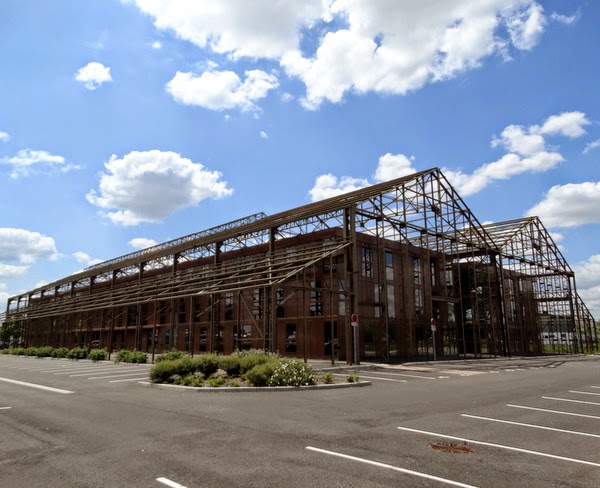
We are in Bègles, not far from the Rives d’Arcins shopping emporium and next to the tiny Port Garonne marina. Unusually, ultra-modern ...


We are in Bègles, not far from the Rives d’Arcins shopping emporium and next to the tiny Port Garonne marina. Unusually, ultra-modern office space has been created inside a metallic cage-like structure. And, tellingly, the new office complex has been given the name “Ateliers Louis Blériot”, a reference to the history of the metal framework, which previously housed workshops founded by aviation pioneer Louis Blériot. What’s the story?

Frenchman Louis Blériot (1872-1936) was an engineer and inventor whose first commercial breakthrough was a patented headlamp for trucks. He ploughed much of his earnings into developing and building aircraft and, in 1909, achieved worldwide fame as the first aviator to fly across the English Channel in a heavier than air aircraft. In 1910 he was registered as France’s first licenced pilot (the official paperwork does indeed feature “N°1”), and continued to achieve success at the head of his company Blériot Aéronautique, later also branching out into the production of motorcycles.

Last year the blog ran a number of pictures that merged old photos with pictures taken from the same spot today, using the expert Photos...


Last year the blog ran a number of pictures that merged old photos with pictures taken from the same spot today, using the expert Photoshop know-how of friend Anthony Poulachon. This time though I have taken a literally hands-on approach to combining old and new, by manually overlaying old postcards onto the modern-day view, i.e. simply holding them in front of the camera lens.

This technique has been used masterfully by photographers such as Julien Knez whose pictures incorporating wartime Paris are particularly effective. The following selection is nowhere near as spectacular, but I hope you'll enjoy the views!

You’ve got to feel sorry for Pont Saint-Jean. In the unwritten hierarchy of Bordeaux’s road bridges, it comes very much at the bottom of...


You’ve got to feel sorry for Pont Saint-Jean. In the unwritten hierarchy of Bordeaux’s road bridges, it comes very much at the bottom of the table, far behind the elegant Pont de Pierre, the slick Chaban-Delmas lift bridge, the wondrous Pont d’Aquitaine suspension bridge and the minimalist Pont Mitterrand. In the otherwise flawless “Dictionnaire de Bordeaux” it doesn’t even get an entry. Let’s face it, if Pont Saint-Jean were one of the Beatles, it would be Pete Best.

The unloved edifice was the result of a relatively short process which began in 1962 with an initial call for tenders to deliver a bridge to connect Quai de Paludate (near Saint-Jean railway station on the left bank) with Quai Deschamps in the right-bank Bastide quarter. Campenon Bernard, a company which is now part of the Vinci group, were selected and they teamed up with the architect Jean-Louis Fayeton (1908-1968). Construction work began in April 1963.