A few months ago Invisible Bordeaux ran a set of pictures merging old postcards with modern-day shots, the end montages produced with th...
A few months ago Invisible Bordeaux ran a set of pictures merging old postcards with modern-day shots, the end montages produced with the expert help of talented work colleague and friend, Anthony Poulachon.
Here then is another selection of pictures that combine past and present, juxtaposing buildings and landmarks that have changed – or no longer exist – with the environment as it looks today.
After recently visiting the 45th parallel north marker in Saint-André-de-Cubzac , it suddenly dawned on me that a remarkably unique latit...
After recently visiting the 45th parallel north marker in Saint-André-de-Cubzac, it suddenly dawned on me that a remarkably unique latitude/longitude confluence point lay just 60 kilometres to the east of Bordeaux: the intersection between the 45th parallel and the Greenwich meridian.
By doing a little bit of research, I realized that visiting confluences of the like had become a pastime for enthusiasts around the world who then posted their stories and photos on the
www.confluence.org website. I was therefore able to read about
other visits to the 45°N 0° confluence and saw that, well, there wasn’t much to be seen there at all.
To celebrate the blog’s third anniversary, Invisible Bordeaux has teamed up with Mollat, the city’s most famous independent bookstore… e...
To celebrate the blog’s third anniversary, Invisible Bordeaux has teamed up with Mollat, the city’s most famous independent bookstore… enabling one lucky reader to win a copy of the marvellous “Nouveau Viographe de Bordeaux”!
To have a chance of winning the coveted prize, simply answer the following question, submitting your response before Sunday November 30th:
[COMPETITION NOW CLOSED!]
A draw will take place on Monday December 1st and the name of the winner will be announced shortly afterwards on the blog!
About the prize: Kindly donated by the good people of Mollat, Robert Coustet’s “
Nouveau Viographe de Bordeaux” is an authoritative 560-page encyclopedic guide to the stories behind every one of the city’s streets and squares. Packed with fascinating historical insight and often surprising architectural information, the book is an invaluable resource for anyone seeking to get under the city’s skin.
Click here for further information.
And of course,
massive thanks to bookstore Mollat for partnering with Invisible Bordeaux for this competition! You can of course visit them on the internet (
www.mollat.com) and hook up with them via various social networks… I particularly recommend their fantastic
Instagram account!
The suburb of Le Bouscat has long been renowned for its racecourse, its residential quarters, its high street shops and, a-hem, its coun...
The suburb of Le Bouscat has long been renowned for its racecourse, its residential quarters, its high street shops and, a-hem, its countless car dealers. But this sign greets visitors to one of the latest additions to the town’s portfolio of potential outings: le Bois du Bouscat.
The Bois du Bouscat provides a landscaped walk in the woods which was two years in the making and was officially opened in June 2013 by local mayor Patrick Bobet. The project was the result of the acquisition of woodland which stretches along one flank of the racecourse (indeed, it was previously best-known as Bois de l’Hippodrome) and next to the high-rise blocks of the Lyautey estate.
We are in Saint-André-de-Cubzac, some 23 kilometres to the north of Bordeaux, on the right bank of the Dordogne… and coincidentally on th...
We are in Saint-André-de-Cubzac, some 23 kilometres to the north of Bordeaux, on the right bank of the Dordogne… and coincidentally on the 45th parallel north, mid-way between the Equator and the North Pole. This part of town is known as Montalon, a large mound which rises 73 metres above sea level and identified in the 18th century as the ideal location to build a number of windmills.
Today, five of these distinctive circular constructions can still be seen, although maps produced in the 19th century record the presence of as many as ten such mills. Three of the surviving structures have been incorporated within private properties – a couple even appear to be the natural extensions of some lucky homeowners’ living quarters. The other two have been partly restored although both were closed when I was there: one provides a unique rooftop vantage point for a panoramic overview of the site, while the other has become an astronomical observatory which is run by the local council in conjunction with an association.
When shooting the footage that formed the basis of the Invisible Bordeaux “View from Pont d’Aquitaine” video clip , I was reminded of a s...
When shooting the footage that formed the basis of the Invisible Bordeaux “View from Pont d’Aquitaine” video clip, I was reminded of a story which was recently covered by local newspaper Sud Ouest: the mystery of the disused iron rig on the Garonne.
The rig in question can be seen near to the left-bank Bacalan district of Bordeaux, more or less mid-way between the Chaban-Delmas lift bridge and
Pont d’Aquitaine suspension bridge. When the subject was initially raised by Sud Ouest, journalist Jean-Paul Vigneaud asked more questions than he provided answers about what he called the “phantom of the Garonne”, a structure “where nobody goes and which nobody is interested in” and which now resembles a “mid-river heap of scrap iron” (
un tas de ferraille au beau milieu de l’eau).
Every day, thousands of vehicles cross Pont d'Aquitaine, the impressive suspension bridge over the Garonne river that connects Bordea...
Every day, thousands of vehicles cross Pont d'Aquitaine, the impressive suspension bridge over the Garonne river that connects Bordeaux and Lormont.
However, only cyclists enjoy the luxury of being able to take in the stunning view over the city, the river and the surrounding area. So, with public interest at heart, I have gone along to the bridge on my bike, camera in hand, and this brand Youtube clip shows what can be seen!
What is 30 metres high, 12 metres wide, made of stone and dates way back to the 14th century? The answer, if you happen to be 65 kilometr...
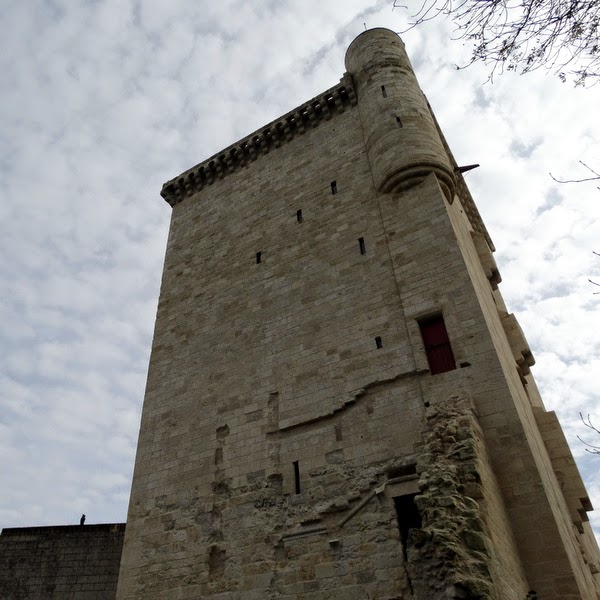
What is 30 metres high, 12 metres wide, made of stone and dates way back to the 14th century? The answer, if you happen to be 65 kilometres to the north of Bordeaux in Lesparre-Médoc, is the magnificent “Tour de l’Honneur”.
The 6-level tower (other than the ground floor, there are four levels each comprising a vaulted room, plus a rooftop terrace), is the sole surviving section of the even grander “Château de l'Honneur de Lesparre”, parts of which even predated the 14th century. The original fortified castle comprised three further towers and was a pivotal means of defence for the Médoc and Gironde Estuary, the area being of strategic importance during medieval times.
Over the years, my views of Bordeaux have been gained either riding a bike, as a pedestrian, behind the wheel of a car, or from the seat ...
Over the years, my views of Bordeaux have been gained either riding a bike, as a pedestrian, behind the wheel of a car, or from the seat of a bus or tram. It struck me that one vantage point I hadn’t really explored was that of the suburban train.
The time had therefore come to report to Blanquefort railway station and buy a €4.30 ticket for the 35-minute journey into Bordeaux’s Gare Saint-Jean. The big question before the train arrived was would I spot anything new from this rear-window vantage point? The answer was not exactly a resounding “yes” or a definite “no” but somewhere in-between: it would simply provide a sample of the city’s suburban living quarters and landscapes, some of which we’ve almost stopped noticing.
Faded hand-painted adverts and signs, so-called ghost signs, have often featured on the blog . And among the interesting subsets which re...
Here are a few examples of the Instagrammed signs that have therefore made it through the times. All are located in central Bordeaux and, other than a couple of exceptions, I think that none of these companies continue to operate - certainly not out of these outlets. But if you know otherwise or can provide information about any of the featured names, then please get in touch!
Towards the top end of Rue des Remparts, the charming, gently sloping pedestrianised street which connects Rue Porte Dijeaux and Place Pe...
Towards the top end of Rue des Remparts, the charming, gently sloping pedestrianised street which connects Rue Porte Dijeaux and Place Pey-Berland, a discreet plaque can be seen on the wall of a three-storey building.
The words are virtually illegible, given that they have been written in white on a white background. But that shouldn’t be enough to put us off deciphering the text: the plaque celebrates the birthplace of Charles Lamoureux, the illustrious violinist and conductor who did much to popularise the music of Berlioz, Wagner and Handel in France.
A few months ago I published an item about the little-known Parc Rivière , a fascinating expanse of greenery which lies between the town...
A few months ago I published an item about the little-known Parc Rivière, a fascinating expanse of greenery which lies between the townhouses of the Tivoli quarter and the high-rise apartment blocks of the Grand-Parc district.
I recently went back and this time filmed the visit, which you can view in this brand new Youtube clip:
The annual European heritage days take place on September 20th and 21st. As ever the event will provide a unique opportunity to get behin...
The annual European heritage days take place on September 20th and 21st. As ever the event will provide a unique opportunity to get behind the scenes of many fascinating places, or else stay out in the open and enjoy some fine guided walking tours.
Once again there are hundreds of options available, making it difficult to know where to start. So to make things easier, Invisible Bordeaux has been through everything on offer and here is a small selection of some of the more unusual and eye-catching visits... while the full list of venues and visits - in Bordeaux and beyond - can be found on the
official event website.
We are in the suburb of Talence and looking at a sign outside a small, carefully-tended plot of land at the end of a cul-de-sac, Rue Bahu...
We are in the suburb of Talence and looking at a sign outside a small, carefully-tended plot of land at the end of a cul-de-sac, Rue Bahus. The sign reads “Commonwealth War Graves” although a more precise description would be “Allied War Graves”.
The tiny cemetery, which is located next to Talence’s municipal graveyard, is the final resting place for 18 men: five Americans, ten Canadians and three Britons (or Australians).
Wooden crosses mark the graves of the five Americans, who died at various dates between 1918 and 1945: Edward Simacys (1918), Anton Rivas (1919), Abraham Hamde (1920), Charles Carroll (1928) and Joseph Bouchard (1945).
In central Bordeaux, three bronze orientation maps (or “ plans-reliefs ” in French) have been positioned at strategic locations. I met ...
In central Bordeaux, three bronze orientation maps (or “plans-reliefs” in French) have been positioned at strategic locations. I met up with François Didier, the sculptor behind these popular hands-on works of public art, to talk about the pieces, about a similar project rolled out near Pauillac and about his private sculpture garden at the northern tip of les Landes.
The
plans-reliefs project was initiated around 2007 by Philippe Prévôt, who is in charge of “
patrimoine historique” (heritage sites) at Bordeaux
Office de Tourisme, as well as being a renowned author of articles and
books about the city’s lesser-known stories. Prévôt had been inspired by a
3-D map in Florence, Italy, and thought his friend François Didier would be the right man for the job, as the sculptor had already produced scale models of towns in the past. The idea soon gained the support of the city council who would go on to commission the works in partnership with the
Office de Tourisme.
Some time ago I published an item about the Devèze and my attempt to track the now mostly-underground river from Mérignac airport all t...
Some time ago I published an item about the Devèze and my attempt to track the now mostly-underground river from Mérignac airport all the way into central Bordeaux.
I recently went back and this time filmed the adventure, which you can view in this brand new Youtube clip:
One of the focal points of the Right Bank botanic gardens, as featured in the previous blog item , is the bronze bust of Carl Linnaeus (1...
One of the focal points of the Right Bank botanic gardens, as featured in the previous blog item, is the bronze bust of Carl Linnaeus (1707-1778). The Swedish botanist, physician and zoologist is regarded as the father of modern taxonomy and one of the initiators of modern ecology.
To get the full story about the bust, I got in touch with Lucie Geffré, the talented Bordeaux-born, Madrid-based artist who was commissioned to produce the piece. Over to you, Lucie!
In the previous Invisible Bordeaux item , we explored the compact botanic gardens which have been located in the grounds of the Jardin Pu...
In the previous Invisible Bordeaux item, we explored the compact botanic gardens which have been located in the grounds of the Jardin Public since the 19th century. This time we are in the Bastide quarter on the Right Bank of the Garonne to visit the bigger, more ambitious and, yes, slightly crazier botanic gardens which were first opened in 2003.
Built to the designs of landscape gardener
Catherine Mosbach and architect
Françoise-Hélène Jourda, the 4-hectare gardens (that's 9 acres or 6 football pitches) are made up of a succession of distinct zones, taking visitors through a wide variety of scenery, greenery and ambiences.




 La base sous-marine: the ghostly WW2 u-boat pen
 Why is the Garonne river brown? Here is the explanation!
 Invisible Bordeaux guided walking tours now available as free PDF downloads
 Léon Gambetta monument: the centrepiece now missing from Allées de Tourny
 Gironde estuary cycle tour 1/4: Bordeaux > Mirambeau
 Frankton 75: the Cockleshell Hero’s grandsons reenacting Operation Frankton
Follow/contact