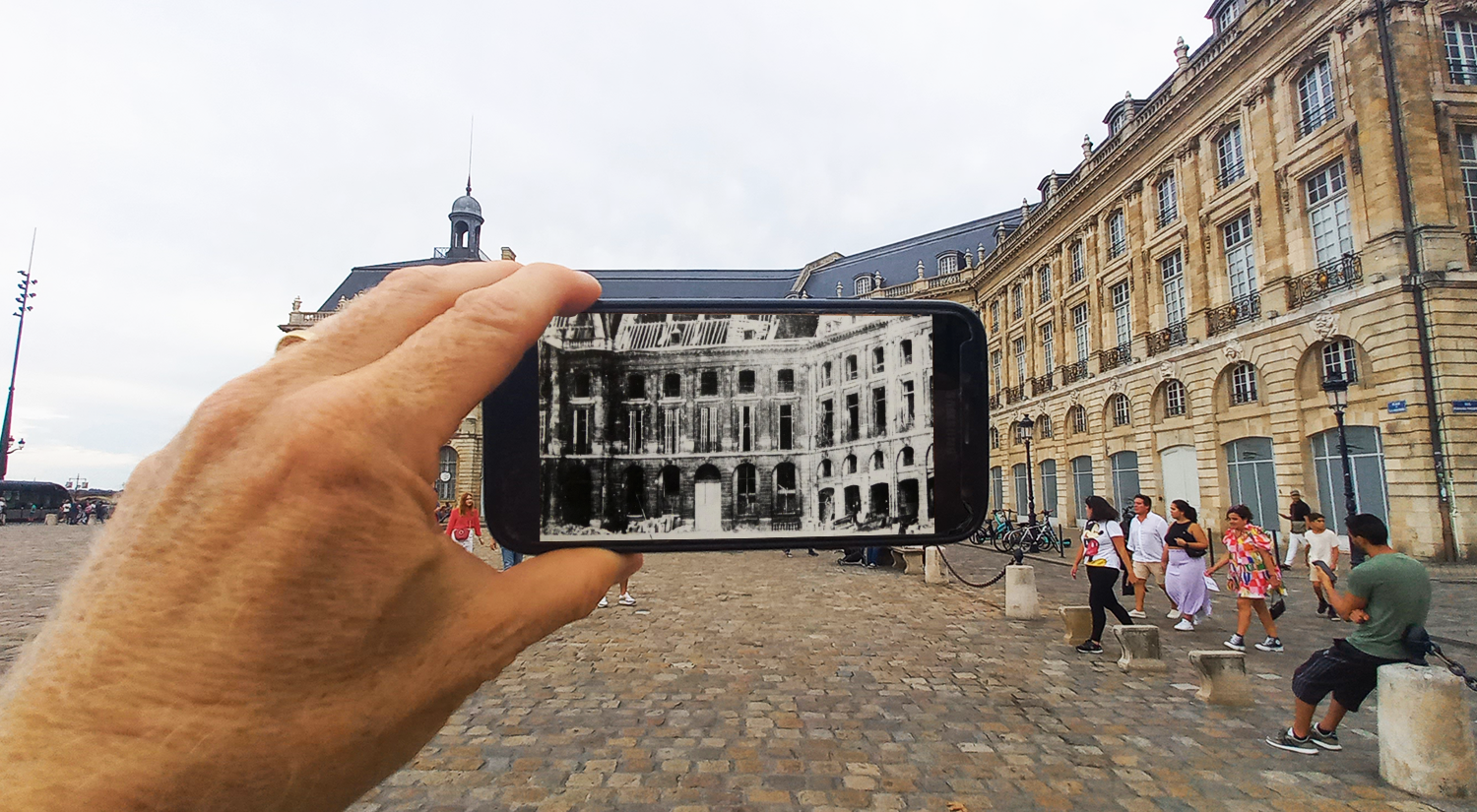
Not long ago at the remarkable Emmaüs charity outlet in Parempuyre, I picked up a couple of out-of-print books by the historian Pierre Décamps (1912-2004): 1940-1944, la Gironde en Images (published by SODIM in 1977) and Bordeaux sous l’occupation (Ouest France, 1983). Both feature some incredible photographs documenting Bordeaux during the Second World War. I set off in search of the same locations in order to merge the 1940s and the 2020s in single shots. The accompanying captions are adaptations of the information shared by Pierre Décamps in the books, all original photos were credited to the Bordeaux Centre Jean Moulin collection.
The disturbing sight of the swastika flying outside the Gironde préfecture on Cours du Chapeau-Rouge, which housed the German army central command centre. The contrast with the massage parlour which is now next door is striking.
These ladies seem to be enjoying their city-centre stroll past fortified shelters and blockhouses built by the Germans at the base of Pey-Berland tower…
During the Second World War, le Théâtre Français (now CGR Bordeaux Le Français cinema) was a cinema which was reserved for German army soldiers, hence the "Soldaten Kino" sign (Soldiers' Cinema).
"French [citizens]... Listen every day to the voice of the Reich". German Information Service sign in front of the Jardin Public terrace.
Place de la Bourse: the British bombardment on the night of December 8-9, 1940 certainly left its mark.
The caption provided by Pierre Décamps states that "This German billboard, installed on Place de la [1918] Victoire in Bordeaux, indicates the victorious march of the German armies in Russia and the location of the battlefields where the Soviet armies were annihilated in 1941."
It’s all about the bronze: removal, on December 6, 1941, of the bronze statue of former president Sadi Carnot, erected on Place Jean-Jaurès.
Next to the now empty plinth, the sign reads "By working in Germany, you'll be an ambassador for French quality".
French citizens enrolling to work for Germany show up at the "Bureau de placement", 103, rue Sainte-Catherine.
August 28th 1944, a group of "Maquisard" Resistants from the Blaye area pictured on Rue Esprit-des-Lois in Bordeaux (the road that runs alongside the Grand Théâtre opera house), just as the city was being liberated.
August 28th 1944, Bordeaux students celebrating the city’s liberation. At the head of the procession, the sign proclaims "À poil les Fritzous, vive les étudiants" (which could be conservatively translated as "the Germans have been disrobed, long live the students").
Dancing in the street: the effigy of a German soldier hangs outside the headquarters of the General Student Association on Cours Pasteur. You can sense the joy in this picture, and no, we're not necessarily talking about the adult shop over to the right!
We are in the Saint-Genès district of Bordeaux, not far from the boulevards, visiting the unusual complex that is la Maison Saint Louis Beaulieu, the diocesan home of the Catholic Church in Gironde. Open to the general public, the Maison is a surprising place to behold… particularly its chapel, library and pleasant grounds.
The history of Maison Saint Louis Beaulieu goes back to the mid-19th century when the Carmelite religious order set up a convent and a chapel, with hermitages dotted around the grounds. In the early years of the 20th century, the Catholic diocese rented the premises to house a seminary, purchasing the land and existing buildings in 1910. Over the following decades, the condition of the property gradually worsened until a full reconstruction began in 1937 to the plans drawn up by renowned architects Louis and Marcel Garros. This resulted in the main building, which still stands tall and proud today, and the intriguing art deco chapel (pictured below), consecrated in 1946 by the Apostolic Nuncio to France, Monsignor Angelo Roncalli, later to become Pope John XXIII.
Unusually, the chapel’s configuration has rotated 180° over the years, with the main entrance initially being street-side, on Rue Saint-Genès, but access now solely being possible via the cloister. The Parisian artists Jean Gaudin and Louis Mazetier provided the decorative touches of the chapel’s mosaics and tiling. The stained glass windows all seem laden with cryptic references. One, for instance, comprises the coats of arms of the city of Bordeaux but also of Bazas, which along with the dioceses of Agen, Angoulême also sent their students to Saint Louis Beaulieu from 1955 onwards. The organ was manufactured by the German company Merklin in 1892 (its most recent overhaul occurred in 2017) and was in the original chapel.
The street-side view and what used to be the main entrance to the chapel (situated behind what is now the altar).
Beyond the pretty cloister/courtyard and the café-restaurant (see lead photo at top of page), a door leads to the library of the Bordeaux diocese, home to some 90,000 books about religious science stored across over four kilometres of shelving. Usually the reading room alone is open to the general public, but our visit tied in with the European heritage days so we were given a glimpse of the inner workings of the library and some of its oldest and most prized possessions.
From there on into the peaceful grounds, tucked away behind the main building. The first most prominent sight is a modern metallic work of art, 'le Chêne de Mambré', produced by Bordeaux artist Christophe Conan. Beyond its aesthetic delights and its designated role as a “meeting place”, the tree features on its leaves the names of benefactors who helped fund the renovation work carried out here in recent years.
Christophe Conan's 'Le Chêne de Mambré'.
Wandering on through the grounds, other than the vegetable patches, herb gardens, and compost heaps, there is an old chapel to be spotted here, a chicken run there, and the inevitable statue of the Virgin Mary, which apparently fell on bad times in recent years. It was smashed to smithereens by unknown night-time intruders and had to be meticulously rebuilt from scratch by an expert at the Louvre museum in Paris. The ultimate 3D puzzle!
Scenes from le Jardin de Beaulieu.
As grumpy as they appear to be, the Madonna and Child actually look as good as new after their recent mishap.
My time here also enabled me to find the exact vantage point to be able to reproduce the view on an old postcard I’d picked up many moons ago before even knowing where the picture had been taken. The postcard, which is captioned overleaf as “Grand Séminaire de Bordeaux - Grand Bâtiment”, includes a hand-drawn circle indicating the postcard-writer’s room – who was the mystery resident at the time? To know just a touch more, the text of the postcard is included at the foot of the article!
Although the living is clearly very gentle here, Maison Saint Louis Beaulieu remains a very active place, and is arguably as dynamic as ever. Other than the aforementioned facets, its website also refers to it being home to the Pey Berland training institute, a number of meeting rooms (which can be rented out for seminars and the like), a bookshop (La Procure Beaulieu), and the studios of the RCF Bordeaux catholic radio station. And the café is as pleasant a place as any for a quiet afternoon cup of tea or similar!
Oh, and one more thing: who exactly was Saint Louis Beaulieu? Well, Louis was born in 1840 in Langon near Bordeaux and went on to be ordained as a priest at the Overseas Missions Seminary in Paris in 1864. He ended up stationed in the mountains near Seoul, Korea, where the presence of foreigners was forbidden. Denounced and arrested, he was executed six months short of his 26th birthday. More than a century later, he and others who met the same fate in Korea were canonized by Pope John Paul II.
> Find it on the Invisible Bordeaux map: Maison Saint Louis Beaulieu, rue Saint-Genès, Bordeaux. > Official website: espacebeaulieu.fr > Thanks to students from the Archimuse association who organised this European Heritage Days visit in 2022. > Here is the text of the undated postcard in full (presumably, Miou was a cat...):
Mon cher Jean-Pierre. Cette vilaine carte t'apporte mon bon souvenir pour ton anniversaire. J'espère que tout va bien à Lyon. Ici ça va. On termine l'année. Je te fais donc un méga bise, ainsi qu'à Miou et je prie bien pour vous. Fafa.
My dear Jean-Pierre. This ugly card brings you my best wishes for your birthday. I hope all is well in Lyon. Things are fine here. We're ending the year. I send you and Miou a big kiss and I'm praying for you. Fafa.
Imagine my surprise when I was out on my bike somewhere between Lacanau and Carcans-Maubuisson, on a stretch of cycle path which is among the prettiest there is in Gironde, and I saw signposts to “la Réserve naturelle nationale de l’étang de Cousseau”. I decided to investigate – what would I find?
I veered off the main cycling route and off down a lane, which stretched on for a kilometre or so, until I was met with the sight of a row of wooden bicycle racks ahead of a gate. I locked up my bike and continued on foot, all the while heading downhill, following a narrow and twisty footpath. It all felt very wild and then, to the left, the idyllic sight of a large expanse of water filtered through the trees, and that was soon followed by a wooden viewing platform. I had very much arrived and the sight to behold was as splendid and as spectacular as you’ll get to see anywhere, period.
The nature reserve – in essence a lake along with an extensive area of marshland – covers a surface of 882 hectares (the lake alone accounts for 50 hectares) and has been open to visitors since 1976. In a way, the reserve gives an idea of the way things were way back, the way back in question being prior to the 19th century when humans re-moulded the Landes landscape and ocean coastline.
Information panels welcoming visitors.
From what I can make out (and it may turn out that this paragraph will have to be rewritten when somebody tells me otherwise), along the Atlantic coast, sand dunes would develop, rising and falling, preventing the inland waters from reaching the sea, forming the great freshwater lakes of Lacanau and Hourtin. Elsewhere, the land was stabilized through the plantation of maritime pines, and the surrounding land was irrigated to make it more habitable. However, in this hillier part of the region it was more difficult to plant maritime pines, and so the wild marshlands have prevailed, providing a home to a rich and ever-developing ecosystem of plants, trees, birds, mammals, and insects.
Among the wildlife present on site, the national nature reserves website notes various species of toads, frogs, newts, roe deer, wild boar, badgers, otters; more than 200 species of birds including osprey, greylag geese, white spoonbills, black-headed gulls, cranes and ducks; while around 70 species of birds come here to breed, including white-winged goshawk, hobby falcon, marsh harrier, buzzard and black kite. Oh, and let’s not forget Cousseau’s miscellaneous reptiles, amphibians, dragonflies (39 species) and butterflies (50 species). I suppose we could go on but if we do we could be here for some time…
Happily, all these constantly evolving facts and figures are permanently monitored by an organisation called SEPANSO (Société pour l'Étude et l'Aménagement de la Nature dans le Sud-Ouest), who manage the reserve. They also oversee the Banc d’Arguin at the mouth of Arcachon Bay, and the Réserve naturelle nationale des Marais de Bruges – the latter of which has long since deserved its own Invisible Bordeaux report.
At Cousseau, to my surprise, a SEPANSO representative was present on the main viewing platform to answer questions, provide guidance and lend out two telescopes to partake in some serious birdwatching. He did point out though that a hot mid-afternoon in June was not optimal in terms of observing anything more interesting than the siege of herons huddling in a tree some way in the distance. Will plan things properly next time!
From there I climbed the steps of one of the reserve’s two tall observation towers, la Tour de Lesperon. In places, poetic notes written on fabric added a little mystique to the proceedings.
La Tour de Lesperon. A poem was written on the white fabric rectangle which moved with the wind.
From the top I felt ever so slightly like I was the king of Cousseau, and to properly crown the occasion I spotted a magnificent cow in the distance. Or was it a bull? A bison? A buffalo? It turns out it was actually a "vache marine" Whatever, this was now a bit like being on safari.
From that vantage point, along with the impressive natural beauty, what was most striking was how peaceful the place was, the silence disturbed only by the buzzing of insects. When I was there, there were just three other visitors, I bumped into two other people on my way out – it was certainly difficult to believe that the reserve reportedly draws between 25,000 and 30,000 visitors per year… The crowds certainly weren’t around on a Sunday afternoon in June.
Anyway, as far as I’m concerned, I will most definitely be paying a return visit before too long to be able to experience the reserve to the full. There is another observation tower to climb, and a full walking circuit to take in. In a way, this first, unplanned venture feels like it was little more than a rushed trailer ahead of the full feature unfolding.
So, dear Réserve naturelle nationale de l’étang de Cousseau, Invisible Bordeaux is very much looking forward to exploring your delights further sometime in the future… and preferably on a day when there are more birds to be seen!
Update: I did make it back shortly afterwards and got to take in the fine view from the top of the second observation tower, Tour Galip. Hurrah!
> Find it on the Invisible Bordeaux map: Réserve naturelle nationale de l’étang de Cousseau, Lacanau. Cycling is the recommended means of reaching the reserve, but there is also a car park located more or less in the vicinity (codenamed 'Marmande" on the D6E1 départementale road to the north of Lacanau), but note that it's a fair old walk from there to the reserve proper.
The small village of Puynormand - and its unusual claim to being the centre of the northern hemisphere - has twice featured on the Invisible Bordeaux blog. It was only really a matter of time before the subject made its way into a song produced by my group Slowrush… and here it is, along with a spectacular video: we give you X Marks The Spot!
X Marks The Spot, which is the lead track on the new Slowrush E.P., Navigation & Time, is the story of two of my trips to the spot where the Greenwich Meridian and the 45th Parallel North converge, i.e. the place where east meets west mid-way up the northern hemisphere.
While there is something very tongue-in-cheek about the track and the way the band appear to get quite excited about something that doesn’t physically exist, it is also a very affectionate nod in the direction of friend of the blog André Stanghellini and the work he has done to raise awareness of Puynormand’s unique status, resulting in a signpost and information panel going up in recent years.
So join Slowrush as we embark on our mission to the centre of our hemisphere, and find out what it is like to perform a sax solo and enjoy drinks where these important invisible lines converge!
OK, everyone else is doing it, so why shouldn’t Invisible Bordeaux? As I’m a bit short on time these days (but the blog will hopefully be back sometime soon with new articles), I wondered whether the already-infamous AI chatbot ChatGPT could provide some instant top tips about the secret sights of Bordeaux. I booted up the bot and ran this exact request: “Provide ten very unusual secret sights to see in Bordeaux, France”. Below are the ten items ChatGPT suggested. Between each I provide my very real, live human take on the responses! What are your thoughts?
> ChatGPT - Sight #1. "Le Passage Souterrain des Moulins: An underground tunnel system built in the 17th century to transport flour between mills, it's now a secret passageway beneath the streets of Bordeaux." Invisible Bordeaux - No idea what this is or where it might be. If it does exist it is truly a remarkable find and surely the city’s best kept secret. I do have a feeling that it doesn’t though, are you aware of it?
> ChatGPT - "Sight #2. La Tour Pey-Berland: A 15th-century bell tower attached to the Cathédrale Saint-André, offering panoramic views of the city." Invisible Bordeaux - OK, not exactly unusual, not very secret, and not exactly physically attached to the cathedral, but let’s go with it!
> ChatGPT - Sight #3. "La Grosse Cloche: A medieval bell tower that served as a gate to the city, with a small museum inside."
Invisible Bordeaux - Hmmm, not sure about the museum inside, and this apparently obscure subject happens to be on the city’s coat of arms, but hey.
> ChatGPT - Sight #4. "Le Jardin Botanique: A lush and peaceful botanical garden located in the heart of the city." Invisible Bordeaux - Approved, a great place to unwind and a fascinating place to visit.
> ChatGPT - Sight #5. "La Rue Saint-James: A narrow street lined with historic buildings, including the oldest house in Bordeaux." Invisible Bordeaux - Most sources concur to say that the oldest house in Bordeaux is on Impasse de Rue-Neuve, but admittedly that is fairly nearby. But, yes, rue Saint-James is a quaint street and well worth a visit.
Rue Saint-James and le Jardin Botanique, yesterday.
> ChatGPT - Sight #6. "Le Pont de Pierre: A stunning stone bridge over the Garonne River, built in the early 19th century." Invisible Bordeaux - I think you’ll find most people in Bordeaux are left stunned by the Pont de Pierre just about every day of every week, it is arguably one of the city’s most prominent and recognizable landmarks.
> ChatGPT - Sight #7. "Les Catacombes de Bordeaux: An underground network of tunnels and chambers filled with human bones, dating back to the 18th century." Invisible Bordeaux - Not sure here whether ChatGPT is getting Bordeaux muddled up with Paris, or whether this is referring to the incredible Roman-period cemetery below Saint-Seurin church. There are actual catacombs in nearby Saint-Emilion, could that be what this is all about?
> ChatGPT - Sight #8. "Le Musée des Arts Décoratifs et du Design: A museum dedicated to decorative arts and design, housed in a beautiful 18th-century mansion." Invisible Bordeaux - Yes, Invisible Bordeaux approves once again, an unusual museum in a spectacular building, although if you want to check it out you will have to wait until the ongoing refurbishment work is finished. The museum is scheduled to reopen in 2025.
> ChatGPT - Sight #9. "La Place de la Bourse: A grand square with a stunning water mirror reflecting the majestic Palais de la Bourse." Invisible Bordeaux - This unusual and secret sight can sometimes even be spotted on Instagram!
> ChatGPT - Sight #10. "Le Jardin Public: A vast public park with a lake, a botanical garden, a zoo, and plenty of peaceful spots to relax and unwind." Invisible Bordeaux - Hmmm, the Jardin Public is indeed a great spot, and does have its own lake and botanical garden. Not sure about whether there’s a zoo per se, although the Natural History Museum and its collection of slightly deceased animals is there. Could ChatGPT be getting mixed up with the Parc Bordelais and the goats, geese and sheep of its “ménagerie”?
Sooooo, all in all, a very mixed bag. There are a few IA-generated suggestions in there that are definitely valid, other suggested sights that are far too obvious to be classified as “unusual” or “secret”, and a couple that are just totally mystifying.
Anyway, there is no doubt that we have turned a major corner lately with regard to AI-powered capabilities. However, perhaps, for the time being, if you’re on the lookout for obscure places to visit in Bordeaux, it’s best to refer to real-world guides and local heritage experts such as Marie Hallier, Fleur Borde, Caroline Calvet and Hela Mansour… or else simply liaise with the official Bordeaux tourism board and check out their excellent local slow tourism website Un Air de Bordeaux!
During the recent Musical Écran festival organised by the Bordeaux Rock association (coincidentally also part of the most recent Invisible Bordeaux blog item), one of the music documentaries I got to see was the incredible “Punk – Il était une fois Gilles Bertin”. The hour-long film, directed by Eugénie Grandval, tells the remarkable story of how a key player on the 1980s Bordeaux punk rock scene was part of a high-profile heist, disappeared off the map completely for 30 years, then sought redemption and to rebuild his identity from scratch.
The story goes that Gilles Bertin was born in Paris in 1961 before spending his formative teenage years in Bordeaux. As soon as he was able to leave behind his home and his civil servant parents he did just that. He moved into a squat and, in 1981, became the vocalist and original bassist of the punk rock band Camera Silens. The group, who tended to hang out around Place Saint-Projet and the Saint-Pierre quarter, were soon big on the local scene, winning high-profile battles of the bands, and they rapidly developed a nationwide following.
Early 1980s Camera Silens publicity shot, Gilles Bertin to the right.
The band’s relative success however was not providing enough income to fund Bertin’s heroin addiction, and so he fell into a life of petty crime and robberies, which adhered to the rules of thumb he and his cronies – mostly artists, fellow drug addicts, and anarchic activists – had set themselves, i.e. that this would generally involve stealing from The Man and that nobody would get hurt in the process.
By 1986, this darker, illicit existence outweighed Bertin’s musical career and he split from Camera Silens. Then, in 1988, he and his partners in crime were involved in their most notorious coup: a large-scale operation, reportedly two years in the making, involving home-made replica police uniforms and a fake police car, a finely-tuned scenario and mock interrogations. The heist enabled them to steal more than 11 million francs in banknotes (around 3 million euros in today’s money) from the Brink’s warehouse located in Toulouse.
Over the following two years, the various members of the gang were caught one after the other. But Bertin had managed to escape to Spain’s Costa Brava, leaving behind not only his homeland but also his partner and newly-born son Loris. While on the run (an international arrest warrant had been issued), as well as spending all his money he met one Cecilia, with whom he moved to Lisbon where they opened a tiny but influential indie record store which operated for ten years.
Needless to say, officially Bertin no longer existed and the fugitive went by various names including Didier Ballet. The plot thickened though when in 1995 Bertin fell ill, and it emerged that his years of heroin addiction had finally caught up with him: he was HIV positive and had contracted AIDS. Despite being at death’s door, he was saved first by a hospital in a Communist-run town where no questions were asked about his identity, then by the advances of research and the administration of triple combination therapy.
In the early 2000s, Bertin and his partner relocated to Barcelona, running the bar owned by Cecilia’s parents. The couple had a child together, Tiago, whose birth in 2011 led to Bertin deciding the time had come to open up about his past and move forward with a clean conscience. In November 2016, he chose to return to France to hand himself in to the authorities.
As detailed in the documentary, by then Bertin was no longer really considered a public enemy, and if anything his reappearance was not especially welcome as it revived a cold case (and therefore multiple layers of paperwork and admin) that was no longer considered relevant by any of the parties involved. But Bertin was nevertheless put on trial and, thirty years on from the heist, was sentenced to a five-year suspended sentence, therefore escaping a stay in jail.
By becoming a free man able to live life in the open once again, from then on Bertin was able to connect with his first son Loris (whose mother had died in the intervening years), took the time out to collaborate with Libération journalist Jean-Emmanuel Escarnot on drafting his memoirs (Trente ans de cavale : Ma vie de punk, published by Robert Laffont in February 2019 – Escarnot passed away before its release), and divided his time between Toulouse and Barcelona, where he continued working in the bar alongside Cecilia, and raising Tiago.
Bertin during a meet and greet event to promote his book in 2019.
But, given that the authorities had declared him deceased in 1992, another of Bertin’s priorities was to obtain his French identity documents. This became a long and drawn-out battle which eventually lasted three years, with some of the Catch 22 situations being caught on camera in the documentary. He was finally given his new ID card on August 2 2019 but, just days later, his health ailing once again, Bertin fell into a coma. He died on November 7 2019 in Barcelona, aged 58.
The Musical Écran screening of the documentary, the first time it had been shown as part of a film festival in France, was an emotionally charged event. Many friends and contemporaries of Gilles Bertin were in the audience, and Eugénie Grandval was herself present to explain how the documentary had initially set out to be the uplifting story of the reformed Bertin regaining his identity, but instead finished up as a sad tale tracking the administrative nightmare of his final years.
Bertin’s partner Cecilia was also present (she had symbolically brought along his trusty briefcase), and highlighted how much that final administrative ordeal had taken out of Bertin. His first son Loris, who is still based in Bordeaux and is now a prominent player on the local techno music scene, also spoke about how his relationship with his father had gradually developed over his final years. Finally, Bertin’s solicitor was on hand to shed further light on the rebirth of the former punk rocker.
As somebody who was very vaguely familiar with the Gilles Bertin story, having skim read press articles that came out when he reemerged into the public domain and once again when he passed away, it was an absolute privilege to be given this more extensive glimpse into the life and times of the reformed punk/bank robber.
And, what can I say, the Eugénie Grandval documentary – the production of which was initially triggered by an article the director had read in Libération – is compelling and essential viewing. It has already been broadcast on terrestrial TV in France, has been screened at other festivals around the world, and does happen to be available on Youtube in its entirety. I’m not sure how legal the upload is but do yourself a favour, set aside 58 minutes of your time, and take in this incredible story. “Once upon a time, there was Gilles Bertin...”
Throughout November and December 2022, a host of commemorations and events will be held to mark the 80th anniversary of Operation Frankton, which ranks as one of the most incredible tales of Bordeaux’s dark wartime years (and which has already been featured on the blog): ten Royal Marines set out from the Atlantic, canoeing down the Gironde Estuary in order to plant mines on German cargo ships docked in central Bordeaux. Only two of the so-called Cockleshell Heroes, Herbert "Blondie" Hasler (1914-1987) and Bill Sparks (1922-2002), survived the mission. After escaping inland to Ruffec, near Angoulême, members of the French Résistance guided them across the Pyrenees and onto to Gibraltar, from where they departed for the UK.
Friend of the blog Jean-Claude Déranlot and his association, Operation Frankton History & Values, have conceived a rich series of events including a number of French-language conferences, as detailed below:
- 1942 : L’année bascule
Speaker: Stéphane Barry, Docteur en histoire, Directeur des éditions Memoring > This conference took place on Thursday November 3
- Le cahier noir du journal “La Liberté du Sud Ouest”
Speaker: Gilles Robert > Tuesday November 15, 18:30, Salle 46, Athénée municipal Joseph Wresinski, Place Saint-Christoly, Bordeaux
- La Garonne et l’estuaire en 1942
Speaker: Éric Veyssy, Directeur et Médiateur culturel « Fleuve / Eau/Climat », Docteur en Biogéochimie de l’environnement > Wednesday November 23, 18:30, Salle 46, Athénée municipal Joseph Wresinski, Place Saint-Christoly, Bordeaux
- Le Renseignement de la France
Speaker: Jean-Claude Déranlot > Thursday December 1, 18:30, Salle 46, Athénée municipal Joseph Wresinski, Place Saint-Christoly, Bordeaux
- L’Opération Frankton
Speaker: Jean-Claude Déranlot > Thursday December 8, 18:30, Amphithéâtre Athénée municipal Joseph Wresinski, Place Saint-Christoly, Bordeaux
- Une mission, des hommes, une équipe, un chef
Speaker: Jean-Claude Déranlot > Sunday December 11, Cap Sciences museum
- Mauriac et la guerre
Speakers: Anne-Marie Cocula, Présidente du Centre François Mauriac, and Astrid Llado, Responsable des projets d’éducation artistique et culturelle du Centre François Mauriac. > Wednesday December 14, 18:30, 18:30, Salle 46, Athénée municipal Joseph Wresinski, Place Saint-Christoly, Bordeaux
In addition, official commemorations will be held in Bordeaux (near Hangar 14 on the Garonne waterfront) and Blanquefort (Château Magnol) on December 9th, and a group of canoes will paddle into Bordeaux on Sunday December 11. An exhibition will also be held at la Maison écocitoyenne on Sunday December 11.
Back in the late 1970s/1980s, the rock music scene in Bordeaux was renowned throughout France as being particularly active and dynamic. The city was home to countless grassroots venues, was the subject of reports on nationwide TV programmes, and all this culminated in flagship local band Noir Désir gradually establishing themselves as one of France’s top acts.
A few years on from those halcyon days, in 2005, the still-evergreen musical association Bordeaux Rock produced a double-CD collection of tracks by various bands and solo singers who were part of that scene. The impressive package, illustrated by the talented Bordeaux artist Jofo, included photos and biographical information about each of the artists featured, making for an excellent compendium of and introduction to the period.
In the impressive package, every artist gets their own page.
These days, the compilation is actually quite desirable (certainly if the authoritative online resource Discogs is to be believed). And, guess what, my good friend Olivier, bassist with my musical project Slowrush, actually owned two precious copies and generously gave one of them to me. Hurrah!
To get the full Bordeaux Rock experience, I decided to sit down and give the compilation a thorough, neutral listen. In fact I would have to approach it with an especially open mind: the liner notes provided a word of warning that the sound quality varied according to the nature and state of the source materials (mostly transferred from studio reels and vinyl, but also sometimes cassette tapes), and the main challenge faced by the person in charge of mastering the tracks was to create a coherent whole. This sounded ominous but I was curious to hear how it all fitted and flowed together.
Looking through the alphabetically organized track listing, none of the artists were familiar, other than Noir Désir and, possibly, the Stilettos, whose name I may have come across here and there. Yes, this would truly be a musical journey through time into the unknown. Inserting CD1 into my player, was I about to make an exciting discovery, in amongst the 41 artists (plus a bonus three whose contributions predate the period at hand)? I hit play and started taking notes.
A compact disc at the ready - older readers may remember these.
Immediate highlights are the no-nonsense guitar and harmonica-led pub rock of Art-314 and the strummy, melodic Californian pop of the aptly-named Beach Lovers, which still sounds fresh and tight. ‘X Ray’ by Bolton (er, Bolton? Why?) mix and match guitars with some nascent electronica, and they sound like just the kind of band that might be called upon to open for Indochine and The Cure (which is precisely what happened).
Hmm, next up is a band that went by the mildly amusing/slightly rude name of Les Cons, except that the moniker was a reference to The Jam’s legendary All Mod Cons album, and you could definitely hear the influence in there, with the energetic instrumentation and sharp harmony vocals. And a little further in, the Flying Badgers sound even more inspired by the British scene (their bass player was actually from Sheffield) – the arrangement is among the most creative on the compilation, and the melody is catchy, definite sing-in-the-shower material.
Gamine’s ‘Julie Julie’ is described as a mid-period track by a band that would later go on to achieve widespread commercial success with their album ‘Voilà les Anges’. They are followed by Hangar 21 featuring, yikes, fine vocals by a female singer. We’re 13 tracks in and Catherine Politoff (for it is her) is only the second female name to be listed among band personnel. Hangar 21 sound like a cross between Nena, Blondie and The Pretenders.
Philippe Jolly is a surprise package and sounds unlike anything else on the compilation, with a big arrangement complete with brass section, keys, backing vocals… it’s the kind of studio performance that leaves you itching to have heard more in a live environment (Jolly reportedly died in 2010). The same could be said of Lucky Monkeys, with their very 1980s slap bass and big choruses, and Le Mix’s acoustic guitars, jangly harmonics, and imaginative backing vocals, whose ‘Aux USA’ features some pleasing changes of direction and dynamics… and some killer key changes!
CD1 closes with ‘Somebody To Love’ by Nightshift, described in the liner notes as being inspired by Elton John and Squeeze. This is something that can easily be perceived in the piano arrangement, the meandering melody and the soulful backing vocals.
The central spread in the booklet. No, I don't know who any of these glum gentlemen are either and there's no caption. Photo taken on the right bank of the Garonne in central Bordeaux and credited to Alain de la Mata.
The inevitable Noir Désir kick off CD2 with the moody, atmospheric and slightly stressful ‘Danse sur le feu Maria’, from their debut album. This segues surprisingly well into the piano-driven, Beautiful South-like ‘I Got It Bad’ by The Owls, featuring Englishman Terry Wood on vocals. The booklet blurb suggests the group showed great promise and were on the verge of being signed by the Barclay record label, until the deal fell through and the band folded.
The following succession of bands, Poupée Cassée, Réverbère, Rotten Roll, and Les Scurs, kind of sound the way you would expect bands with names like that to sound. Once again, it takes a solo artist to break things up nicely, namely Patrick Scarzello and all 1’25’’ of his chirpy, old-school ‘La Clope’.
Spina Bifada are described as being one of the first Bordeaux bands to use samplers, resulting in a more hypnotic, experimental sound than most of their contemporaries. Their track (conveniently entitled ‘Spina Bifada’, what were the odds?) is among those on the album that have arguably aged the best over the years.
The dynamic, post-punky Stilettos are next up, and deserve a notable mention because they featured in their ranks the influential José Ruiz, a long-time mover and shaker on stage, in the media, and behind the scenes in and around Bordeaux. He founded and remains president of the Bordeaux Rock association, which continues to conceive and produce a whole host of events, including the annual Bordeaux Rock festival, Plages Pop series of concerts, and the Musical Ecran rock documentary festival. Way to go, José.
Just when you feel you’re about to OD on the constant flow of male testosterone and distorted guitars, the unexpected Takenoko pop up, with one Vanessa on lead vocals, providing a pleasing, airy melodic overlay to the pitter-patter of synths and a rudimentary drum machine. There’s also a very 1980s sax solo thrown in for good measure. Checking the credits, I notice that the keyboardist and co-songwriter is an online acquaintance, Bruno Aujard. [Note: I got in touch with Bruno ahead of this article going live, and he was delighted to hear that his band's legacy was still be being unearthed and explored. You can hear their output over on Soundcloud.]
The raucous Wet Furs track ‘Au lit les bébés’ closes proceedings, ahead of the surprising aforementioned inclusion of bonus tracks by 1960s and 1970s artists Tony March & Ses Blousons Noirs, Absinthe, and Salty Dog. It’s an interesting way to utilize the available CD space but does also make for a bizarre way of signing off. Were the songs drafted in because, as the booklet explains, the bands Camera Silens, Les Exemples, and Kid Pharaon declined to be part of the compilation?
The track listing in full.
Anyway, what is the overall verdict? Well, in spite of the mastering engineer’s fears, the collection does make for a coherent listen. Aside from a few exceptions, these are self-produced heads-down recordings of bands capturing their live arrangements on tape, making for energetic recordings but perhaps generally short of unusual musical ideas or instrumentation… and given that a vast proportion of the bands were the classic vocals/guitar/bass/drums formation, a few decades on many of them sound a touch… interchangeable. The exceptions to that rule (such as Philippe Jolly, Spina Bifada, and Takenoko) come across as especially refreshing.
It also has to be said that, a-hem, there wasn’t much in terms of lyrical content to get excited about. Perhaps it’s the lo-fi recording technology used by many here, but much of the time it’s actually impossible to make out what is being said, whether in French or English. However, once again, there were a few positive surprises in the mix (Noir Désir and Les Stagiaires spring to mind). To be fair though, when you're mainly intent on belting out 99 decibels of noise every week at Le Jimmy, coming up with subtle lyrics is possibly not priority #1!
The compilation admittedly sells itself as delivering rock… so rock is pretty much what you get, and fairly punky rock at that. Listening from start to finish, there is little or no hint of what was going on elsewhere around the same time. In the UK, this period was synonymous first with the rise of new wave and synth pop bands, ahead of the melodic indie sounds of groups like The Smiths and Lloyd Cole & The Commotions taking root. Stateside, dominant sounds included the post punk movement that gave us Talking Heads, followed by the alternative college rock scene led by R.E.M.. But there’s little sign of those movements here, other than in the tracks offered, say, by Flying Badgers, Le Mix, and Gamine.
Finally, going through the track listing one last time, Les Stagiaires, Stalag, Les Standards, Steel Angel, Les Stilettos, Stillers, STO, and Strychnine would no doubt recommend that the best starting point for a Bordeaux band is to pick a name that begins with the letters S and T! There was definitely a bit of a trend there; it reportedly harks back to the influence of the (Rolling) Stones and The Stooges!
All in all, listening to the compilation made for an unusual musical trip through time in search of a scene which may be no more, but that has certainly developed and evolved into the musical scene that can still be sensed today in venues such as Rock School Barbey and the Krakatoa. And I, for one, will certainly be further exploring the careers of artists like Spina Bifada, Philippe Jolly, Takenoko, Flying Badgers, and The Owls, whether online or in the real world.
So vive Bordeaux Rock and, a few years on from that 2006 release, congratulations to everyone involved in producing this compilation (apparently a full year in the making), which forms a very worthy and valuable musical time capsule!
> Big thanks to Olivier Rols for kindly giving me a copy of this rare musical artefact!
> Find out what the good people of Bordeaux Rock are up to these days by checking out their website: www.bordeauxrock.com




.png)


Follow/contact