[April 2015 update: the boat is now in Arcachon] On the southern edge of Arcachon Bay, the Port du Canal in Gujan-Mestras is home to a ...

[April 2015 update: the boat is now in Arcachon]

On the southern edge of Arcachon Bay, the Port du Canal in Gujan-Mestras is home to a number of oyster farmers, fishermen and ship-builders. It is also here that a record-breaking high-speed catamaran conceived by renowned Arcachon-based sailor Yves Parlier has seemingly been left to rest in peace in full view of all-comers. What is more, at the time of writing, it can be yours for €250,000.

Originally unveiled by Parlier in 2004 after six years in the making, the boat is the “hydraplaneur”, a 60-foot (18.28m) carbon fibre “hydro-glider”. She was designed by a partnership known as Aquitaine Design Team and manufactured by Chantier Naval de Larros (CNL). The boat’s main innovations were its twin rig with a mast on each hull (unlike on trimarans where the central hull supports the mast), and the “stepped” hull design, inspired by the use of this shape on seaplanes enabling the aircraft to take off and land at high speed.

The annual Journées européennes du patrimoine take place on September 15th and 16th. A number of places previously featured on Invisibl...

The annual Journées européennes du patrimoine take place on September 15th and 16th. A number of places previously featured on Invisible Bordeaux will be open to the public, while others are on my list of things to see and write about!

Here is but a small selection of the places to see in Bordeaux itself, bearing in mind that throughout the region a whole host of fascinating venues are taking part in the event!

Perhaps the most surprising sight in the quiet residential town of Saint-Aubin-de-Médoc is a 1/5 scale model of a 1960s Diamant A rocket ...

Perhaps the most surprising sight in the quiet residential town of Saint-Aubin-de-Médoc is a 1/5 scale model of a 1960s Diamant A rocket positioned in the middle of a roundabout.

The model, which was funded by the space technology company EADS Astrium and manufactured by Matisa, was unveiled by the local mayor in November 2009. It celebrates the contributions made by engineers in the town to the Diamant A project, which formed part of President Charles de Gaulle’s plans to develop an independent nuclear defence system at the height of the Cold War.

On Rue Charles-Domercq, a side-street adjacent to Saint-Jean railway station, a 1929 building continues to reign supreme: the former Bord...

On Rue Charles-Domercq, a side-street adjacent to Saint-Jean railway station, a 1929 building continues to reign supreme: the former Bordeaux postal sorting office.

The structure was designed by the Toulouse-born architect Léon Jaussely (1875-1932), who had been appointed chief architect of the postal services in 1914 and is also famed for his extravagant “Hall de la Dépêche du Midi” in Toulouse and the “Cité Nationale de l'Histoire de l'Immigration” in Paris.

What is the connection between t he aircraft electronics specialist Thales Avionics, a flower bulb and seed company in Carbon-Blanc, and...


What is the connection between the aircraft electronics specialist Thales Avionics, a flower bulb and seed company in Carbon-Blanc, and a giant artichoke on a roundabout in Macau? The answer is the gardener Toussaint-Yves Catros.

Toussaint-Yves Catros was born in the Breton town of Saint-Brieuc in 1757 and defined himself as a “cultivateur de pépinières” (tree nursery agriculturist), an occupation which had already run in his family for a number of generations. His first big break came when he relocated to Paris and was chosen to oversee the royal tree nurseries in the 8th arrondissement (Faubourg-du-Roule quarter) and in Vincennes.

The tall steeple of Saint-Seurin church is one of the most outstanding features of the Médoc village of Lamarque, best-known as the l...


The tall steeple of Saint-Seurin church is one of the most outstanding features of the Médoc village of Lamarque, best-known as the left-bank departure and arrival point of the small ferries that criss-cross the Gironde estuary (the right-bank counterpart being the town of Blaye).

The church itself was built over a 40-year period between 1830 and 1870. Its steeple was topped off by a dome which, come 1968, was in a critical state of disrepair. The dome was dismantled and the steeple remained in its decapitated form for a number of years. 

At the turn of the millennium, the Lamarque village council launched a project to rebuild the dome. Municipal funds were boosted by subsidies from the Gironde département and a grant from the European Union, within the framework of the Leader+ programme aimed at promoting the development of rural areas.

Throughout 2003 and 2004, craftsmen from two local companies, the carpenters Pierre-Jean Juste and roofing specialists Fetis, set about delivering a new staircase and dome that would not only complete the church’s silhouette but that would also be a destination in itself, providing visitors with a unique view over the village of Lamarque, the surrounding vineyards (this is Haut-Médoc territory, wine-lovers) and countryside, and out towards the Gironde estuary.


The view has to be earned though. To reach the 39-metre-high vantage point, there are 189 wooden steps to climb. In all, seven landings break up the ascent, and each section of the staircase boasts a different shape and design. According to guide Josette Nonier, the chops and changes in the meandering and winding route of the staircase were inspired by the labyrinth scene which takes place in a library in Umberto Eco’s “The Name of the Rose”.

Cross-section of steeple and its staircase,
as featured in official leaflet.

The staircase also passes very close by to the 1-ton church bell, which is rarely in use. However if, like me, you happen to be there on the day a wedding is taking place, you will witness the bell in full flow and, believe you me, it is one loud and powerful beast. Several weeks on, I can still feel the vibrations in my bones.


The final destination is the 9-ton lead-plated dome itself, which comprises an observation deck with four oval bull’s eye windows to take in the view, complete with information panels detailing the points of interest that can be spotted.  


From that vantage point, the only way is down... but gazing back up at the dome from ground level, the dome and its windows no longer look quite the same!


> Find it on the Invisible Bordeaux map: Dôme Panoramique de Lamarque, Place de l'Église, Lamarque 
> The dome is open to the public 1.30-5.30PM Wednesdays-Sundays, admission costs 2 euros. 
> Further information on the official Lamarque website, in this introductory leaflet and in this Sud Ouest piece. 
> The Pierre-Jean Just website includes this picture gallery of the wooden frame of the dome taking shape. 

I am extremely pleased and proud to have been interviewed by Sud Ouest journalist Catherine Darfay. The resulting feature appeared in t...

I am extremely pleased and proud to have been interviewed by Sud Ouest journalist Catherine Darfay.

The resulting feature appeared in the August 10th 2012 issue of Sud Ouest (Bordeaux and greater Bordeaux editions). The article serves as a fine introduction to the story and thinking behind Invisible Bordeaux, reveals how I go about producing the pieces... and has gone some way to making my yellow bicycle a celebrity in its own right!

We are in the quiet town of Sainte-Hélène, located mid-way between Bordeaux and Lacanau. Across the road from the water tower, tucked ...


We are in the quiet town of Sainte-Hélène, located mid-way between Bordeaux and Lacanau. Across the road from the water tower, tucked in between the bakers' and the community hall, is a curious, narrow, landlocked house that was built in 1930 by one Mr A. Naturel.

In the late 1920s Mr Naturel, a pork-butcher by trade, was looking to purchase a plot of land where he could construct a building that would be both his shop and family residence. He found a spot which was centrally-located in the town but which was far too small for his plans.

The seller was keen to push things through and asserted that the neighbours were willing to part with a section of their land, which would have left the buyer with a larger area on which to build. A deal was therefore reached and Mr Naturel purchased the diminutive original plot.

However, the neighbours backed out of their promise to sell… or perhaps they never intended to do so in the first place. Naturel filed legal action but to no avail: he was stuck with his tiny plot of land.


Naturel was bitter but proceeded to build his house all the same (“quand même”). Not only that, but as a sign of his contempt (“mépris”) for his neighbours, he opted to make his house the most extravagant design ever to squeeze into such a small space. And to sum up his overriding feelings, the villa was given the name “Quand-Même et Mépris”.


The reaction of the neighbourhood is undocumented but the façade is a case study in bravura. On either side of the first-floor bow window (which features Mr Naturel’s initials) and below the pictures of vases containing bouquets of yellow and blue flowers are hunting scenes painted on tiles, showing hounds chasing down deer and wild boar. 


Naturel’s name and trade are spelled out above the ground floor (shop) entrance and window in gold lettering. The surrounding blue, green and orange mosaic pattern is repeated below the window. What may or may not be a lightning rod adds a little more height to the building which is so short on width and depth!


The building is now solely a private home and no longer a shop, but the 1930 design remains… and presumably today’s occupiers are happy to make do with the square opposite the house when they need to stretch their legs!

> Find it on the Invisible Bordeaux map: Villa Quand-Même et Mépris, Route de Castelnau, Sainte-Hélène 
> Further photos on dedicated "Petit Patrimoine" page, the content of which largely served as the basis for this item. 
Thanks to Élisa for the detailed instructions that enabled me to find the villa!

The small triangular Place Picard in the Chartrons district is home to one of the world’s many replicas of the Statue of Liberty...


The small triangular Place Picard in the Chartrons district is home to one of the world’s many replicas of the Statue of Liberty. The recently-restored resin model which can be seen today has been in position since 2000, but the presence of the statue on the square goes back much further.

Of course, the marginally better-known full-size version of the statue in New York (full name: “La Liberté éclairant le monde” or “Liberty Enlightening the World”) was executed to the designs of the French sculptor Frédéric-Auguste Bartholdi (1834-1904) and given by France to the United States in 1886 as a memorial to America’s independence.

La Nécropole Nationale du Natus  is a memorial located just off a winding forest road to the south of La Teste-de-Buch, by the Bassin ...


La Nécropole Nationale du Natus is a memorial located just off a winding forest road to the south of La Teste-de-Buch, by the Bassin d'Arcachon. It offers a poignant reminder of one of the saddest chapters in the history of the First World War: the lives and deaths of hundreds of soldiers at the Camp du Courneau military base.

In 1914, with war raging in Europe, France made the decision to seek reinforcements from overseas, most notably from Senegal, a French colony at that time. Two transit camps were set up away from the frontlines to welcome, train, organise and rest these extra "tirailleurs sénégalais" (Senegalese infantrymen). One was in Fréjus on the Mediterranean coast, the other was Camp du Courneau, on a parcel of newly-irrigated marshland where rice used to be cultivated between La Teste and Cazaux.

From April 1916 until July 1917, the camp accommodated an estimated 27,000 (some say up to 40,000) Senegalese infantrymen who had arrived by boat in Bordeaux before being ferried by rail to Courneau. The conditions were rudimentary though and the poor hygiene contributed to the loss of 940 soldiers – in other words, 940 victims of war who succumbed to illness rather than enemy fire on the frontline.

Senegalese soldiers on Rue du Port in La Teste (source: La Teste-de-Buch à travers les siècles).
Life on the camp for the Senegalese with their mascot,
a sheep (source: arcachon-nostalgie.com).
The final stop for many Senegalese troops.
On the camp, up to 60 men would squeeze into one of the 400 barracks which measured 6 by 30 metres. The shelters were not waterproof for long and rainwater would seep through into the dwellings. Small stove heaters offered little warmth for the troops who found it hard to adjust to the European climate and damp terrain. Laundry was washed in the canal that ran between Cazaux and the Bassin d’Arcachon. The only electrical power available was in the hospital tent.

In front of the barracks (source: La Teste-de-Buch à travers les siècles).
Washing clothes in the canal (source: arcachon-nostalgie.com).
The canal today.
Despite methodical daily cleaning procedures, the cramped living quarters and aforementioned conditions meant that illness spread like wildfire, with most of the deaths of the Senegalese being caused by lobar pneumonia (although it is believed that the bacteria had been brought over from Africa). From June 1916 onwards, the bodies were buried in a mass grave and later transferred one kilometre, forming a mound in a place known as Le Natus. To this day, the necropolis and memorial form one of the most harrowing sites/sights in the region.


In 1917, subsequent to the departure of the Senegalese (those who were still alive had been sent to fight in the Battle of Chemin des Dames), the camp became home to Russian troops who had been committed to the French front. 16,000 Russian troops were sent to France but many rebelled. Around 6,500 of the reluctant soldiers eventually ended up at Courneau around the time of the October Revolution in their home country. On the camp, a laissez-faire atmosphere reportedly reigned; many of the men devoted much of their time to alcohol-fuelled outings to Bordeaux and Arcachon. Twelve Russians died at Courneau and they too are buried at the Natus site.

US forces at
Camp Hunt (source:
La Teste-de-Buch à travers les siècles)..
In January 1918, the camp was transferred to US forces, who had joined allied operations six months earlier. They demanded the departure of the Russians and set about improving conditions on the site, which became known as Camp Hunt and was mainly used for artillery practice by the 165th then 161st Field Artillery brigades. The Americans (of whom there were almost 16,000 in all) were reportedly popular with locals. One soldier, Jerry Pearce, even ended up marrying a Bordeaux girl and descendants remained in the area.

They too lost a number of men through accidents and illness. 87 bodies were buried on a plot of land just yards away from the Natus grave of the Senegalese and Russian troops. After the Second World War, the remains of those US troops were transferred either back to the States or to the American military cemetery in Suresnes near Paris. The memorial remains.


While there is no way a humble blog item could possibly do justice to such a vast topic, former top rugby player (and now Doctor) Serge Simon went much further by filming “Une pensée du Courneau”, a revealing documentary broadcast by France 3 Aquitaine in November 2011. When researching the subject, he uncovered unsettling evidence of experiments which had been carried out on the Senegalese, "who were relegated to the state of human guinea pigs".

One Dr Joseph Kérandel, affiliated with Institut Pasteur in Paris, had been drafted into the camp to eradicate the lobar pneumonia epidemic sweeping through the troops. Though incurable in these pre-antibiotic times, it was hoped the illness could at least be prevented and Kérandel developed a vaccine in under four weeks. The product, which had not been tested on animals, was widely administered to Senegalese soldiers and results were monitored and documented with a view to subsequent capitalisation and more extensive deployment of the vaccine.

When revealed at the time, news of the life-size experiments resulted in Kérandel being dismissed, but a commission decreed that Institut Pasteur and the military could continue to administer the vaccine in order to use up the 6,000 doses they still had. According to Serge Simon, quoted by newspaper Sud Ouest, “the vaccine was neither dangerous nor effective, but experiments were undeniably carried out on humans. If there hadn’t been all those vaccines to get rid of, the camp may have been abandoned earlier.”

In research carried out since this Invisible Bordeaux article was originally published, writer Eric Joly has however established that the vaccine was derived from a formula used with success on miners in South Africa. Was Kérandel's dismissal therefore misguided?

Tall fences surround the former camp.
Either way, the Nautus memorial offers a disturbing reminder of this painful heritage. There are still a few remnants of the camp itself, with visits very occasionally being organised in agreement with the local military (the zone is part of a wider military base that encompasses an area twice the size of Paris). Most of the time though it is hidden deep in the forest behind tall impenetrable fences, out of sight... but it is our collective duty to ensure that what happened there is never out of mind.

2018 centenary update: on November 10th 2018, after years of painstaking research by local historian Jean-Pierre Caule and the ONAC (Office National des Anciens Combattants), plaques featuring the names of the Senegalese soldiers were unveiled. 

> Find them on the Invisible Bordeaux map: Nécropole Nationale du Natus (or Nécropole Nationale de La Teste-de-Buch), Camp du Courneau 
> Other archive pictures in these two YouTube clips:


Further reading: 

> Full information including detailed figures tracking the death toll
> Slate Afrique article 
> Sud Ouest article and interview with Serge Simon
> Sud Ouest piece about Eric Joly research

On Cours du Général Gallieni, one of the main thoroughfares that connect Bordeaux with the suburb of Pessac, the recently-restored faça...

On Cours du Général Gallieni, one of the main thoroughfares that connect Bordeaux with the suburb of Pessac, the recently-restored façade of the former Ciné-Théâtre Girondin offers an instant means of rewinding almost 100 years.

The cinema was completed in 1919 and opened in 1920. Located close to the Barrière de Pessac, it was one of a number of cinemas that popped up on the periphery of Bordeaux. Its construction had been commissioned by a local man who had achieved fortune either in the United States or Argentina according to which source you refer to. What is generally agreed though is that the architect's designs were inspired by a structure in Argentina.

This week saw the launch of the first spin-off of the Invisible Bordeaux project : a set of guided walking tours that are available to do...

This week saw the launch of the first spin-off of the Invisible Bordeaux project: a set of guided walking tours that are available to download and run on iPhones, iPads and other iDevices that may or may not yet exist. 

The tours aim to provide visitors (and locals!) with interesting itineraries through the city that take in a host of sights of architectural, historical and cultural significance. As well as written word, the guides feature full audio commentary and original photography.

As we saw in part 1 of this piece , Arcachon’s Place Fleming was the focal point of Englishman Reverend Radcliff’s influence on the ...


As we saw in part 1 of this piece, Arcachon’s Place Fleming was the focal point of Englishman Reverend Radcliff’s influence on the town of Arcachon, but it also formed the backdrop to a royal birthday…
But first of all, back to Saint Thomas church, described by the British novelist George Gissing as “the prettiest Anglican church in France”. Sadly, the chapel fell into disrepair towards the middle of the 20th century, its expatriate congregation having dwindled to virtual nothingness. In 1974, the chapel was acquired and renovated by the Église Réformée de France, ironically enough the very movement who had originally welcomed the Anglican congregation to their temple 100 years earlier. The first service under the new denomination was held there on March 9th 1975.

Deep in the elegant Ville d’Hiver district of Arcachon sits a quiet square: Place Fleming (originally Place des Palmiers). Landmark...

Deep in the elegant Ville d’Hiver district of Arcachon sits a quiet square: Place Fleming (originally Place des Palmiers). Landmarks include its bandstand and a church that, since 1974, has belonged to the Église Réformée de France movement. However, the chapel was originally an Anglican church built to serve Arcachon’s British community and founded in 1878 by one Reverend Samuel Radcliff.

While the Garonne river naturally represents the eastern flank of the heart of Bordeaux, the remainder of the central city’s modern-day ...


While the Garonne river naturally represents the eastern flank of the heart of Bordeaux, the remainder of the central city’s modern-day boundaries are formed by a semi-circular succession of wide boulevards which took shape from 1853 onwards. With the development of the boulevards came the construction of offices whose duty it was to collect an ancient and generally unpopular tax, the “octroi”.

Arlac is a quiet residential district in the suburb of Mérignac, and nestled in amongst the houses and cornershops is a concert venue whi...

Arlac is a quiet residential district in the suburb of Mérignac, and nestled in amongst the houses and cornershops is a concert venue which, since 1990, has been an essential port of call for many of the leading names in contemporary music: the Krakatoa. 

The “Krakatoa” moniker is particularly relevant; it refers to a volcanic island between the islands of Java and Sumatra in Indonesia. When the volcano exploded in 1883, killing 40,000 people, the roar was considered to be the loudest sound ever heard in modern history, with reports of it being heard nearly 5,000 kilometres from its point of origin. Krakatoa concerts aren’t quite that loud, but you get the idea…

This impressive figure is Francisco José de Goya y Lucientes (1746-1828), or simply Francisco Goya, the Spanish artist who left an ind...


This impressive figure is Francisco José de Goya y Lucientes (1746-1828), or simply Francisco Goya, the Spanish artist who left an indelible mark on Bordeaux, having spent the last four years of his life in the city.

The bronze statue is a replica of the 1902 work by Mariano Benlliure which stands outside the Goya entrance to the Museo del Prado in Madrid. It was a gift from the city of Madrid (one of the twin cities of Bordeaux) in March 1995 and was originally positioned in the Jardin Public. In 2008, the statue was relocated to Place du Chapelet, just outside the main entrance to Cour Mably and just metres away from Notre-Dame church, where Goya’s funeral took place. 

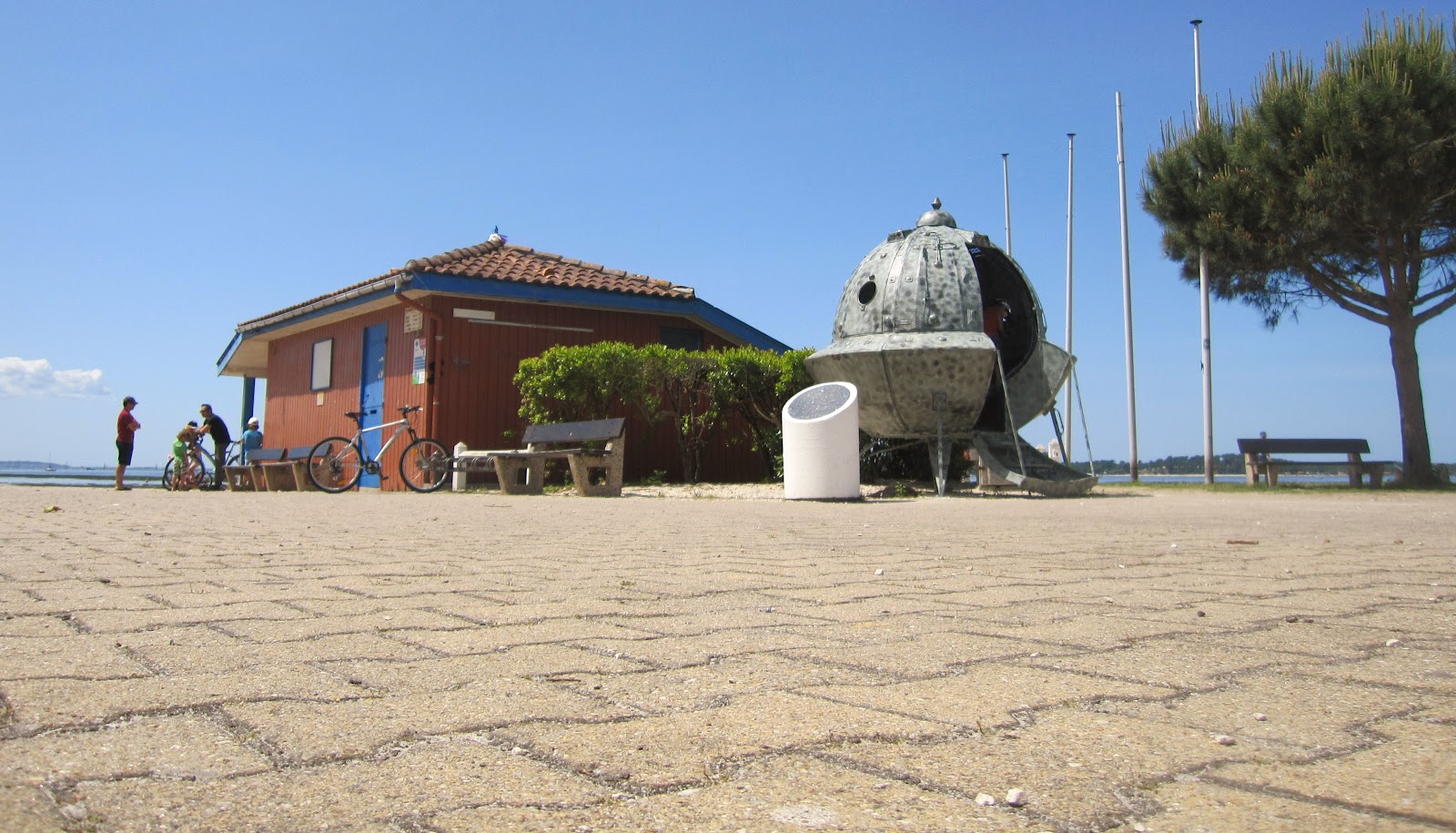
[ A revised version of this article was published in 2016 subsequent to the arrival of a new spacecraft structure. ] Arès is a quiet reso...

[A revised version of this article was published in 2016 subsequent to the arrival of a new spacecraft structure.]

Arès is a quiet resort towards the northern tip of the triangle formed by the Bassin d’Arcachon which, for nearly 40 years, has maintained a designated waterfront landing pad for unidentified flying objects.

The story began on August 15th 1976 when the so-called “ovniport” (OVNI: objet volant non-identifié) was officially inaugurated as one of the highlights of that year’s oyster festival. The idea, which at the time got extensive coverage in the media (most notably the United States), had originally been dreamt up by a group of locals led by one Bob Cotten, a Mérignac airport employee who, as well as being a renowned expert in electronics, was a UFO enthusiast who claimed to be disgruntled by the lack of landing facilities for alien spacecraft.