A few days ago I attended a concert by the Australian folk and indie pop duo Angus & Julia Stone at l'Espace Médoquine in Talen...

A few days ago I attended a concert by the Australian folk and indie pop duo Angus & Julia Stone at l'Espace Médoquine in Talence (usually simply known as "la Médoquine"). This was, in all likelihood, my last visit to the venue which will close for good in 2018, with residential buildings and scenic greenery set to take its place.

The multi-purpose venue, best known as a concert hall but also used by local associations and businesses for meetings, conferences and miscellaneous events, was built in the late 1980s to the designs of the Gujan-Mestras-based architect Bernard Vayssière. French singer Yves Duteil was the first headline artist to perform there on March 4th 1989.

The venue could be configured according to the event at hand, catering for attendances of anything between 250 and 1,000 if seated, and up to 3,000 standing. The standing configuration is the one with which I am most familiar as a concert-goer; during my first stay in Bordeaux in the 1990s I saw many personal favourites there including Joe Jackson, Lloyd Cole, Stephen Duffy and Tears For Fears. In more recent years, my occasional Médoquine concert outings have included the electronic rock outfit Archive and alternative pop band Metronomy.
The days before barcodes: old Médoquine concert tickets!
Metronomy, November 2014.
Having said all that, one of my most memorable Médoquine (non-) events was a date by Oasis back in 1996, when they were at the height of their Britpop fame. Reportedly underwhelmed by the safety barriers that had been installed in front of the stage, the band decided to cancel their performance at the last minute, to the great disbelief, disappointment and anger of the crowd waiting outside! (The group did return to the venue in 2009 and apparently played an uninspired Oasis-by-numbers set.)

But the local music history books will probably associate the venue with more notable appearances by the likes of the Michael Hutchence-led INXS in June 1993. They had just made the uncomfortable move of downsizing from stadium gigs to more intimate mid-sized venues, and la Médoquine fitted the bill nicely. And, in June 1997, one David Bowie brought his Earthling tour to Talence; this was the only time Bowie was to perform in the area.

Beyond my personal concert-going memories of the venue, my day-job duties in the Communications team at Thales have enabled me to view la Médoquine in a whole new light, spending full days there working on the organisation of new year all-staff meetings. This has meant I have enjoyed the enviable privilege of sitting behind a big mixing desk feeling like I’m important or, with the whole venue to myself pre-event, wandering about on stage secretly pretending I’m Joe Jackson or David Bowie. 

On stage: take the seats away and you more or less have a Bowie-eye view of la Médoquine.
Mixing desk vantage point.
However, possibly the most enduring memory of those days spent at la Médoquine, invariably at the height of winter, is how cold the place was. Although the heating system would be switched on in the morning, it took until mid-afternoon for the temperature to reach anything approaching bearable. As somebody who is more used to working in a comfortable office environment, my days at la Médoquine generally meant wrapping up like I was off to a ski station. Thales managers, ahead of their keynote talks to employees, would be checking out their notes wearing warm coats and scarves. In contrast, when I've attended concerts, the place has felt a little like being stuck inside an oven, regardless of the time of year. Go figure...

Behind the scenes on stage at la Médoquine.
Which brings us on to why the municipally-owned la Médoquine is to be demolished: the rapidly-ageing dysfunctional venue was in dire need of being overhauled and the bill for Talence would have come to between 2 and 4 million euros. Although the venue is run by the semi-public company Talence Gestion Équipement, the municipality continued to provide a substantial annual subsidy (322,000 euros) to cover losses and funded ongoing maintenance and repair work in full. Hence the decision to sell off the land to private property developers, with the resulting revenues being injected into a new project to build a combined music and dance school with a performance hall nearer to the centre of Talence.

La Médoquine's futuristic design will soon be a thing of the past...
Also, while concerts only accounted for a little under a third of the venue’s average annual revenues (29%, while corporate events generated 39% and municipal/associative events 32%), la Médoquine certainly retained its image as a live venue and began to struggle in the distinctly crowded Bordeaux concert hall landscape. La Médoquine has thus been left trailing behind more modern, more attractive and better-equipped counterparts such as Le Rocher de Palmer (comprising separate 250-, 650- and 1,200-capacity halls), which coordinates its highly desirable concert programme in partnership with Bordeaux’s Rock School Barbey and Mérignac’s Krakatoa.

Elsewhere on the outskirts of Bordeaux, Théatre du Casino Barrière and suburban venues like Théâtre des Quatre Saisons in Gradignan have also drawn potential artists and clients away from la Médoquine. Finally, over in Floirac, the cutting-edge Bordeaux Metropole Arena will shortly be opening for business, with a capacity ranging from 2,500 to 11,300, simultaneously overshadowing la Médoquine and replacing the acoustically-challenged Patinoire Mériadeck in central Bordeaux. Meanwhile, Cenon is also considering building an additional 2,500-capacity venue alongside the Rocher de Palmer!

Angus & Julia Stone and a sea of mobile phones, October 2017. The bird statue thing was part Muppets and part Spinal Tap.
According to media reports such as an interesting France Bleu feature broadcast in 2015, locals have mixed feelings about the closure. Many were only too receptive to the activity the venue generated in the neighbourhood and each event was synonymous with lively, lucrative nights for nearby bars and fast-food outlets. But others won’t miss the venue and its crowds; they had previously been vocal in their opposition to la Médoquine, resulting in measures including a strict 10:30pm curfew for concerts. And they probably don’t look back fondly on highly-publicised incidents such as the acts of night-time vandalism carried out in March 2017 ahead of Emmanuel Macron’s campaign rally there in the run-up to his election as French president! 

Anyhow, with a few months to spare ahead of what appears to be the final concert date, veteran singer Hugues Aufray’s March 29th 2018 performance, let us bid a fond farewell to La Médoquine. Thank you for the memories and good night!

The scene at the end of Angus & Julia Stone's set.
No re-admittance...
> Find it on the Invisible Bordeaux map: la Médoquine, 224-226 Cours Gallieni, Talence.
> At the time of writing, la Médoquine does still have an official website: www.medoquine.com 
> Some of the figures in this piece were culled from an excellent, informative, highly-recommended article published by in March 2017 by Rue 89 Bordeaux : http://rue89bordeaux.com/2017/03/fin-de-vie-indigne-medoquine/
> Ce dossier est également disponible en français !

[BONUS] In case you're wondering, here are the songs performed by David Bowie at la Médoquine in 1997 (via setlist.fm):
 
David Bowie Setlist Espace Médoquine, Talence, France 1997, Earthling

A few weeks ago, Invisible Bordeaux interviewed Rich Heard about the Frankton 75 project to re-enact the legendary 1942 Operation Frank...


A few weeks ago, Invisible Bordeaux interviewed Rich Heard about the Frankton 75 project to re-enact the legendary 1942 Operation Frankton, the heroic raid which proved deadly for all but two members of the squad: Herbert "Blondie" Hasler (1914-1987) and Rich’s grandfather, Bill Sparks (1922-2002). 

The Frankton 75 team, which also included Rich’s brother Mike and their uncle Terry (Bill Sparks’s son), recently completed their reenactment, paddling for four days up the Gironde estuary and walking from Blaye to Ruffec over the following four days. I caught up with Rich to get the full story.

Having completed the reenactment, what do you now know that you didn't previously know about what your grandfather went through 75 years ago?

I have learned a lot about the Gironde and the surrounding area, the layup points where my grandad hid during the day, and the ordeal that faced the marines during their first couple of nights on the water, and then the travelling through France for Sparks and Hasler. 

I didn't know that they were kept on a farm outside of Ruffec for 41 days, literally kept in a room so that they weren't seen! I had the pleasure of meeting René, the son of the farmer that housed my grandad. I also heard of a funny story that happened afterwards: having been confined to the room Hasler and Sparks lost a considerable amount of their fitness, so when it came to the trek through the mountains they got a bit of abuse from an RAF officer! 

How was the challenge on both a physical and mental level? 

Physically it was incredibly tough and completing eight long physical days in a row took its toll. The paddle was tough on the backside, shoulders and back, the kayaks not being built for comfort necessarily, but we muddled through it and completed it faster than anticipated. 

At times it felt like landmarks were being moved along the river to trick us; on day one, from Le Verdon to Pauillac, there seemed to be a lighthouse which took three hours to pass!! Just the sheer enormity of the Gironde!

The three kayaks arriving in Macau at the end of their second day of paddling.

Hitting dry(-ish) land in Macau.
The walk was something else entirely! The sheer mileage we had to cover meant we were walking pretty much from sun up to sun down, and after four days of having wet feet the first day’s walking was incredibly painful. I had massive blood blisters surrounding both heels!

Four days of this was mentally challenging too. Our bodies ached; we only got a few hours’ sleep a night as we got in late and were up early to travel to each drop off point. But we bantered each other the whole way through and really dug in as a team to get the job done. 


Outside the Toque Blanche in Ruffec!
What were the high points of your adventure, and low points if there were any?

We met an incredible amount of French people who were only too happy to help and support us, as well as giving of their time to show us the sights and memorials dedicated to the marines.

Highlights were definitely getting into the boat on day one and overshooting our planned route to hit Macau! Plus coming into Blaye and looking back at the river having completed our paddle.

My other highlight was getting into Ruffec, especially visiting the Toque Blanche. Being in the very same room that Grandad met the Résistance in was so, so humbling and we were all overcome with emotions and shed tears. So much happened in that room, without which I wouldn't be alive! 

My lowest points came on day two of the walk, starting the day in a bad way led to my feet being in an even worse position after walking 20 miles. The pain was almost bearable, but the impact I was having on the pace we walked at put our timescale in jeopardy, so I had to make the tough call to sit out on day three... but strapped my feet back together long enough to complete the final walk!    

We had a reception put on for us on Courcôme, which was amazing! Fifty people turned up to meet us and spend the evening with us! It felt like we were celebrities, we received a welcome of claps and cheers!

The reception held in Courcôme, organised by Mary Messer, Jean-Claude Déranlot and the Frankton Souvenir association.
Are there any standout locations or scenery that you took in during your trek through south-western France? 

There were so many beautiful little towns, and more stunning hills filled with vineyards than I can remember! We started our walk alongside the Gironde at the site where Hasler and Sparks sank their canoe. This was an incredible place to visit and served as a good start point to focus on our trek.
Walking into Ruffec will always stand out, walking along the streets in the town up to the Toque Blanche, then seeing a building that was so familiar from photographs, and being lucky enough to go in. Breathtaking!

 [Video interlude: looking back on the adventure]

What happens next?

Well, we are continuing to raise funds for Weldmar Hospice Care. We have just tipped over the £10,000 mark so we have hit the target we had set, which is amazing!

As for me, I'm looking forward to settling back into family life, enjoying my young family and getting used to my new job! 

Who knows what the next adventure will be, I'm always up for a challenge!


> You can still support the Frankton 75 fundraising effort by checking out this Justgiving page: www.justgiving.com/Frankton75inthefootstepsofourgrandfather
> Cet article est également disponible en français !

Bordeaux Métropole is made up of 28 separate municipalities, all of which boast their own mayors, town halls, websites and, yes, logos. ...


Bordeaux Métropole is made up of 28 separate municipalities, all of which boast their own mayors, town halls, websites and, yes, logos. Invisible Bordeaux thought it might be interesting to head out on an armchair tour of those 28 logos. To make the journey as painless as possible, they have been grouped together in a series of totally arbitrarily-chosen categories, the first of which is...

The most evocative
This first selection of logos is heavy on symbols: Saint-Médard's recently-revamped logo attempts to merge elements of a human being with lines representing the Earth, and stars that, well, represent stars, in reference to the town's contribution to space exploration through local industry and research players. A star also features in Floirac's logo, possibly a nod towards the former observatory located on the town's hilltops. Bassens offers a reinterpretation of the Bordeaux crescent symbol, in keeping with its location at a bend in the river Garonne, the colour blue no doubt symbolising its credentials as a maritime port. The Gradignan logo clearly highlights the town's position on the Santiago de Compostela pilgrimage route.
The most elegant
Serious graphic designers were obviously brought in to work on the following set, featuring Artigues and its flower petals (is the hexagon a reference to France?), Pessac and its enigmatic falling hula-hoop, and Le Taillan's wine label-like visual identity. Note the way the "a" and "n" of the word "Taillan" also form the "M" of "Médoc", in a square where the urban grey meets the red which is reminiscent of Bordeaux wine. Le Taillan's is also the first of our logos to include a slogan.

The ones with slogans
For yes, there are other logos with slogans. Le Bouscat promises a "ville à vivre" (a town to live in but also to be experienced to the full?). Carbon-Blanc's slightly abstract logo, the initial design of which was the work of local school-children, features a series of verbs in the infinitive: "dream, share, innovate". Ambès's multicoloured offering promises a territory, er, where you meet people. Whereas Cenon, whose logo appears to have been borrowed from some organic food packaging, name-checks "nature" and "culture".

The ones with skylines
Saint-Aubin-de-Médoc combines its own slogan with a single-line evocation of the town's skyline, comprising a couple of trees, the parish church and what could either be the roof of a very low house or else a submarine, I'm not sure. Bouliac has also gone for the skyline option, with big, colourful Scrabble letter-like blocks. Surprisingly, the most recognisable landmark on the logo is Bouliac's church rather than its 250-metre-high radio mast, which can be seen from most points in central Bordeaux and beyond! It is surprising to think it must have been rejected! :-)
The most minimalist
Mérignac's logo uses triangles to form an "M" shape, the three colours reportedly representing aerospace (blue), economic development (red) and nature (green). Le Haillan recently unveiled its H-themed logo in a colour scheme that wouldn't look out of place in a chemist's. Ambarès and Villenave d'Ornon have opted for two-colour squiggly shapes that possibly represent their names. They probably look good on municipal newsletters anyway. 
The ones that need revising
Hmmm. Talence, what's with the roller-coaster loop-the-loop motif that appears in the middle of your logo? Is there some kind of funfair theme in there? Parempuyre currently employs a cartoon bird and a bunch of grapes as its visual identity. Lormont is another flower petal municipality, the multicoloured petals linking up with a lowercase letter L, the blue of which possibly cross-checks back to the blue of the Garonne river, which is of course brown in real life. Eysines' giant E on a red rectangle can surely be enhanced. As for Metropolitan newcomer Martignas-sur-Jalle, the current makeshift logo is just a bunch of curly writing combined with the town's historic crest.
The most timeless
The first of these two is possibly Invisible Bordeaux's favourite Métropole logo: Bruges has retained its historic crest, inserted it in a circle and combined it with a modern, no-frills version of its name, the end-product being delivered in a single shade of light blue. The city of Bordeaux's logo, meanwhile, is a familiar sight to locals and visitors alike. It has already been covered at length on the blog as part of an article about the city's historic coat of arms. 

The ones that need a makeover
There's nothing especially wrong about the next two, but you do sense that they could do with a bit of a millennial makeover. Bègles has opted for an in-your-face "B", with more of that mystifying blue Garonne water (brown, it's brown, see above!) and a sandy triangle that possibly points the way to the beach (maybe even Bègles plage). As for Blanquefort's sand-grass-sky semi-handwritten logo, well, you can imagine it on a white t-shirt or beach towel, but perhaps the time has come for something a bit more formal. 
The most oddball
And then there are the Métropole's two smallest communes, Saint-Vincent-de-Paul (population: 1,021) appears to make do with the medallion pictured below, featuring the village church, its bridges, bunches of grapes and, presumably, the original Saint Vincent de Paul. The medallion is reproduced as-is on official literature. Similarly, Saint-Louis-de-Montferrand (population: 2,175), has yet to invest heavily in a logo. The bizarre wishbone-like Miró-esque visual below (which in fact depicts the village's geographic position at the point where the Dordogne meets the Garonne) is pretty much all is available for now.
Then there's Bordeaux Métropole itself...
When the Communauté Urbaine de Bordeaux was re-booted and re-branded as Bordeaux Métropole in January 2015, a brand new logo was launched. The intriguing design which, at first glance, was a little like a colourful fireworks display, was in fact constructed around 28 dots, each dot representing the geographical location of the associated municipality. In the mother logo, Bordeaux is the focal point and each line connects the city with a Métropole counterpart. But the Métropole also delivered a variant for each town, each version featuring a different colour scheme and the lines departing from the relevant starting point. Although the individual towns have been encouraged to use their personalized versions, in practice they have not really warmed to the concept. 
Above: the variants conceived for each of the Métropole's individual municipalities.
To finish off (if you are still reading), my colleague Edgar suggested I should layer the 28 logos on a map to enable you, dear reader, to easily locate each Métropole municipality! So here goes:


And, as it's a slow news week, here are the same logos pasted onto the relevant dots of the Bordeaux Métropole logo!
And, to check that you really are familiar with all those logos now, test your knowledge on the Invisible Bordeaux logo quiz! 

We have already twice encountered the hugely influential Swiss architect Le Corbusier (1887-1965) on Invisible Bordeaux, when touring t...


We have already twice encountered the hugely influential Swiss architect Le Corbusier (1887-1965) on Invisible Bordeaux, when touring the Cité Frugès prefab housing estate in Pessac and its smaller predecessor in Lège-Cap-Ferret. But the oldest and possibly most surprising of Le Corbusier’s projects in Gironde (and reportedly his first in France) was in fact an unusual lighthouse-like water tower in Podensac, 35 kilometres to the south-east of Bordeaux.

At the time of its construction, in 1917, Le Corbusier still went by the name of Charles-Edouard Jeanneret-Gris. He had been called upon by a friend, the wealthy Girondin entrepreneur François Thévenot, to design the water tower as part of a wider scheme to ensure that Thévenot’s newly-acquired property (the centrepiece of which was to be his residence, Château Chavat) would boast an efficient water management system.


Le Corbusier thus conceived the 25-metre-tall circular steel-reinforced concrete tower, which was delivered by the company which employed him at the time, Société d’Application du Béton Armé (SABA). A spiral staircase wound its way up the inside of the structure to the 80-cubic-metre water tank at its top, but rather than the tower being an opaque vertical cylinder, it also comprised a landing two-thirds of the way up, with eight pairs of tall French windows on all sides offering a panoramic vista over the surrounding area. But was the room solely designed to take in the view? Some sources do indeed call it a “gloriette”, a place to relax and enjoy some downtime, but Le Corbusier referred to it as the “garçonnière”, suggesting it may also have served as a discreet meeting point for the landlord and his “acquaintances”!

Topping off the structure was a terrace, although the original plan to build an additional look-out tower on top never came to fruition.


Around the time of the Second World War, the water tower and the surrounding land became the property of the local council, which split the wider domaine into smaller plots (although the château and its adjoining park remained more or less as-is). The water tower had ceased to operate in 1940, and it was soon to be dwarfed by a far more modern counterpart. The Le Corbusier structure was resolutely ignored and fell into a state of disrepair until, in 1983, two Dutch architects rediscovered the tower and its history.

It was not immediately listed as an historic monument (an application submitted by the local council was rejected in 1986) and, in 1987, its administration was handed over (for a period of 99 years) to “Le Groupe des Cinq”, a collective originally formed by five architects (Laurent Cazalis, Alain Loisier, Bertrand Nivelle, Daniel Sarrazin and Jean de Giacinto) to preserve and revive historic sites, coupling them with cultural events. Throughout the second half of the 1990s, the association oversaw substantial refurbishments conducted on the water tower (notably the roofing, the terrace, and the interior and windows of the garçonnière) and, in November 2005, the Château Chavat park, its water features, greenhouses and water tower were all finally listed as historic monuments.

Ever since then, le Groupe des Cinq has worked on bringing the water tower to life, developing its touristic, pedagogical, cultural and historical appeal. This has translated into its inclusion on local tourist maps, hosting school groups, and the organization of various exhibitions, installations and the like. Memorable shows have included "sound sculptures" by the acoustician Didier Blanchard in partnership with composer Georges Bloch back in 1995, and a lightshow and spoken word performance entitled “Les jardins noctiluques” in 2006.

The ground-level entrace to the water tower.
The day I was there, it didn’t exactly feel like a hive of cultural activity though (admittedly, this was late afternoon on a Sunday in August). To reach the base of the tower, I trespassed through what I think was a private car park; a sign mentioned it was part of “le chantier CSMR”, possibly in reference to extension work being carried out on a nearby old people’s home. On the other side a sports pitch cuts off access from the main road. On the tower itself there was no mention of its historical significance, no information panel and no sign of life; it wasn’t until I got back home and did my homework that I found out it was occasionally more animated and wasn’t just an abandoned, empty shell.

But perhaps that’s the way Podensac wants it to remain. While architecture enthusiasts might flock to Le Corbusier’s Villa Savoye in Poissy, the Cité Radieuse in Marseille and the recently UNESCO-listed Cité Frugès in Pessac, this lowly water tower is not so much as signposted and remains tucked away, off the beaten track, sandwiched between an inhospitable car park and a football pitch: Gironde’s strangest and unlikeliest architectural claim to fame.

Le Corbusier loses out in the battle of the water towers by some margin.
> Find it on the Invisible Bordeaux map: Podensac water tower, rue Pierre-Vincent, Podensac
> Ce dossier est également disponible en français !
> The Podensac water tower has its own, dedicated website:
http://www.chateaudeaulecorbusier.sitew.fr Resources available include plans and archive photographs of the tower being built, see http://www.chateaudeaulecorbusier.sitew.fr/#LES_PLANS_.B

This 3-D simulation, produced by Le Groupe des Cinq, gives an idea of what the water tower is like on the inside:  

It was an absolute privilege to have contributed to this year's European Heritage Days events with a little help from my employer T...

It was an absolute privilege to have contributed to this year's European Heritage Days events with a little help from my employer Thales, who authorized visits of the historic arboretum located behind our former Le Haillan facility. 

The guided tours were an opportunity for visitors to familiarize themselves with the history of the arboretum and to view some of the most striking trees that are still present on site (atlas cedars, Douglas firs, Japanese camellia, etc.). Despite the damp weather, particularly during the first of the three tours, the 50+ people who took part were delighted to get the inside view of a little-known site that is usually behind closed doors.

The arboretum was initially created at the end of the 18th century by Toussaint-Yves Catros, previously head of the royal tree nurseries until the French Revolution. It extended over an area of 15 to 20 hectares and endured many ups and downs over its history (clear cuts, wartime bombing and the like). What started out as a veritable “garden of Eden” according to contemporary observers – given the number of rare and exotic species planted by Catros as a result of his ties with overseas botanists and societies – is now a more unruly forest where only the most robust species have survived and multiplied. 

This Heritage Days event was a first for Thales in Bordeaux, but will in all likelihood be the only time this happens as we will be vacating the Le Haillan facility in the coming weeks after 46 years spent there. The time was therefore right to organize this Heritage Days event, which was even ranked by local newspaper Sud Ouest as one of the top ten unusual outings to enjoy!

Thanks to everyone who came to visit the arboretum, and a big shout out to Pascal Guesnet, who conducted the tours with me, and to Thales Bordeaux Campus site director Pierre-Emmanuel Raux for fully supporting the project!

During his lifetime, Toussaint-Yves Catros (1757-1836) was saluted as having “raised the art of naturalising foreign plants to the highest degree”. He played a part in planting the pines that secure the sandy coastline of south-western France, developed the practice of growing artichokes in Macau (where the vegetable is now a local speciality) and founded the seed distribution company Catros-Gérand (which still continues to operate out of its head office in Carbon-Blanc near Bordeaux). He also authored a 600-page encyclopedic catalogue of fruit trees, published in 1810 and which can be viewed here.

> Full article about Toussaint-Yves Catros here.
> Full article about the Le Haillan arboretum.

All photos: Xavier Audu/Thales.

The usual Invisible Bordeaux catchment area is in and around Bordeaux and Gironde, but every now and then the blog does spread its wing...

The usual Invisible Bordeaux catchment area is in and around Bordeaux and Gironde, but every now and then the blog does spread its wings a little further! (There was, after all, a full article about a sight in Québec City last year…) So it makes sense that I should recount the weekend spent with my wife Muriel cycling along the rather scenic Canal de Garonne from Castets-en-Dorthe to Agen.

The canal, which is officially known as Canal Latéral à la Garonne, is actually far more popular with foreign visitors to France than it is with locals (perhaps it’s not exotic enough, or else is too close to home for most Girondins!). In all it stretches over 193 kilometres, hooking up with the Canal du Midi in Toulouse, the two combining to form a non-stop waterway connection between the Atlantic and the Mediterranean.

It was built in stages: work began in 1838 on the stretch from Toulouse to Montauban, which opened in 1844; it was extended as far as Buzet-sur-Baïse in 1853 and the canal was fully operational in 1856. In spite of tough competition from the rail and road transport networks, until the 1970s most of the canal traffic was merchant shipping. Now the waterway is mainly the scene of gentle leisure travel. In all, around 450 boats and barges are based on the canal, which in turn accounts for around 500 jobs. 

The point in Castets where the canal links up with the Garonne. Note the iron road bridge in the background.
After the 60-kilometre drive from Bordeaux, Muriel and I park our car and hop on our bikes in Castets at the end-point (or starting point) where the canal meets the Garonne, at the foot of an Eiffel-inspired early 20th-century single-lane iron road bridge. We embark on the towpath and the initial kilometres are a succession of locks, narrow bridges and waterside cafés, while our fellow inhabitants of the canal are fishermen and dog-walkers (generally with very well-trained dogs that are clearly used to encountering cyclists). The backdrop is formed by cornfields, the occasional rows of vines, and extensive sunflower patches which, sadly, are just past their glorious prime at this stage late in August.

Reaching Fontet, barely ten kilometres into our ride, we encounter what will be the strangest sight on the whole trek, the concisely-named “Musée d’artisanat, de monuments en allumettes et sciences naturelles”. Given the all-encompassing name, we had to venture inside and… it truly proved to be one of the most bizarre places we’ve ever visited.

The museum is overseen by volunteers who first take you round a barn filled floor to ceiling with a seemingly random selection of exhibits: taxidermied animals, farming implements, gadgets from bygone times and pieces by local artists. Visitors are then ferried into another building which is the personal kingdom of one Gérard Gergerès, who is present on site to provide the full background story.

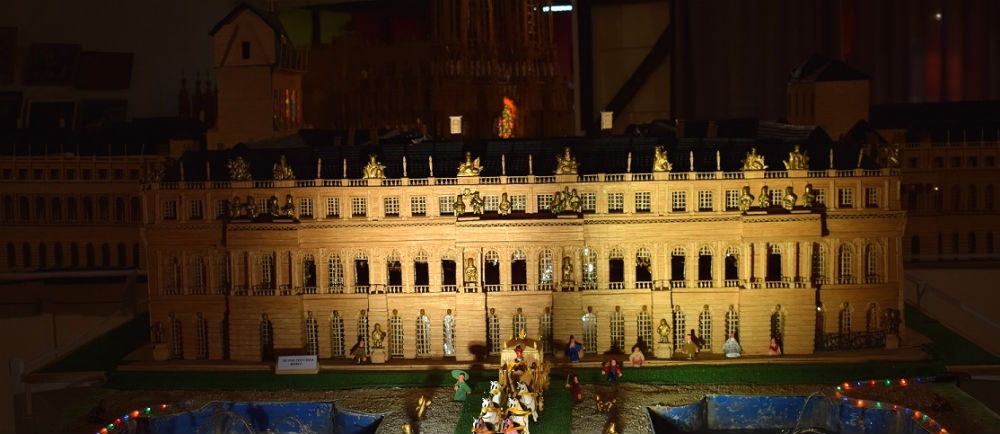
This disabled pensioner has taken it upon himself to build model replicas of French landmarks… out of matchsticks. The models are impressive, spectacular and just a little bit eerie too, particularly when pre-programmed son-et-lumière and waterworks features kick in. His take on the palace of Versailles covers much of the floorspace and almost dwarves his version of Reims cathedral, which earned him a mention in the Guinness Book of Records (not quite sure what the precise category was). Anyway, the whole experience was all very peculiar and kind of has to be seen to be believed, although it is most definitely not for the faint-hearted. All of the above can be yours for a 5-euro admission fee.

Photography was one of many things that were prohibited inside the museum, so this picture of the miniature Versailles palace (built out of 450,000 matches over a 14-year period) has been naughtily lifted from the museum website: http://museeallumettes.com
Moving on to one of the stretches where the canal is within easy reach of the Garonne, we stop by one of the canal’s prettiest locks and admire a watermill built in 1880, le Moulin de l’Auriole. It no longer appears to be grinding out flour though. 


A long and especially pleasant plane tree-lined section follows, taking us cyclists out of la Gironde and into le Lot-et-Garonne. As if on cue, we immediately spot some melon patches upon entering the département, which is renowned for its fruit production. We keep our heads down and pass Marmande, which lies somewhere over to our left, and stop in one of the most scenic perched villages on the route: Mas d’Agenais.

A steep road leads us up to the central square and a covered marketplace, which is just a short walk from the village church, Église Saint-Vincent, which we enter in search of Mas d’Agenais’s most valuable possession: a crucifixion scene painted by the Dutch master Rembrandt. The story goes that the piece had ended up in the possession of a family, the Duffours, who were originally from Mas d’Agenais but had moved to Dunkerque in northern France. As a gesture of their attachment to their hometown, they donated the picture to the parish in 1804. The gift must initially have gone virtually unnoticed; it was only really unearthed in the sacristy in 1850! Speculation (very) slowly escalated as to who the artist was and, in 1960 (i.e. 110 years later), infrared analysis revealed Rembrandt’s signature and the date 1631. 

The delightful Mas d'Agenais.
Sadly though, our pre-trip research hasn’t been up to scratch: the painting is conspicuously absent from the church because it is currently in… Bordeaux, where it can be viewed at Cathédrale Saint-André on Wednesdays, Saturdays and Sundays! This is a temporary measure while the display case used to showcase the painting in Mas d’Agenais undergoes repairs (a crack in its joints had meant it had become a health and safety hazard for visitors). Once the painting returns, it will be on show to the general public in “improved security and presentation conditions” according to the message that is currently displayed where the painting should be.  

A Sud Ouest cutting is currently standing in for the Rembrandt masterpiece.
Back on our bikes, we rejoin the canal and make our way past Mas d’Agenais’s magnificent suspension bridge, which has provided a means of crossing the Garonne here since 1840, no less! 

Looking down on the suspension bridge. The canal can be seen in the foreground while the Garonne can be spotted in the background.
We continue to make good progress, cycling through the canal port village of Villetong, where the quayside has been given the name of the “humanitarian sailor” Pierre Ribes. A panel explains that Ribes would depart from that spot every year in September for Royan, prior to heading for Africa, sailing alone on his yacht “Le Sphinx” and carrying medication which he delivered to the needy upon arrival. Nicknamed “Dr Bateau”, Ribes’s 24th such venture, aged 75 in 2004, was to be his last. He remains lost at sea.

Nearby is a warehouse with a number of old tractors and other farm vehicles parked outside, for this is the “Musée des Amis de la Mémoire Paysanne”, where the information panel outside promises “a collection of machines  and tools that retrace the history of agriculture and its mechanization”. It appears to be closed though, so we only alight long enough to take this photo. 


Our next stops are the charming bastide town of Damazan and the wine-growing town of Buzet-sur-Baïse, beyond which the canal loses a bit of its scenic value, certainly once we have passed the curious double lock system that links the canal with the river Baïse. The sound of the busy A63 motorway - connecting Bordeaux and Toulouse - edges ever closer. But this is almost forgotten when crossing a remarkable aqueduct over the Baïse; the structure is undoubtedly one of the most impressive sights on the trip.


The accompanying landscape now moves on to apples and kiwi fruit, and ever so gradually the cycling population ceases to be solely populated by overseas visitors weighed down by bags, given the influx of increasing numbers of more leisurely, urban cyclists… for we are nearing our final destination, Agen. But before we enter the town proper, the canal has one more surprise in store: the unusual Pont-Canal d’Agen. The 539-metre-long, 12.5-metre-wide and 10-metre-high structure enables the canal to cross its older, more energetic cousin, the Garonne river. Completed in 1847 and operational from 1849 onwards, the bridge was built to the designs of engineers Jean-Baptiste de Baudre and Jean Gratien de Job. Needless to say, it is one of Agen’s most renowned and popular landmarks.

The immensely photogenic and slightly mad Pont-Canal d'Agen.
After treating ourselved to a whistle-stop tour of the town centre (which is buzzing on this late August Saturday afternoon), Muriel and I make our way back out to the quiet village of Brax where we enjoy a deserved rest and meal (washed down with a bottle of Buzet), recharging our batteries before the return trip the next day.

So, what are the lasting impressions of the 180-kilometre round-trip? Well, on the minus side, one thing to bear in mind is that the surface is not quite as smooth as in the movies. Along the section we cycled there are plenty of tree roots playing havoc with the tarmac, making for a sometimes bumpy ride. But reliable sources have stated that the Canal de Garonne boasts a far more pleasant and well-maintained towpath than the Canal du Midi, for instance.

One thing I found striking was that cycling a route like this serves as a gentle reminder that much of France remains farming territory, with agricultural plots as far as the eye can see. 

Apples.
Kiwi fruit.
Melons.
Corn.
Another aspect that I enjoyed about this ride was that you’re in a warm and fluffy environment where fellow cyclists all greet each other, and that when you spot someone on a boat, communication is far more likely and animated than with people on dry land. Then again, the same can no doubt be said about most waterway cycling expeditions.

But generally the overall feeling is that this really as good as it gets as far as cross-country cycling is concerned: much of the time it really does feel like you’re gliding through a postcard view of France and witnessing the kind of scenery you could easily imaging gracing the cover of a tourist brochure. Cycling along this canal is not just a case of being parallel to the Garonne, much of the time it almost feels like being in a parallel world. 


> If, rather than cycling, you're considering cruising the canal by boat or barge, the excellent French Waterways website includes exhaustive practical and navigation information: www.french-waterways.com/waterways/south-west/canal-garonne/
> Ce récit est également disponible en français !