[Please note the entrances to the Jardin des Remparts are currently closed and have been for some time, so the park can sadly no...

[Please note the entrances to the Jardin des Remparts are currently closed and have been for some time, so the park can sadly not be visited (June 2025)]


Invisible Bordeaux came across an unexpected delight when out and about on a recent assignment, for tucked away above the remnants of the old city walls is the small but perfectly-formed Jardin des Remparts, another contender for Bordeaux’s “Best Kept Secret” award! 

Although seemingly rich in history, as a public garden the story is a recent one: the Jardin des Remparts, in its current form, was first opened to the general public by the city council in December 2013. This development was a by-product of a campaign called Bordeaux [Re]Centres, the local application of a nationwide project to revitalise run-down areas in city centres. The latter went by the delightful, easy-to-remember name of PNRQAD (Plan national de requalification des centres anciens dégradés).

The 2013 breakthrough followed on from initial efforts to bring the place to life in 2010, led by a local association poetically known as “Le Bruit du Frigo”. They held various happenings here in an area that was, in essence, little-used land that was split between the student housing organisation CROUS and the vocational training establishment ERP Robert Lateulade (the city council has gained the right to use the State-owned ground and will, in time, fully acquire the property). Prior to that, the area was part of a convent, le Couvent des Capucins.


The garden’s most notable characteristic though is that it stretches along the old city walls ("les remparts"), as hinted at when looking at the long, linear stone wall which separates the Jardin from neighbouring houses (as pictured above). By one of the two entrances to the garden (where there are currently temporary metal staircases, set to be replaced by permanent steps sometime soon), a surviving section of the 14th-century wall is fully exposed. At garden level, there are even traces of the old artillery terrace and parapet walk.

Top: remnants of the old city wall by the eastern entrance to the park. Bottom: traces of what must have been a doorway to and from the parapet walk, or else a sentry post.
The remainder of the 3,400-square-metre park is suitably low-fi and yet neat and pleasant. A pretty row of plane trees is broken up by the occasional bench and, more surprisingly, a small shrine or oratory, no doubt a survivor of the area's convent past. Looking closely, a Latin inscription can just about be made out at its base. The text reads “Filioli mei, quos iterum parturio, donec formetur Christus in vobis”. With a little help from Twitter, and more specifically the good people at the Association Régionale des Enseignants de Langues Anciennes de l'académie de Bordeaux (@Arelabor), this was identified as being a bible verse, Galatians 4:19, the King James translation being “My little children, of whom I travail in birth again until Christ be formed in you”.

The oratory and the old steps which led down to the courtyard.
The fenced-off remains of a stone staircase lead down from the oratory to the courtyard of today’s vocational training establishment, although it is easy enough to imagine the scene being that of the 17th-century convent. Down at that lower level, some serious street art now adorns a wall that forms a bit of a dead end for visitors. As I take a photo of the wall, a dog runs up to the wall and starts performing for the camera before heading back up to join its master and his fellow dog-walkers.

I believe the dog's name was Watson. Elementary.
For it turns out that the Jardin des Remparts is a meeting point for the local dog-owning community (although I must say that, having read an article over at the brilliantly-named thetropicaldog.com, I was indeed expecting to encounter some canine friends). It is still early on a Sunday morning, but a group of dog-walkers have assembled towards the middle of the 100-metre promenade. And while I’m in the vicinity, a further gentleman and his two greyhounds arrive only to be gently told off for being 20 minutes late for the appointment!

I carefully make my way past the playful dogs and exchange a few niceties with one of the owners. We generally comment on how pleasant the Jardin is, but she quickly adds that it can only remain that way if people respect it. I ask her to explain what she means and she mentions that the place is often littered with the remains of food left by people passing through. And, in one corner, I do indeed spot some rogue beer bottles and wrappers that really shouldn’t be there. This is obviously a place that the locals have quickly warmed to and that is not be messed with; you get a feeling that the park is a natural extension of their habitat.
Views from the Jardin.
Finally, I make use of this unusual raised vantage point to take in a few sights that I’ve never before viewed from this angle: the spire of Saint-Michel church, the roof of the recently-renovated Marché des Douves building, and the exterior of the old convent chapel that lies within the grounds of the CROUS, a place which seems to be out-of-bounds but which can, apparently, occasionally be visited. I also spot an unusual, enigmatic white dome, which I think is pictured on the ERP Robert Lateulade's website here.

My time in the Jardin des Remparts has come to an end but I just know I’ll be back. I have a feeling the next time I’m in amongst the hustle and bustle of the Saint-Michel district or the Capucins market, surely among the liveliest and most energetic of the city's neighbourhoods, I will be only too proud to guide whoever is with me back towards the city’s secret garden on the old city walls, to enjoy a quiet walk in amongst the local dog population!

> Note: at this point in time, the Jardin des Remparts can only be reached via metal staircases on rue Marbotin and rue des Douves. Disabled access will reportedly be added in the future. 
> Find it on the Invisible Bordeaux map: Jardin des Remparts, rue Marbotin/rue des Douves, Bordeaux.
> Extra special thanks to Association Régionale des Enseignants de Langues Anciennes de l'académie de Bordeaux (@Arelabor), contacted via Émilie Bordographe, for help in deciphering and identifying the Latin inscription on the oratory. Thanks also to Alan Davey who was in touch too!
> Ce dossier est également disponible en français !  

In the Sainte-Croix district, which lies mid-way between the Saint-Michel quarter and Saint-Jean railway station, there are a number of...


In the Sainte-Croix district, which lies mid-way between the Saint-Michel quarter and Saint-Jean railway station, there are a number of unusual sights to take in. Here is the Invisible Bordeaux guide to four of those sights, bearing in mind that they are all interconnected in many ways.

Sainte-Croix church 


This magnificent church was originally an abbey that formed part of a Benedictin monastery whose roots can be traced back to the 7th century. As with many churches, sections have been added over the course of time: the right-hand bell tower dates back to the 12th century, whereas the left-hand bell tower is a relatively recent addition, conceived as it was in the 19th century by the architect Paul Abadie, who we have already encountered on the blog and who is perhaps best-known as the man behind the famous Sacré-Coeur church on the heights of Montmartre in Paris. 

The exterior is a remarkable succession of impressive details, such as the hundreds of individual carved figures above the main door. And I’ve always been a bit of a fan of the sculpture of Saint George slaying the dragon, which can be spotted over to the left-hand side of the main façade.


One of the most characteristic features of the church is its organ. It was originally installed in the 1740s by one of the abbey’s monks, one Dom Bedos de Celles. The organ was considered to be so good that, in 1812, the archbishop of Bordeaux decided he wanted it to be moved to the city’s cathedral. A straightforward “organ swap” and each church installed the other’s organ, as it were (other than the cabinets, which remained in place). In the 1970s, the cathedral decided to commission a new organ and the original Dom Bedos creation was transferred back to Sainte-Croix in 1984. The move as overseen by organ specialists Pascal Quoirin, who meticulously followed instructions drafted by Dom Bedos 250 years earlier. The relocation was a success and is regarded as a milestone event in the recent history of organs!

Sainte-Croix fountain (also known as Fontaine des Bénédictins)

In the grounds behind the church, known as Square Dom Bedos, a Baroque style dressed stone fountain which is now dry can be spotted, its twin staircases leading down to the basin which lies below ground level. It was first installed here in 1735 by another group of Benedictin monks, who were decidedly productive during that period! The fountain was listed as an historic monument in 1890, the year after the nearby abbey monastery building was converted, by architect Alphonse Ricard, into the city’s Ecole des Beaux-Arts.

The fountain is a veritable work of art, with various carved figures to take in, a pair of rather magnificent columns, the word “pax” prominently displayed towards the top, and a pleasing sense of symmetry that wouldn’t look out of place in the grounds of a royal residence. The piece is topped off by a shell-shaped motif. The fountain’s main initial purpose was to embellish the old city wall which ran alongside the grounds of the monastery, and that is our next stop.

Remnants of the old city walls


Over the course of its history, Bordeaux has gradually expanded, and in medieval times the fortified city walls had to be revised and rebuilt to keep up with the city’s outward evolution. The section of wall that can be viewed here is referred to as Bordeaux’s “troisième enceinte”, in other words the third-generation city wall. It was erected between 1302 and 1307 at a time when Bordeaux was under English rule. So, in a way, this is a little bit of England in Bordeaux!

Looking at it today, it is not too difficult to imagine archers positioned on the wall, their heads peering above the parapet to protect the city from intruders. On the city side of the wall, doors are positioned either side of the fountain. What could possibly be behind those doors? Another section of the “troisième enceinte” city wall can be found just a few hundred metres away. Invisible Bordeaux investigates the subject, one of the city’s hidden gems, here


École des Beaux-Arts

We finish up outside the École des Beaux-Arts, the city’s fine arts college. Within the grounds, near to the aforementioned fountain, a fine wrought iron gate can be admired. It is among the features retained by Alphonse Ricard when he overhauled the building ahead of the educational establishment moving in. Another door also proudly displays the word “pax”, a carved legend from the Benedictin monks’ era that has stood the test of time. But perhaps the most surprising exhibits are to be found outside the main entrance to the Ecole, where several pieces are on display and used by students for their artistic projects. To visitors, it feels more like walking into an archaeologist’s dream.


There is an elegant frontispiece that (according to a ground-level plaque nearby) was originally designed to end up on Place de la Bourse, sculpted by Claude Francin, whose work does indeed grace the buildings on Bordeaux’s most picture postcard-friendly square. Other sources suggest it was part of the "Porte Neuve" decorative gate that used to stand in the Capucins district. Which version is correct? And there are four statues, “muses” which stood atop the Grand-Théâtre until they became so weather-beaten that they had to be replaced by newer versions of themselves (in all likelihood around the end of the 19th century). It is fascinating to be able to have a closer look at these figures which remain the direct counterparts of the famous opera house statues that can only really be viewed from ground level and therefore from a certain distance.

> Find them on the Invisible Bordeaux map: Sainte-Croix church, Sainte-Croix fountain and city wall, École des Beaux-arts. 
> NB: Square Dom-Bedos (where the fountain is located) is only open daytime until 6pm and is closed at weekends.  

Hundreds of sculpted masks, or “ mascarons ” (from the Italian “ mascherone ”), can be seen on the exteriors of buildings in Bordeaux. ...

Hundreds of sculpted masks, or “mascarons” (from the Italian “mascherone”), can be seen on the exteriors of buildings in Bordeaux. On the 18th-century façades of Place de la Bourse, one of the city's most emblematic squares, there are 86 such mascarons to be spotted, 55 on the square proper while the others are on the waterfront façades of the buildings that flank the square.

Each and every mascaron seems to have its own unique personality, although some do seem to be eerily similar... and to make life easier for you, all the Place de la Bourse mascarons feature in this short clip! There are mascarons that represent ancient gods or mythological figures, others which are symbols of the city's slave trade past, and others still that depict bygone Bordeaux dignitaries.

So sit back, relax, enjoy the clip and then hop on a tram to view them all for yourself!

A blog such as Invisible Bordeaux is, in essence, a linear compilation of content with articles stacked up in chronological order, with ...


A blog such as Invisible Bordeaux is, in essence, a linear compilation of content with articles stacked up in chronological order, with the most recent items given priority homepage treatment. 

But don't forget that there is another way of browsing subjects: by consulting the Invisible Bordeaux map! It includes literally hundreds of pinned locations in and around Bordeaux (and one in Canada), all of which feature photos, a brief description and a link to the related blog item. 

So get scrolling and spot the unusual sights that are to be seen. You can click through to the Invisible Bordeaux map here, and if you're viewing this page in a standard internet browser, it should also appear as if by magic in a window below. Enjoy!

Bordeaux’s wartime history remains an opaque affair. Throughout that dark period, the city was the scene of many events, some of which ...

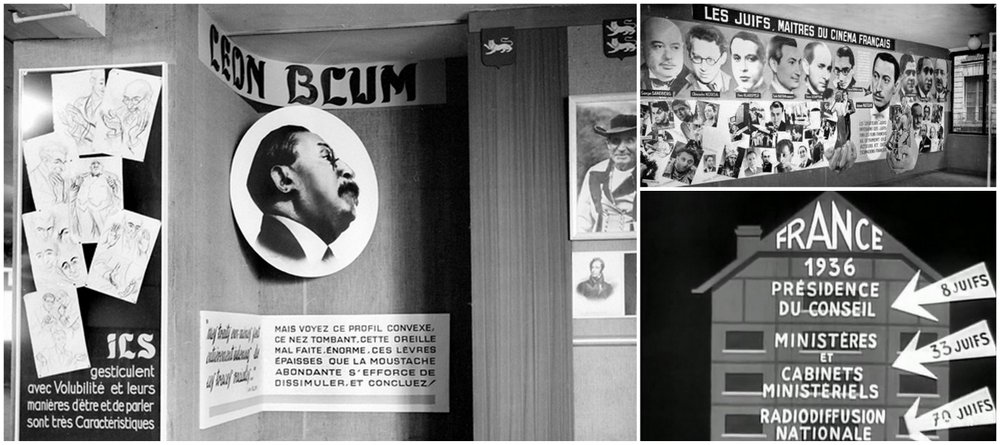
Bordeaux’s wartime history remains an opaque affair. Throughout that dark period, the city was the scene of many events, some of which were of huge strategic significance, some proved dramatic, others inspirational, while others stand out as particularly unsavoury when viewed from a 21st-century vantage point. One such example of the latter is an exhibition entitled “Le Juif et la France” hosted at the city hall over six weeks.

Outside the Palais Berlitz event in Paris,
photo source: www.cndp.fr
The context is well-documented: in late 1940, the Vichy regime began implementing a policy aimed at excluding Jews from any kind of role in the community. Jews found themselves being rejected from positions in all walks of life, from the civil service to education, press and the cinema industry. This policy facilitated the radical plans deployed by the Nazis to deport and exterminate Jews with a view to enacting their so-called “Final Solution”. 

To gain widespread public support among France’s non-Jewish population, the regime resorted to various propaganda drives that stigmatised Jews. These initiatives included the Le Juif et la France exhibition which was first held at Palais Berlitz on the boulevards in Paris from September 5th 1941 to January 15th 1942. The exhibition was organised by IEQJ, the Institut d’Études des Questions Juives, a body which was financed by the German embassy in France and overseen by Nazi security and propaganda services.

The exhibition sought to highlight the stronghold that Jews had secured within institutions and economic sectors throughout France. In addition, to help citizens become more effective in recognising the “enemy”, the exhibition provided a beginners’ guide to the physical features of Jews. It also went beyond these stereotypes to point fingers at emblematic individuals who were showcased on large panels, such as the furniture seller Wolff Lévitan, radio journalist Jean-Michel Grunebaum, playwright Henri Bernstein and the politician Léon Blum.

Some of the displays from the Paris leg of the exhibition, picture sources:
aufildelhistoire.u.a.f.unblog.fr, parisenimages.fr and voir-et-transmettre.fr
Reported attendance figures for the four-month run in Paris vary wildly; estimates range from 155,000 to 500,000 visitors! But it is generally thought that after initial success, interest soon waned as locals grew wary of what they were being fed. The time had come for the exhibition to relocate to the provinces and the plan was to hold it in ten other cities throughout France. In the end, it travelled to just two: Nancy and Bordeaux.

Significantly, the Bordeaux event was held in a wing within the grounds of the city hall, where the Musée des Beaux-Arts can now be found. The building had already served a similar purpose in May 1941, when it hosted an exhibition entitled “L’Allemagne de nos jours”, aimed at raising awareness about German culture and industry, its centerpiece being a bust of Adolf Hitler surrounded by a colourful hydrangea bed.

The Bordeaux leg of the Juif et la France exhibition opened on March 28th 1942 and ran for six weeks until May 11th (the Nancy event later stretched from July 4th to August 2nd). Again, it is difficult to establish reliable attendance figures but it is thought that over 60,000 viewed the exhibition in Bordeaux, including children from all local schools. The IEQJ's short-lived official publication, Le Cahier Jaune, later saluted the figure, equating it to 20% of the 300,000 living in and around Bordeaux at the time.

Along with the static exhibits, a makeshift cinema was set up under canvas in the gardens of the hôtel de ville, showing films including “Le Péril Juif” and “Les Corrupteurs”, and no less than three conferences were held each week.

The "cinéma permanent" and the same scene today.
The entrance to the exhibition (as also pictured in the lead photo at the top of the article), and the view today.
Reporting on the exhibition, local newspaper La Petite Gironde (whose allegiances lay firmly with German forces) related that those “forty days sufficed for our fellow citizens to take stock of the Jewish threat. In criminal enquiries it was hitherto customary to seek out the implication of a woman. We now know that when studying the causes of all misery, bankruptcy, financial disasters, scandals and war, we have to seek out the Jews”. Whether the message taken home by the people of Bordeaux was that clear-cut cannot easily be established, but the exhibition undeniably contributed to the climate that ultimately resulted in hundreds of Bordeaux Jews being rounded up and deported over the following months.

A closer look at the disturbing illustration that promoted
the exhibition. Source: http://paril.crdp.ac-caen.fr
What can be said about the involvement of local authorities? According to the writers of the authoritative biography of the mayor of Bordeaux at the time, Adrien Marquet (see footnote), the very fact that the city hall hosted the event demonstrated that the mairie was prepared to help channel the propaganda drive. Marquet (whose chequered legacy is detailed in a dedicated article here) certainly did not object to the event being held, although he kept a conspicuously low profile when it came to appearing at official functions, instead sending his deputy Robert Poplawski to the inauguration in his place.

In this instance, as so often when relating these wartime tales, what went on seems to be the unbelievable end-product of some unrecognisable parallel universe. And yet the setting is so familiar and so recent that it makes for chillingly painful reading. Then again, perhaps we need more stark reminders of these past events right now… 

This "Actualités Mondiales" clip reports on the exhibition in Paris:
> The authoritative biography of Adrien Marquet referred to further up the page is Adrien Marquet, les dérives d'une ambition by Hubert Bonin, Bernard Lachaise and Françoise Taliano Des Garets.
> Further reading:  
- https://www.histoire-image.org/etudes/exposition-juif-france-paris 
- http://www.gauchemip.org/spip.php?article8812 
- http://rue89bordeaux.com/2015/05/13-mai-44-dernier-convoi-bordeaux-auschwitz/
> Photos from the Bordeaux event extracted from report in IEQJ publication Le Cahier Jaune, archived by the Centre de documentation juive contemporaine (report featured in Adrien Marquet, les dérives d'une ambition). 
> Ce dossier est également disponible en français.

Invisible Bordeaux recently came across one of the city’s most unusual – and, it turns out, controversial – permanent art installatio...

Invisible Bordeaux recently came across one of the city’s most unusual – and, it turns out, controversial – permanent art installations: a house located on a traffic island near to the Pellegrin general hospital, sandwiched on all sides by streets and the tram A line. Welcome to “la Maison aux personnages”.

The exhibit is the work of Russian artists Ilya and Emilia Kabakov and was unveiled in October 2009: it consists of a two-storey house comprising a number of rooms, each of which has been designed and filled with scenery and accessories to look like it is inhabited by an imaginary character. Visitors can tour the exterior of the house, peek in through the windows (including the upstairs room which can be reached via an outdoor staircase), and take in the various still-life scenes, with poetically-worded panels about the associated characters there to provide additional context and pointers. 

This is la Maison aux personnages, although at first glance there is nothing to suggest the house is a permanent artistic installation. Pellegrin hospital can be seen to the left.
Much like the outsize tracksuit trouser sculpture covered in the previous Invisible Bordeaux item, la Maison aux personnages was commissioned as part of a campaign to install modern public artwork at various points along the metropole’s tram network. The house and its surrounding square were arguably the most ambitious of the resulting pieces. Ahead of the official inauguration (in the presence of the artists, city mayor Alain Juppé, France’s then culture minister Frédéric Mitterrand, and the then president of the metropole, Vincent Feltesse), the area was a building site over a seven-month period.

All of which leads us on to one of the most surprising aspects of the installation: remarkably, the 148-square-metre air-conditioned house and its garden were purpose-built to become this artistic exhibit. Working to the designs drawn up by Ilya and Emilia Kabakov themselves (some of the original sketches can be viewed here) and inspired by the characteristics of Bordeaux’s échoppes and townhouses, the building was conceived by the architects Samira Aït-Mehdi and Sylvain Latizeau, and delivered by the contractors DV Construction.

Given the expense involved (somewhere in the region of 500 to 600,000 euros), the project has proved controversial. The politician Emmanuelle Ajon, a Bordeaux city councillor and Gironde department vice-president, condemned the venture by writing that it was “indecent to let homeless people look in on what it is like to have a roof, and to spend 560,000 euros on a house which will only ever be exhibited and never occupied”.

Peering inside.
A Direct Matin Bordeaux7 report collected opinion among locals who were dubious about the exhibit “which nobody ever visits”, “blocks the view” and is, in terms which echoed those of Emmanuelle Ajon, “a house that cannot be entered while there are homeless people sleeping rough nearby”. Finally, the associated Yelp page includes a comment from somebody who lives across the road, and who mentions the incessant traffic which isn’t exactly conducive to people reaching the house, let alone taking time out there to rest and reflect on its meaning. The writer signs off by saying “the work might be interesting but it remains invisible”.

Which, appropriately enough, is where Invisible Bordeaux steps in: I braved the elements to plot my way through the traffic across to the house, in order to report back on what there is to see through the windows. So here goes: I think the most interesting rooms to view were those entitled “En barque sous les voiles” (which includes a pretty wooden sailboat), “La soif d’inventions” (which appears to be a mad professor’s workshop, complete with illuminated fairy lights and a lot of work in progress) and “Ne jamais rien jeter” (with its collection of collections, i.e. hundreds of labelled items, along with a number of suspended objects and little cards with open questions to the viewer written on them). Of the others, “Le paradis sous le plafond”, in the upstairs room, featured little more than an armchair and a ladder to nowhere – it felt a bit overly minimalist and underwhelming. Most of the remaining rooms were more conventional living and sleeping quarters, and looking inside did feel a little voyeuristic, if you can picture a voyeur also standing there scratching his head about the meaning of it all.

Four of the rooms: "En barque sous les voiles", "La soif d'inventions", "Ne jamais rien jeter" and "Le paradis sous le plafond".
Anyway, having written all of the above, it turns out I’ve almost forgotten to acknowledge the Soviet Union-raised, New York-based artists themselves; just who are they? Ilya Kabakov was born in 1933 in what is now Ukraine’s fourth largest city, Dnepropetrovsk. For much of his life, his main activity
The Kabakovs,
picture source: artnet.com
was that of an illustrator for children’s books, but from 1980 onwards he became well-established as a painter and writer. In 1988, he began collaborating with his future wife, Emilia (née Lekach), born in 1945 also in Dnepropetrovsk, who studied Music and Spanish in Moscow before moving to Israel then New York, where she became a curator and art dealer.

The couple have worked together ever since and have earned distinctions including France’s Chevalier des Arts et des Lettres in 1995 and Austria’s Oskar Kokoschka Preis in 2002. Their work, which “fuses elements of the everyday with those of the conceptual” (according to artnet.com), has been exhibited in venues including New York’s Museum of Modern Art, the Stedelijk Museum in Amsterdam and the State Hermitage Museum in St Petersburg. The Bordeaux installation is just one of many public commissions delivered throughout Europe and elsewhere

So, how can Bordeaux’s Maison aux personnages be defined? If you extract adjectives from this article you’ll find words such as invisible, controversial, indecent, but also unusual, imaginary, poetic and interesting. As with all forms of artwork, there are as many definitions as there are people viewing the piece. If you haven’t witnessed the house yet, perhaps your time has come.

> Find it on the Invisible Bordeaux map: La Maison aux personnages, place Amélie Raba Léon, Bordeaux.

We’re in Mérignac, between the Pin Galant concert hall and its associated tram stop and, yes, that might just be a massive sculpture re...

We’re in Mérignac, between the Pin Galant concert hall and its associated tram stop and, yes, that might just be a massive sculpture representing a gentleman's legs and feet, dressed in tracksuit bottoms and wearing a pair of tassel loafers. Er, hello?

This unusual public artwork is entitled, aptly enough, "Pantalon de jogging et mocassins à pampilles". It was officially unveiled on July 12th 2014 and was produced by the artistic duo Daniel Dewar and Grégory Gicquel. It was commissioned as part of a programme to install art pieces at points alongside Bordeaux metropole’s tramway network, within the wider framework of an initiative coordinated by France’s culture ministry and the Aquitaine region’s departments for artistic creation and cultural affairs. So there. 

The piece is a good four metres tall (yes, the artists opted for a grand 4:1 scale). Working our way up from the bottom, at its base is a 90-centimetre plinth made out of black granite from Lanhélin in Brittany. The tasteful leather-like moccasins and their tassels are made out of polished ochre-red marble, specifically Caunes-Minervois marble from the Languedoc region. They are topped off by the elegant tracksuit bottoms, complete with practical tie-up waist belt and handy back pocket, carved from a block of grey granite from the Côtes d’Armor area of Brittany. 

Details from the piece. You have to admit that both the loafers and trousers do look extremely comfortable and practical.
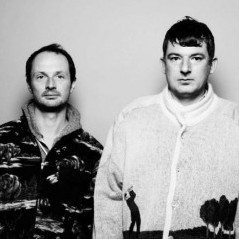
Who are the two artists responsible for the piece? Daniel Dewar, originally from the Forest of Dean region in south-western England, was born in 1976, and met Grégory Gicquel, one year his senior and from Saint-Brieuc in Brittany, when the two were studying at the École des Beaux-Arts in Rennes. The pair graduated in 2000 and have collaborated ever since, operating out of Paris.

Grégory Gicquel and Daniel Dewar,
picture source: www.actuart.org
The fruitful creative partnership has become firmly established on the international art scene and produced artwork that is mainly inspired by and depicts everyday icons of popular culture (including bathtubs, sinks and bidets), mixing styles, periods and techniques; Dewar & Gicquel are equally at home whether carving wood, cutting stone, moulding clay or weaving huge tapestries. A subtle touch of humour is a virtual constant in their work, and recognition by the artistic community includes being awarded the prestigious Marcel Duchamp prize in 2012.

There is definitely a touch of tongue-in-cheek humour in Dewar & Gicquel’s portrayal of the functional tracksuit bottoms and moccasins, both of which are items of clothing that manage to be seemingly timeless while simultaneously drifting in and out of fashion. The morning I was there was the day that Cuban leader Fidel Castro died, so viewing a gigantic pair of tracksuit trousers seemed to be a highly appropriate way to spend some time. Whatever, the piece is an oddball and surprising addition to the Mérignac landscape, so look out for it the next time you’re in the area!  

The trouser-shaped sculpture is clearly visible from line A trams.
> Find it on the Invisible Bordeaux map: Pantalon de jogging et mocassins à pampilles, avenue Dorgelès, Mérignac.
> An impressive 17-page press package was produced to tie in with the work being unveiled in 2014 and features full biographical information about Dewar & Gicquel, an interpretation of the work that is far more poetic and wordier than anything Invisible Bordeaux could ever manage, and some interesting work-in-progress photos including those featured below. You'll find it here (the workshop photo has been borrowed from art-flox.com). 

It's been another interesting twelve months feeding the beast that is Invisible Bordeaux, with highlights including some memorable ev...

It's been another interesting twelve months feeding the beast that is Invisible Bordeaux, with highlights including some memorable evenings performing The Shuman Show (the first instance of a blog item being turned into a full-on live music extravaganza), and a bizarre afternoon spent monitoring the progress of my "Welcome Arthur 2016 remake" video as it rose to number 13 in the Youtube France trending chart, courtesy mainly of a nice plug on the Sud Ouest website

But to sign off for this year, we give you this traditional festive season rundown of 2016's most popular articles. Have you read them all? Click on the titles or associated pictures to check them out!

http://invisiblebordeaux.blogspot.fr/2016/02/all-change-in-2016-for-observatory-of.html
The resident astrophysics research unit has since moved out, but much of the legacy equipment remains on site at what was the Observatory of Bordeaux, the various components of which I was able to examine during the final open day to be held there. 

http://invisiblebordeaux.blogspot.fr/2016/05/could-this-be-coolest-house-in-bordeaux.html
A reader told me about an unusual hôtel particulier in the city's Saint-Seurin district. Heading over there, it was obvious that the house deserved not only its own article, but also the enviable unofficial "Bordeaux's coolest house" accolade. Unless you can think of one that is even cooler...

http://invisiblebordeaux.blogspot.fr/2016/05/may-1968-barricades-and-night-bordeaux.html
With the valuable support of archivists at Sud Ouest, I ploughed through old newspaper cuttings with a view to reconstructing one of the most raucous nights in the city's recent history, during the tumultuous month of May 1968. The most pleasing end-product of the exercise was when Sud Ouest themselves reported on the research in a new newspaper article looking back on the events that took place 48 years ago. Things had come full circle.

http://invisiblebordeaux.blogspot.fr/2016/06/lalhambra-iconic-bordeaux-venue-which.html
The story of the Alhambra brought back a lot of memories for a lot of people in Bordeaux and beyond, all of whom seemed to cherish the concert hall and the eclectic range of shows it put on. This piece also led to a collaboration with local music authority Philippe Serra, who selflessly shared tales of events he had attended there in a sister article.

http://invisiblebordeaux.blogspot.fr/2016/01/the-hair-raising-names-of-hairdressing.html
This was a job that somebody had to do, so I took it on: to collect the good, the not-so-good and the sometimes astounding names of hairdressing salons in and around Bordeaux. Beware, the piece contains lots of "hair" and "tifs". And, despite that (or perhaps it's the reason why!), this was the year's most-read Invisible Bordeaux item.

And now, roll on 2017!

Every day, thousands of vehicles drive along Quai de Paludate and past Château Descas, which is simultaneously one of the most spectacul...


Every day, thousands of vehicles drive along Quai de Paludate and past Château Descas, which is simultaneously one of the most spectacular and one of the most mysterious buildings in central Bordeaux. I thought it might be interesting to investigate the subject!

Although the central section of the building currently lies empty, it is best known as having been the eponymous offices and wine cellar of the wine merchants Descas, whose founder Jean Descas (1834-1895), an Entre-Deux-Mers wine barrel manufacturer turned trader (and also the mayor of his hometown Camiran), first installed his then 20-year-old company here in 1881. The location was strategically close to Saint-Jean train station, giving him easy access to the burgeoning railway delivery network, and thus an extra edge over his counterparts who were traditionally positioned further north in the Chartrons district. This decision was also compounded by Descas’s focus on supplying affordable wine to customers in France, while the Chartrons players built their wealth on the high-end export market.

The property acquired at an auction by Jean Descas had, since 1661, been home to the city’s first general hospital, Hôpital de la Manufacture, the ancestor of today’s “CHU” (Centre Hospitalier Universitaire). For many years the establishment also provided a safe haven for abandoned children, with a peak of just under 900 being accommodated around the time of the French Revolution in 1789.

The way it was: Hôpital de la Manufacture in an 1830 portrayal by the lithographer Légé; picture borrowed from http://bordeauxmaritime.free.fr, the website which was expertly curated by the late, great Hervé Guichoux.
Jean Descas called on the architect Alphonse Ricard to transform the place into a grandiose celebration of Descas’s nouveau riche wealth and success, resulting in the fascinating exterior which can still be admired today. Features include countless mascarons, sculpted figures that represent Mercury and vines, dragon-shaped bas-reliefs, Jean Descas’s initials above the main entrance, chimneys that are as aesthetically pleasing as they are functional, a number of tiny balconies and, topping off the edifice in style, a vertigo-inducing lookout tower.

Plenty to spot, from the lookout tower to Jean Descas's initials, and the face of a man who appears to be surrounded by a full year's supply of grapes.
During the wine trading years, the building was reportedly as impressive inside as it was from the outside. Throughout the 10,000-square-metre warehouse, which was accessed from behind the building via the former hospital courtyard, Descas could store up to 1.5 million bottles. A then-ultramodern system of elevators and wagons made it easy to handle and manoeuvre stocks whenever necessary, something which had been a constant challenge for Chartrons-district counterparts in their more conventional facilities.

The company and its château warehouse continued to go from strength to strength for the best part of a century, until they were taken over by the Merlaut family in 1979. Descas’s assets were relocated to the right bank of the Garonne and a modern-day warehouse just off Quai de Brazza. This remains Descas’s head office and is where its director Denis Merlaut monitors the group’s many contemporary business interests, which range from wine production and trading to the ownership and rental of business units.

Mercury and Vine.
Château Descas still belongs to them (the actual storage warehouse was demolished in 1984), but to many it is now synonymous with fading memories of Bordelais night-life! For, in 2001, the château was transformed into a cabaret-nightclub, le Caesar’s, newly evicted from a quayside warehouse that was about to be demolished. Le Caesar’s wanted to become a direct tenant but Denis Merlaut didn’t believe this to be a viable option. Instead, the city council - who were keeping a close eye on le Caesar’s predicament, possibly because the manager was a close friend of several councillors - came to the rescue and rented the building, subletting it on to the nightclub throughout the duration of a two-year lease.

Then the château was turned into a short-lived disco known as le Rikiki Palace, which hosted DJs including Bob Sinclair. The following, final nocturnal incarnation was le Mystic, a “restaurant-club” described by observers as a “haunted venue” where little people manned the door and, even more bizarrely, a gigantic animated mask served as master of ceremonies. Business ceased in 2007.

And, ever since then, an ugly legal battle has been underway between Descas and Bordeaux city council over unauthorised structural work carried out inside the building (which included the complete gutting and removal of the third floor), as noted when the municipality’s lease expired in 2003. Descas are claiming damages of 6 million euros to get the premises back into shape, although the ongoing legal efforts have been undermined by the use of the building beyond 2003 to house Rikiki Palace and le Mystic.

Which brings us to the present day’s empty shell, albeit one which is flanked by two wings which are occupied by various companies, associations and even a bar, le Point Rouge, not to mention the swish old people’s residence which has gone up behind the château, sandwiching what GoogleEarth would suggest is a pleasantly symmetrical garden/square.

The current view from GoogleEarth. The next time I go back I'll try heading round the back via rue... Jean Descas! 
This aerial view from sometime between 1950 and 1965, as featured on the fantastic http://remonterletemps.ign.fr website, clearly shows the extensive warehouses behind the château.
Back in front, to add to the haunted nature of the building, a long-disused “restaurant club” sign still hangs above the main entrance, and many of the “windows” (across the whole of the first floor and much of the ground floor) are actually wooden panels that have been painted to look like panes of glass; they are in fact convincing “trompe-l’oeils”!

Ground-floor trompe-l'oeils: Ceci n'est pas une fenêtre. Et ceci n'est plus un restaurant club.
But perhaps everything is not lost: peering through one of the (real) ground floor windows, lights were on, and low-key renovation or maintenance work was in progress. It will be interesting to keep track of what happens to the building; perhaps the legal wrangling will soon be in the past and, once again, Château Descas will come back to life.

A naughty look at the inside view where work appears to be in progress in between the marble columns.
> Find it on the Invisible Bordeaux map: Château Descas, quai de Paludate, Bordeaux
> When I went to view Château Descas (on what happened to be the coldest morning of 2016), I was accompanied by the delightful Noémie and Sarah, students at the IJBA school of journalism in Bordeaux. Thank you both for coming along and for filming a report about Invisible Bordeaux, which went something like this:
> Finally, Château Descas is a subject that was suggested to me by a number of readers, including Byron Sharp and Karen Ransom, both of whom are based in Australia. I hope you have enjoyed the read, Byron and Karen!  
> Ce dossier est également disponible en français !