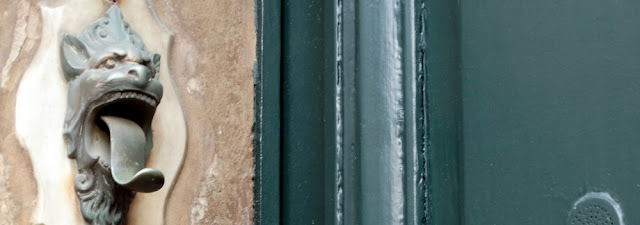
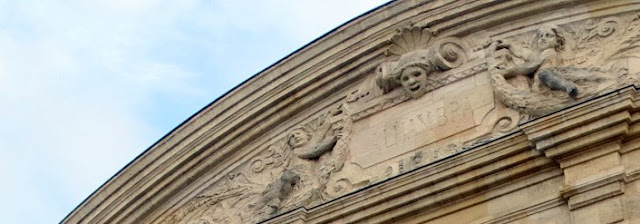
Hundreds of sculpted masks, or “ mascarons ” (from the Italian “ mascherone ”), can be seen on the exteriors of buildings in Bordeaux. ...
New video: the 'mascarons' on Place de la Bourse
A blog such as Invisible Bordeaux is, in essence, a linear compilation of content with articles stacked up in chronological order, with ...
You are here: browse the Invisible Bordeaux map!
A blog such as Invisible Bordeaux is, in essence, a linear compilation of content with articles stacked up in chronological order, with the most recent items given priority homepage treatment.
Bordeaux’s wartime history remains an opaque affair. Throughout that dark period, the city was the scene of many events, some of which ...
Le Juif et la France: when the anti-Semitic propaganda exhibition came to wartime Bordeaux
![]() |
| Outside the Palais Berlitz event in Paris, photo source: www.cndp.fr |
To gain widespread public support among France’s non-Jewish population, the regime resorted to various propaganda drives that stigmatised Jews. These initiatives included the Le Juif et la France exhibition which was first held at Palais Berlitz on the boulevards in Paris from September 5th 1941 to January 15th 1942. The exhibition was organised by IEQJ, the Institut d’Études des Questions Juives, a body which was financed by the German embassy in France and overseen by Nazi security and propaganda services.
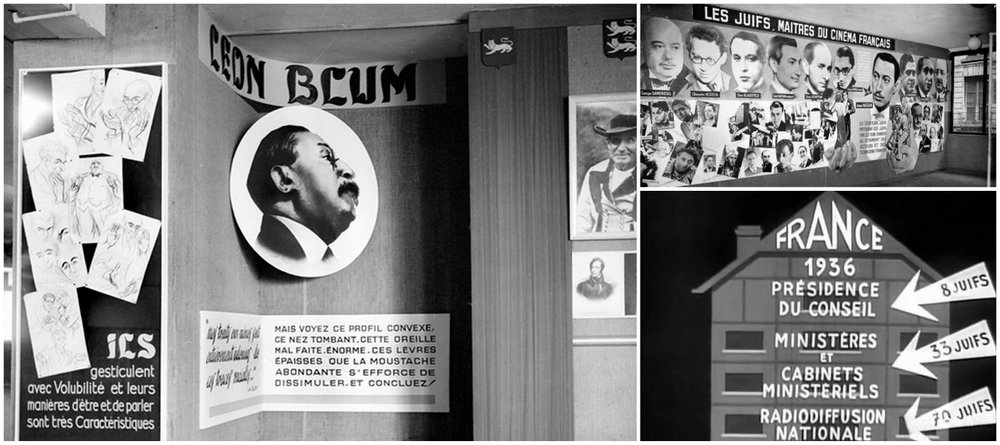
The exhibition sought to highlight the stronghold that Jews had secured within institutions and economic sectors throughout France. In addition, to help citizens become more effective in recognising the “enemy”, the exhibition provided a beginners’ guide to the physical features of Jews. It also went beyond these stereotypes to point fingers at emblematic individuals who were showcased on large panels, such as the furniture seller Wolff Lévitan, radio journalist Jean-Michel Grunebaum, playwright Henri Bernstein and the politician Léon Blum.
![]() |
| Some of the displays from the Paris leg of the exhibition, picture sources: aufildelhistoire.u.a.f.unblog.fr, parisenimages.fr and voir-et-transmettre.fr |
Significantly, the Bordeaux event was held in a wing within the grounds of the city hall, where the Musée des Beaux-Arts can now be found. The building had already served a similar purpose in May 1941, when it hosted an exhibition entitled “L’Allemagne de nos jours”, aimed at raising awareness about German culture and industry, its centerpiece being a bust of Adolf Hitler surrounded by a colourful hydrangea bed.
The Bordeaux leg of the Juif et la France exhibition opened on March 28th 1942 and ran for six weeks until May 11th (the Nancy event later stretched from July 4th to August 2nd). Again, it is difficult to establish reliable attendance figures but it is thought that over 60,000 viewed the exhibition in Bordeaux, including children from all local schools. The IEQJ's short-lived official publication, Le Cahier Jaune, later saluted the figure, equating it to 20% of the 300,000 living in and around Bordeaux at the time.
Along with the static exhibits, a makeshift cinema was set up under canvas in the gardens of the hôtel de ville, showing films including “Le Péril Juif” and “Les Corrupteurs”, and no less than three conferences were held each week.
![]() |
| The "cinéma permanent" and the same scene today. |
![]() |
| The entrance to the exhibition (as also pictured in the lead photo at the top of the article), and the view today. |
![]() |
| A closer look at the disturbing illustration that promoted the exhibition. Source: http://paril.crdp.ac-caen.fr |
In this instance, as so often when relating these wartime tales, what went on seems to be the unbelievable end-product of some unrecognisable parallel universe. And yet the setting is so familiar and so recent that it makes for chillingly painful reading. Then again, perhaps we need more stark reminders of these past events right now…
- https://www.histoire-image.org/etudes/exposition-juif-france-paris
- http://www.gauchemip.org/spip.php?article8812
- http://rue89bordeaux.com/2015/05/13-mai-44-dernier-convoi-bordeaux-auschwitz/
> Photos from the Bordeaux event extracted from report in IEQJ publication Le Cahier Jaune, archived by the Centre de documentation juive contemporaine (report featured in Adrien Marquet, les dérives d'une ambition).
> Ce dossier est également disponible en français.
Invisible Bordeaux recently came across one of the city’s most unusual – and, it turns out, controversial – permanent art installatio...
La Maison aux personnages: art house in the middle of our street
The exhibit is the work of Russian artists Ilya and Emilia Kabakov and was unveiled in October 2009: it consists of a two-storey house comprising a number of rooms, each of which has been designed and filled with scenery and accessories to look like it is inhabited by an imaginary character. Visitors can tour the exterior of the house, peek in through the windows (including the upstairs room which can be reached via an outdoor staircase), and take in the various still-life scenes, with poetically-worded panels about the associated characters there to provide additional context and pointers.
| This is la Maison aux personnages, although at first glance there is nothing to suggest the house is a permanent artistic installation. Pellegrin hospital can be seen to the left. |
All of which leads us on to one of the most surprising aspects of the installation: remarkably, the 148-square-metre air-conditioned house and its garden were purpose-built to become this artistic exhibit. Working to the designs drawn up by Ilya and Emilia Kabakov themselves (some of the original sketches can be viewed here) and inspired by the characteristics of Bordeaux’s échoppes and townhouses, the building was conceived by the architects Samira Aït-Mehdi and Sylvain Latizeau, and delivered by the contractors DV Construction.
Given the expense involved (somewhere in the region of 500 to 600,000 euros), the project has proved controversial. The politician Emmanuelle Ajon, a Bordeaux city councillor and Gironde department vice-president, condemned the venture by writing that it was “indecent to let homeless people look in on what it is like to have a roof, and to spend 560,000 euros on a house which will only ever be exhibited and never occupied”.
| Peering inside. |
Which, appropriately enough, is where Invisible Bordeaux steps in: I braved the elements to plot my way through the traffic across to the house, in order to report back on what there is to see through the windows. So here goes: I think the most interesting rooms to view were those entitled “En barque sous les voiles” (which includes a pretty wooden sailboat), “La soif d’inventions” (which appears to be a mad professor’s workshop, complete with illuminated fairy lights and a lot of work in progress) and “Ne jamais rien jeter” (with its collection of collections, i.e. hundreds of labelled items, along with a number of suspended objects and little cards with open questions to the viewer written on them). Of the others, “Le paradis sous le plafond”, in the upstairs room, featured little more than an armchair and a ladder to nowhere – it felt a bit overly minimalist and underwhelming. Most of the remaining rooms were more conventional living and sleeping quarters, and looking inside did feel a little voyeuristic, if you can picture a voyeur also standing there scratching his head about the meaning of it all.
![]() |
| Four of the rooms: "En barque sous les voiles", "La soif d'inventions", "Ne jamais rien jeter" and "Le paradis sous le plafond". |
![]() |
| The Kabakovs, picture source: artnet.com |
The couple have worked together ever since and have earned distinctions including France’s Chevalier des Arts et des Lettres in 1995 and Austria’s Oskar Kokoschka Preis in 2002. Their work, which “fuses elements of the everyday with those of the conceptual” (according to artnet.com), has been exhibited in venues including New York’s Museum of Modern Art, the Stedelijk Museum in Amsterdam and the State Hermitage Museum in St Petersburg. The Bordeaux installation is just one of many public commissions delivered throughout Europe and elsewhere.
> Ce dossier est également disponible en français !
We’re in Mérignac, between the Pin Galant concert hall and its associated tram stop and, yes, that might just be a massive sculpture re...
Mérignac’s 4:1-scale tracksuit bottoms and moccasins
This unusual public artwork is entitled, aptly enough, "Pantalon de jogging et mocassins à pampilles". It was officially unveiled on July 12th 2014 and was produced by the artistic duo Daniel Dewar and Grégory Gicquel. It was commissioned as part of a programme to install art pieces at points alongside Bordeaux metropole’s tramway network, within the wider framework of an initiative coordinated by France’s culture ministry and the Aquitaine region’s departments for artistic creation and cultural affairs. So there.
The piece is a good four metres tall (yes, the artists opted for a grand 4:1 scale). Working our way up from the bottom, at its base is a 90-centimetre plinth made out of black granite from Lanhélin in Brittany. The tasteful leather-like moccasins and their tassels are made out of polished ochre-red marble, specifically Caunes-Minervois marble from the Languedoc region. They are topped off by the elegant tracksuit bottoms, complete with practical tie-up waist belt and handy back pocket, carved from a block of grey granite from the Côtes d’Armor area of Brittany.
![]() |
| Details from the piece. You have to admit that both the loafers and trousers do look extremely comfortable and practical. |
![]() |
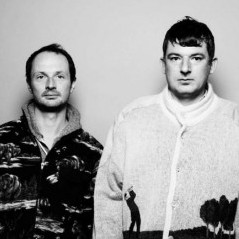
| Grégory Gicquel and Daniel Dewar, picture source: www.actuart.org |
There is definitely a touch of tongue-in-cheek humour in Dewar & Gicquel’s portrayal of the functional tracksuit bottoms and moccasins, both of which are items of clothing that manage to be seemingly timeless while simultaneously drifting in and out of fashion. The morning I was there was the day that Cuban leader Fidel Castro died, so viewing a gigantic pair of tracksuit trousers seemed to be a highly appropriate way to spend some time. Whatever, the piece is an oddball and surprising addition to the Mérignac landscape, so look out for it the next time you’re in the area!
| The trouser-shaped sculpture is clearly visible from line A trams. |
It's been another interesting twelve months feeding the beast that is Invisible Bordeaux, with highlights including some memorable ev...
Farewell 2016: the year’s most-read Invisible Bordeaux items
Every day, thousands of vehicles drive along Quai de Paludate and past Château Descas, which is simultaneously one of the most spectacul...
Château Descas: the wine merchant’s warehouse turned nightclub... which is now an empty shell
Every day, thousands of vehicles drive along Quai de Paludate and past Château Descas, which is simultaneously one of the most spectacular and one of the most mysterious buildings in central Bordeaux. I thought it might be interesting to investigate the subject!
Although the central section of the building currently lies empty, it is best known as having been the eponymous offices and wine cellar of the wine merchants Descas, whose founder Jean Descas (1834-1895), an Entre-Deux-Mers wine barrel manufacturer turned trader (and also the mayor of his hometown Camiran), first installed his then 20-year-old company here in 1881. The location was strategically close to Saint-Jean train station, giving him easy access to the burgeoning railway delivery network, and thus an extra edge over his counterparts who were traditionally positioned further north in the Chartrons district. This decision was also compounded by Descas’s focus on supplying affordable wine to customers in France, while the Chartrons players built their wealth on the high-end export market.
The property acquired at an auction by Jean Descas had, since 1661, been home to the city’s first general hospital, Hôpital de la Manufacture, the ancestor of today’s “CHU” (Centre Hospitalier Universitaire). For many years the establishment also provided a safe haven for abandoned children, with a peak of just under 900 being accommodated around the time of the French Revolution in 1789.
![]() |
| The way it was: Hôpital de la Manufacture in an 1830 portrayal by the lithographer Légé; picture borrowed from http://bordeauxmaritime.free.fr, the website which was expertly curated by the late, great Hervé Guichoux. |
![]() |
| Plenty to spot, from the lookout tower to Jean Descas's initials, and the face of a man who appears to be surrounded by a full year's supply of grapes. |
The company and its château warehouse continued to go from strength to strength for the best part of a century, until they were taken over by the Merlaut family in 1979. Descas’s assets were relocated to the right bank of the Garonne and a modern-day warehouse just off Quai de Brazza. This remains Descas’s head office and is where its director Denis Merlaut monitors the group’s many contemporary business interests, which range from wine production and trading to the ownership and rental of business units.
| Mercury and Vine. |
Then the château was turned into a short-lived disco known as le Rikiki Palace, which hosted DJs including Bob Sinclair. The following, final nocturnal incarnation was le Mystic, a “restaurant-club” described by observers as a “haunted venue” where little people manned the door and, even more bizarrely, a gigantic animated mask served as master of ceremonies. Business ceased in 2007.
And, ever since then, an ugly legal battle has been underway between Descas and Bordeaux city council over unauthorised structural work carried out inside the building (which included the complete gutting and removal of the third floor), as noted when the municipality’s lease expired in 2003. Descas are claiming damages of 6 million euros to get the premises back into shape, although the ongoing legal efforts have been undermined by the use of the building beyond 2003 to house Rikiki Palace and le Mystic.
Which brings us to the present day’s empty shell, albeit one which is flanked by two wings which are occupied by various companies, associations and even a bar, le Point Rouge, not to mention the swish old people’s residence which has gone up behind the château, sandwiching what GoogleEarth would suggest is a pleasantly symmetrical garden/square.
![]() |
| The current view from GoogleEarth. The next time I go back I'll try heading round the back via rue... Jean Descas! |
![]() |
| This aerial view from sometime between 1950 and 1965, as featured on the fantastic http://remonterletemps.ign.fr website, clearly shows the extensive warehouses behind the château. |
![]() |
| Ground-floor trompe-l'oeils: Ceci n'est pas une fenêtre. Et ceci n'est plus un restaurant club. |
| A naughty look at the inside view where work appears to be in progress in between the marble columns. |
> Ce dossier est également disponible en français !
One sight which is visible from most points along the waterfront in central Bordeaux is the Bouliac radio mast, the tallest man-made st...
Pylône de Bouliac: the vertical line on Bordeaux’s horizon
The mast goes by a number of names according to where you look: antenne TDF (which originally stood for TéléDiffusion de France), pylône TDF or pylône de Bouliac. You might think that one thing that cannot be disputed is its height, but even that information differs in places! Most sources record it as measuring 252 metres, some round it down to 250 metres while others downgrade it to a lowly 232 metres. Whichever figure it might be, if you can picture the Eiffel Tower, the Bouliac mast tops out at the equivalent of a bit above mid-way between the second and third platforms.
![]() |
| This is kind of how things would look if the Bouliac mast was in central Paris. (Eiffel Tower picture source: Wikipedia.) |
The mast was first installed in 1957 and was soon ranked as one of TDF’s seven main transmission masts; illustrious counterparts on that list include the aforementioned Eiffel Tower and the Pic du Midi in the Pyrenees. The pylon was replaced in 1988 but, that short overhaul period aside, the antenna has been a permanent fixture on the Bordeaux skyline for almost 60 years. Around 1 million people are served by the signals it emits, either directly or via one of six relay antennae that are strategically positioned throughout Gironde (Arcachon, Bordeaux Caudéran, Langoiran-Portets, Latresne, Lesparre and Soulac).
![]() |
| Close-up views of parts of the mast including the tip and the base. |
Anyway, as you gaze upstream along the Garonne river taking in the waterfront, the Miroir d'Eau, the buildings and the bridges, do not forget to gaze upwards towards Bouliac, the balcony of Bordeaux and the TDF mast!
| Yes, that's our pylon over there on the left, beyond the Miroir d'Eau and the Pont de Pierre. |
> Clicking here will take you through to Wikipedia's guide to the tallest structures in France
> Cet article est également disponible en français !
Congratulations Charlotte Grandjean, who is the winner of the competition which ran on social media to celebrate Invisible Bordeaux...
#InvBdx5, the fifth anniversary competition: and the winner is...
Charlotte, a Dane living in Marseille who took part in the competition on Facebook, wins two nights’ bed and breakfast accommodation for two people at Novotel Bordeaux Lac, along with two 2-day Bordeaux Metropole CityPass tickets, offering unlimited travel on public transport and reduced rates for guided tours and admission to museums.
A few weeks ago, reader Conchi shared a link on her Facebook page which led to the Institut National de l'Audiovisuel 's websit...
New video: 'Welcome Arthur', the 2016 remake
A few weeks ago, reader Conchi shared a link on her Facebook page which led to the Institut National de l'Audiovisuel's website and a delightful if somewhat bizarre short film entitled "Welcome Arthur".
In the days that followed the recent publication of a piece about the Alhambra concert hall , I was struck by the number of stories share...
Philippe Serra's Alhambra scrapbook
Many of the tales I read were recounted by Philippe Serra (pictured left), one of the contributors to a benchmark book about the local music scene, Denis Fouquet's "Bordeaux Rock(s)". For Invisible Bordeaux, Philippe kindly agreed to talk us through some of the events he attended at this iconic venue, in some cases drawing on his draft memoirs of the 1962-1972 period. Here then are a number of snapshots that will take us back through time, but in each case the backdrop remains the same: we give you the Alhambra.
October 1963: Gene Vincent
"I attended this concert more out of curiosity than because I was familiar with the artist. It turned out to be a pleasant surprise. He may have limped but he was full of energy, clad in leather yet demonstrating heightened sensitivity, he boasted a distinctive and yet almost inexplicable stage presence. At the time we hadn't begun to regularly use the word "charisma", but that is certainly what it was. In my post-war childhood years I had admired Line Renaud before becoming a jazz enthusiast, and I hadn't exactly been drawn to rock'n'roll. By the time I left the Alhambra that night, I had become a rock'n'roll convert, although my faith was still very fragile!"
![]() |
| Chuck Berry, hooked up to his 30-watt Vox amp. (Picture courtesy of Christian Perez) |
"This was an unmissable event! Memphis Slim, Ronnie Bird, Antoine and Chuck Berry. I was astonished by the latter's energy combined with his notable economy of means: Berry's red Gibson guitar was plugged into a small 30-watt Vox amplifier that wasn't even fed through the house PA. Then again, the Alhambra PA was probably no more powerful than Chuck's Vox amp! Rock concerts still retained a music hall format at the time, with a support bill comprising a host of artists. You would sometimes even see tightrope walkers! If my memory serves me well, the Chuck Berry show opened with a performance by a foot juggler…"
November 1967: Pierre Henry
"Pierre Henry was like some kind of DJ beamed in from the next century, setting up his tape players, mixing desks, amplifiers and what seemed like generators, inside a boxing ring positioned in the middle of the Alhambra's Casino hall. His attitude was unpretentious and down-to-earth, even though he was piecing together an other-worldly concert. Sound was fed through ten separate channels into groups of speakers that formed a sort of magic circle surrounding listeners lying on mattresses. I was there ahead of the event and helped out as best I could with the final fine-tuning, which involved hanging huge sheets from the ceiling down to the floor at strategic points, so as to improve the acoustics of the cube-shaped venue. On the night of the performance, no doubt distracted by the large crowd of excitable youths, I barely noticed that the whole set-up had been shifted into the Alhambra's other hall! Despite its oblong shape, the permanent stage and the balcony which ran around the three other sides, it turns out that the theatre was a better match for the perfect sound which was sought than the ballroom where we had put all our efforts into setting things up.
"This was the bravura piece of the outrageous Living Theatre company. They made use of a huge amount of scaffolding which no doubt accounted for much of the ten tons of equipment that their leader Julian Beck spoke of in interviews about the show. This new interpretation of Mary Shelley's classic tale was ideally designed to provide its receptive audience with an unforgettable experience by unparalleled theatrical performers."
November 1969 > Soft Machine
"The Alhambra was almost an embryonic multiplex with its hall, its bar, its lobbies and its two main venues: on one side there was the casino which, other than its small stage featured nothing but a dancefloor; while to the other side was the concert and theatre hall. The large door which separated the two was almost always closed. On this occasion it was open, enabling the public to mill between the two venues to enjoy the "Guinch Experiment" that formed part of the Sigma 5 arts festival. Music-wise, two groups were on the bill: Soft Machine and the Ronnie Scott Band. The use of the twin stages meant the bands could perform simultaneously. The stalls had been removed from the theatre and in the middle of the venue there was a massive inflatable installation that had been conceived by the visual artist Jeffrey Shaw. But I didn't get to see much of the band there as I only had eyes for Soft Machine, who were performing next door. The floor of that venue was entirely covered with balloons and, incredibly, mid-way through the performance, an elephant suddenly appeared; its sole task appeared to be that of going about bursting the balloons! You can imagine the chaos that ensued! Of course, I might not have been quite so surprised at this turn of events had I seen the elephant (on loan from a travelling circus) promoting the unforgettable show in the streets of Bordeaux that afternoon. My most vivid memory of the concert is an intense 20-minute drum solo by a bare-chested Robert Wyatt, who had been given completely free musical rein by his bandmates.
![]() |
| Left: the Ronnie Scott Band with large inflatable contraption (Sigma archives). Right: Robert Wyatt mid-solo (photo: Anne Lafosse). |
November 1979 > The Stranglers
"This was a couple of years before the release of Golden Brown, but there was already a sense that the Stranglers' punk sound was making way for a more tuneful approach. I listened carefully to this fine band and enjoyed them thoroughly, but I kept a particularly close eye on Jean-Jacques Burnel's legwork. This wasn't because he was the group's resident Frenchman but rather because he was the bassist, and I'd taken up that very instrument. Bordeaux musicians, whatever their level of proficiency, made a point of coming to the Alhambra which for long had been the perfect place to admire the greats, and perhaps to borrow, more or less consciously, new things from them in this permanently-evolving world of rock culture!"
![]() |
| Concert ticket including the "quartet" reference. (Philippe Serra collection) |
"I appreciated the all-round versatility of the fine guitarist Larry Coryell, who was back in an acoustic period. I had even enjoyed him as a singer on the album The Real Great Escape, but the concert ticket had this date enigmatically billed as the "Larry Coryell quartet". As it turned out, alongside Larry there was another six-string virtuoso, Philip Catherine and even, I seem to recollect, a third guitarist, namely the impressive Paco de Lucía. It was an absolute delight! The Alhambra, in keeping with the Granada reference of its name, always knew how to spring surprises on its audiences!"
November 1981 > Indoor Life, Rita Mitsouko and Bernard Szajner
![]() |
| Bernard Szajner and his laser harp. (Source/photographer unknown) |
![]() |
| Cover of the tour programme. (Philippe Serra collection) |
"This fashionable record label offered a great lineup of artists on a tour that went by the name of "Some of the interesting things you'll see on a long-distance flight". It included Tuxedo Moon vocalist Winston Tong (from San Francisco), Manchester's The Durutti Column, Richard Jobson (London), Paul Haig (Edinburgh) and the Parisian band Antena. Of the bunch, the one I remember best is Durutti Column, which was essentially the project of a solo performer on guitar. This reminded me of an expression I'd often heard in my youth: "Every Englishman is an island". And I believe that it was, for the punter that I was, my final gig at the Alhambra. "
- Massive thanks to Philippe Serra for this fabulous trip back in time!
- Find it on the Invisible Bordeaux map: L'Alhambra, rue d'Alzon, Bordeaux
- Ce dossier est également disponible en français !


Follow/contact