While the Garonne
river naturally represents the eastern flank of the heart of Bordeaux, the remainder of
the central city’s modern-day boundaries are formed by a semi-circular succession of wide boulevards which took
shape from 1853 onwards. With the development of the boulevards came the
construction of offices whose duty it was to collect an ancient and generally unpopular
tax, the “octroi”.
Arlac is a quiet residential district in the suburb of Mérignac, and nestled in amongst the houses and cornershops is a concert venue whi...
Arlac is a quiet residential district in the suburb of Mérignac, and nestled in amongst the houses and cornershops is a concert venue which, since 1990, has been an essential port of call for many of the leading names in contemporary music: the Krakatoa.
The “Krakatoa” moniker is particularly relevant; it refers to a volcanic island between the islands of Java and Sumatra in Indonesia. When the
volcano exploded in 1883, killing 40,000 people, the roar was
considered to be the loudest sound ever heard in modern history, with
reports of it being heard nearly 5,000 kilometres from its point of
origin. Krakatoa concerts aren’t quite that loud, but you get the idea…
This impressive figure is Francisco José de Goya y Lucientes (1746-1828), or simply Francisco Goya, the Spanish artist who left an ind...
This impressive figure
is Francisco José de Goya y Lucientes (1746-1828), or simply Francisco Goya, the Spanish artist who left an
indelible mark on Bordeaux, having spent the last four years of his life in the
city.
The bronze statue is a replica of the 1902 work by Mariano Benlliure which stands outside the Goya entrance to the Museo del Prado
in Madrid. It was a gift from the city of Madrid (one of the twin
cities of Bordeaux) in March 1995 and was originally positioned in the
Jardin Public. In 2008, the statue was relocated to Place du Chapelet,
just outside the main entrance to Cour Mably and just metres away from
Notre-Dame church, where Goya’s funeral took place.
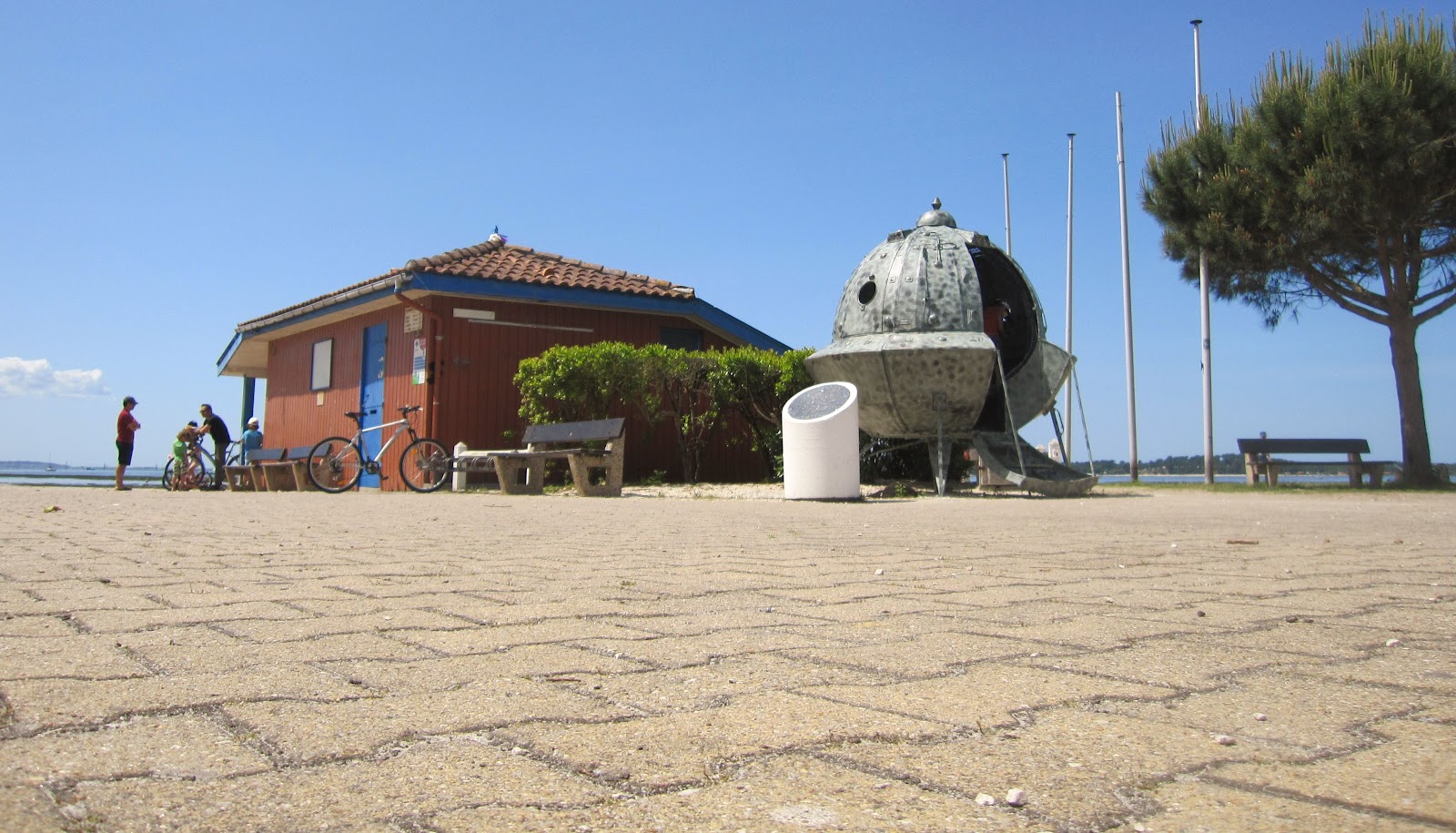
[ A revised version of this article was published in 2016 subsequent to the arrival of a new spacecraft structure. ] Arès is a quiet reso...
Arès is a quiet resort towards the northern tip of the triangle formed by the Bassin d’Arcachon which, for nearly 40 years, has maintained a designated waterfront landing pad for unidentified flying objects.
The story began on August 15th 1976 when the so-called “ovniport” (OVNI: objet volant non-identifié)
was officially inaugurated as one of the highlights of that year’s
oyster festival. The idea, which at the time got extensive coverage in
the media (most notably the United States), had originally been dreamt up by a group of locals led by one
Bob Cotten, a Mérignac airport employee who, as well as being a
renowned expert in electronics, was a UFO enthusiast who claimed to
be disgruntled by the lack of landing facilities for alien spacecraft.
Le Haillan (population 10,000) is a quiet residential suburb to the north-west of Bordeaux and is arguably best-known for its château ...
Le Haillan (population 10,000) is a quiet residential suburb to the north-west of Bordeaux and is arguably best-known for its château, which is the headquarters and training centre of local top-flight football team Girondins de Bordeaux. Down the years, the town has also developed ties with three twin towns elsewhere in Europe, and these links are celebrated in a series of landscaped roundabouts.
Arcachon’s La Salesse villa was built in 1854, making it one of the oldest properties in the town. And it played a bit part in the mave...
Arcachon’s La Salesse villa was built in 1854, making it one of the oldest properties in the town. And it played a bit part in the maverick career of the Spanish surrealist painter Salvador Dalí.
In 1936, Dalí fled his native Spain, which was in the midst of a civil war. For the next three years, he and his wife Gala divided their time between London, New York, Paris and fashion designer Coco Chanel’s residence in Roquebrune on the French Riviera. By 1939, the travelling was taking its toll though and war was looming large. Dalí and Gala headed to the Pyrenees for some downtime, staying near the Spanish border at the Grand Hôtel in Font-Romeu (although Dalí later noted that for him “to rest meant to immediately begin to paint 12 hours a day”). But their hotel suite was commandeered by the Chief of Staff of the French army who was in town to inspect border fortifications. Dalí and Gala elected to head to Paris.
Once there Salvador unfolded a map of France and “studied my winter campaign, trying to plan it in such a way as to combine the possibility of a Nazi invasion with gastronomical possibilities”. Putting his finger as close as possible to the Spanish frontier “and at the same time on a neuralgic point of French cooking” he ended up pointing at Bordeaux, “one of the last places the Germans would reach if they should win. Moreover Bordeaux naturally meant Bordeaux wine, jugged hare, duck liver aux raisins, duck aux oranges, Arcachon Claire oysters…” The penny dropped: Arcachon would be Dalí’s choice for his wartime refuge.
The Dalís arrived around late August/early September 1939, just days before the Allies declared war on Germany, and stayed in this colonial-style villa which they rented from one Henry Calvé of Bordeaux, who later turned down Dalí’s offer of a portrait in gratitude.
At the time, the villa wasn't locked in by neighbouring buildings. The scene looked more like this and this, as featured on visuel.free.fr.
The villa boasts its own little panoramic belvedere, a no doubt excellent vantage point to take in the view over Arcachon bay!
It was not all work though. Dalí would take time out to decorate seashells brought to him by local children. And with next-door neighbour, fellow surrealist painter Leonor Fini, the Dalís would often eat out at restaurants in Bordeaux and go sight-seeing locally. They are pictured below with surrealist writer André Pieyre de Mandiargues at Villa Salesse and on the Dune du Pilat.
Left-right: Gala, Salvador Dalí, Leonor Fini and
André Pieyre de Mandiargues (source: leonor-fini.com)
Left-right: Salvador Dalí, André Pieyre de Mandiargues,
Leonor Fini and Gala.
It is thought that the Dune inspired the sandy background of the painting “Two Pieces of Bread Expressing the Sentiment of Love”, the chess pawn of which is a reference to the games of chess Gala played in Arcachon with artist and writer Marcel Duchamp while Dalí painted.
With the Germans making headway in France though, the Dalís decided to make a move once again, barely six months after arriving in Arcachon. They spent “a sinister day” in Bordeaux as German bombs fell nearby, obtaining visas (numbers 2519 and 2520) to leave the country from Portuguese consul Aristides de Sousa Mendes, and fled into Spain shortly before the bridge in Hendaye was seized by the invader. After a short time spent back in Spain and Portugal, the Dalís relocated to the United States, where they went on to spend eight years.
Meanwhile, back in Arcachon, little or no trace of their brief passage remains… but wouldn’t it be great to find out what became of those children’s seashells!
> Much of the information in this piece was loosely adapted from a post on the excellently-named Dali Planet website, which sadly appears to be no more but nevertheless deserves a posthumous credit here. The Dalí quotes are extracts from the artist’s 1942 autobiography “The Secret Life of Salvador Dalí”. > A recommended guide to Salvador Dalí's life and career can be found here: https://salvador-dali.info/
The distinguishing features of Place Stalingrad, known until 1946 as Place du Pont given its proximity to the Pont de Pierre, include t...
The
distinguishing features of Place Stalingrad, known until 1946 as Place du Pont
given its proximity to the Pont de Pierre, include the large, modern sculpture of a lion (designed by the French artist Xavier Veilhan with a little help from some
computer software), one of the seven cast-iron Wallace drinking fountains to be spotted around the city, and a building which now comprises 13 luxury flats and a
ground-floor restaurant. This building used to be known as Théâtre Alcazar.
The sixty-kilometre cycle path that runs from Bordeaux to Lacanau provides a practical, if somewhat flat and linear, mea...
The sixty-kilometre cycle path that runs from Bordeaux to Lacanau provides a practical, if somewhat flat and linear, means of getting to the Atlantic coast by pedal power alone. And, like many cycle paths, it used to be a railway line.
The railway line was built in the 19th century, forming part of a network of routes run by Société Générale des Chemins de Fer Économiques. The network was primarily designed to easily ferry maritime pinewood from its native Médoc to other parts of the Bordeaux region, ahead of the focus shifting to passenger traffic. One line ran north to south from Lesparre-Médoc to Saint-Symphorien, a second covered a south-western diagonal from Hostens to Beautiran, and this third line connected Bordeaux to Lacanau.
This statue of Toussaint Louverture ( see part 1 for the story behind the subject matter ), which is gazing downstream along the Garonne ...
This statue of Toussaint Louverture (see part 1 for the story behind the subject matter), which is gazing downstream along the Garonne river, is positioned opposite the quay from which ships set sail between 1672 and 1837, on the first legs of 508 triangular slave trade voyages that resulted in 150,000 Africans being deported to the Americas.
Bordeaux was not alone. In France - which ranked solely behind Great
Britain and Portugal in terms of the scale of its slave trade - the city
of Nantes organised 1,744 expeditions, and the ports of La Rochelle and
Le Havre were on a par with Bordeaux.
Before the triangular voyages began (they peaked in the 1780s), the boats departing from Bordeaux conducted straightforward two-way commerce with the Caribbean. Boats would carry wine, oil and flour, all of which would be exchanged for local produce.
With the onset of triangular trade, vessels would leave from Bordeaux loaded with foodstuffs, cloth, arms and trinkets which, upon arrival on the eastern coast of Africa six to eight weeks later (the “outward passage”) would be exchanged for slaves. The dangerous middle passage would then follow, with the slaves being ferried in inhumane conditions to the colonies, mainly Saint-Domingue as far as the Bordeaux ships were concerned. The death rate on board the boats was between 10 and 20 per cent.
Upon arrival, the (surviving) slaves would be sold or auctioned off and set to work on the plantations where the average life expectancy was a lowly five to six years. Meanwhile, the boats would embark on their return passage to Bordeaux carrying sugar, cocoa, tobacco, cotton and other produce, making a substantial contribution to the city’s wealth.
Until the mid-1990s, this inconvenient chapter in the city’s history was more often than not glossed over. But, in recent years, Bordeaux has begun to come to terms with its past, hence the unveiling of this statue of Toussaint Louverture (who also has a cul-de-sac named after him, as pictured above), as well as a plaque on the Quai des Chartrons acknowledging the memory of the slaves whose destinies were dictated by the boats that departed from that spot.
The plaque reads: "It is from
here that the first slave trade vessel
departed from Bordeaux at the end of the 17th century. Several hundred voyages followed suit until the 19th
century. The city of Bordeaux honours the memory of the African slaves who were
deported to the Americas with disregard for their human rights."
Another notable development has been at the Musée d’Aquitaine, which now has a permanent exhibition dedicated to the city’s links with the slave trade. Finally, in early 2012, the renaming of a section of the Garonne-side pathway as Promenade Martin Luther King Jr., in recognition of the achievements of “this emblematic figure in the fight for equality, civil rights and diversity” (in the words of the official press release), was in keeping with the municipality’s desires to wrong the rights of the past.
Many of these moves can be attributed in part to the tireless campaigning of an organisation formed in Bordeaux called “Fondation du Mémorial de la Traite des Noirs” (the Slave Trade Memorial Foundation, originally known as “Diverscités”). Other achievements include the backing of an authoritative book by the retired historian and teacher Danielle Pétrissans-Cavaillès entitled “Sur les traces de la traite des Noirs à Bordeaux” (“Following the tracks of the Slave Trade in Bordeaux”). Ongoingprojects include a large-scale permanent national memorial in Bordeaux (which was initially green-lighted but has stalled in recent years), as well as lobbying efforts to raise awareness of street-names that refer to people who played a part in the slave trade.
In Bordeaux these include Rues Saige and David-Gradis, and Cours Balguerie-Stuttenberg, and there are similar examples in Le Havre, Nantes, La Rochelle, Marseille, Honfleur and Dunkerque. The organisation is calling for the street-names to be changed or, at the very least, for some form of clarification to feature on the street signs. The official line in Bordeaux is that the street-names honour families that have made substantial contributions to civic life over the years and who “must not be stigmatised” because of their part in the slave trade.
In any case, at least the slave trade subject is out in the open in the modern-day incarnation of Bordeaux, and no longer brushed under the carpet as it was in the recent past. It will be interesting to see whether I have to return to this article in the coming months and years to make further updates on the situation...
This statue of François-Dominique Toussaint, better known as Toussaint Louverture, was donated to the city of Bordeaux by the Republic of Haiti in 2005. The subject matter of this work, sculpted by Haitian artist Ludovic Booz, and its riverside location are heavy with significance, forming an important step on the road to Bordeaux coming to terms with its slave trade past.
On a quiet side street in the right-bank quarter of La Bastide, all the available space on the façade of an otherwise unassuming building...
On a quiet side street in the right-bank quarter of La Bastide, all the available space on the façade of an otherwise unassuming building is filled with a host of inscriptions: welcome to the Crèche de la Bastide.
The Crèche was founded in 1891 by the local dignitary Charles Cazalet (1858-1933), at one time deputy mayor of Bordeaux. This successful wine trader was seeking to give something back to the district where he was born and brought up.
If you’re not afraid of heights, and are both willing and able to climb a few steps, the Observatoire Sainte-Cécile in Arcachon’s Ville...
If you’re not afraid of heights, and are both willing and able to climb a few steps, the Observatoire Sainte-Cécile in Arcachon’s Ville d’Hiver quarter will reward you with one of the finest possible views over Arcachon bay.
This observation tower, completed in 1863, was the brainchild of Paul Regnauld. Regnauld, who was also the man behind the casino in the nearby Parc Mauresque, was an engineer with the railway operators Compagnie des Chemins de Fer du Midi, owned by the brothers Émile and Isaac Pereire, who did much to promote and develop the town of Arcachon. Regnauld was also behind the conception of the first wave of elegant villas in the Ville d’Hiver quarter, as well as designing a railway bridge in Bordeaux, the 1858-1860 construction of which was led by a young man called Gustave Eiffel.
The sun rises over the Garonne and above the familiar arches of the 19th-century Pont de Pierre … flanked as ever by the more angular silh...
The sun rises over the Garonne and above the familiar arches of the 19th-century Pont de Pierre… flanked as ever by the more angular silhouette of the Benauge fire station or, to give it its full title, the Centre d’Intervention et de Secours de la Benauge.
The building, designed by the architects Claude Ferret, Yves Salier and Adrien Courtois, was completed in 1954 and has struggled to gain acceptance from a city that traditionally warms more easily to classical architecture. Over the years, there has even been recurring talk of tearing down the building but, in 2008, it was awarded a “Patrimoine du XXe Siècle” label, officially registering its status as an example of 20th-century heritage to be preserved - a proud victory for the many people who have become attached to the presence of the fire station.
Bordeaux is not a city that is naturally associated with bullfighting and yet for many years it had its very own Plaza de Toros in ...
Bordeaux is not a city that is naturally associated with
bullfighting and yet for many years it had its very own Plaza de Toros in the
north-western suburb of Le Bouscat. And even today, the bullfighting
tradition lives on in nearby La Brède once a year.
Let’s begin though by rewinding to 1863, when a bullring was set up in the
Caudéran area of Bordeaux by a Spaniard named Lopez Vincent: les Arènes Bordelaises. A second, La Benatte, was opened in 1899 in the Saint Seurin quarter. They operated
until the early years of the 20th century, ahead of the more substantial
Arènes du Bouscat being opened on May 8th 1921.
The Le Bouscat venue’s 25 stands could hold 10,500 spectators and, as
well as being used for corrida meetings, the 41-metre-diameter ring was
also used as a backdrop for concerts and wrestling bouts. From 1951
onwards, under the impetus of the renowned promoter Vicente Jorda, a
prestigious bullfighting contest known as “L’Oreille d’Or” was held
annually.
Pictured right is the legendary bullfighter Antoñete at the Arènes du Bouscat in July 1953, on his way to winning the first of three “Oreille d’Or” titles (he also won in 1955 and 1956). Meanwhile, rare Pathé footage of a 1950 bullfight in progress can be viewed here.
The last “Oreille d’Or” contest was held on June 18th 1961, shortly before the venue was closed down. It had fallen into a state of disrepair and the coup de grâce was reportedly the collapse of a staircase that resulted in the death of a spectator. There were several attempts to save the arena but it was eventually demolished in 1970, making way for a major residential complex that is aptly known as “Les Arènes”. The centrepiece of Les Arènes is a 1974 pink
granite sculpture by Israeli artist Shelomo Selinger entitled “La Tauromachie” (see top picture), which harks back to the confrontations between man and beast that took place at that exact spot.
Bullfighting then faded into obscurity in the area until 1985, when meetings began to be held again in Captieux, 85 kilometres to the south of Bordeaux. Corridas are still organised there annually and frequently draw big-name matadors: in 2011, the star attraction was the world number one, El Juli.
Then, in 1988, a dismountable structure was erected in Floirac, in the immediate suburbs of Bordeaux. The venue, which prided itself in its status as the northernmost bullring in the world, was known as Plaza de Goya. The “temporary” 7,000-capacity structure remained in place for almost 20 years (!), before being auctioned off for 35,000 euros in November 2006.
The stands are now used in Fenouillet, to the north of Toulouse, although, at the time of writing, the Floirac arena was still visible on the GoogleMaps satellite picture of the area (right). The arena most definitely is no more though: apartments have now been built in its place and, as in Le Bouscat, the name of the building is a clear reference to the bullring history of its location: Résidence Plaza de Goya.
Meanwhile, in 1999, some 20 kilometres to the south of Bordeaux the small town of La Brède (the birthplace of the writer and thinker Montesquieu) began hosting well-attended bullfighting meetings as part of wider festivities known as la Fête de la Rosière in a temporary structure on an expanse of land known as Pré de l’Espérance.
For a time around 2004, as had already been the case in 1989, there was even talk of a permanent bullfighting venue being built in La Brède, whose mayor Michel Dufranc is a bullfighting enthusiast. But the project was not deemed financially viable by the prospective Spanish investors, who also backed out of a competing project in Floirac, no doubt to the delight of numerous local animal rights campaigners (such as the Collectif Girondin Contre les Arènes, or COGICA).
The La Brède festivities continue to take place every last weekend in June. The name of the event is in reference to the annual crowning (since 1824) of the “Rosière” that rewards the town’s “most virtuous young woman” (candidates are all aged 18). The bullfights are generally “novilladas”, combats between young toreros and young bulls, and the programme also features traditional “jeux de vaches landaises”, which are mayhem-filled contests that involve men (and sometimes women) running, jumping and employing improvised acrobatics around the ring to avoid getting hurt by visibly annoyed cows.
Pré de l'Espérance in the foreground, with La Brède's Église St Jean d'Étampes in the distance.
At the time of writing, there is talk of the municipally-owned land being used to build a privately-funded and privately-run multi-purpose venue that would incorporate its own dismountable 3,000-capacity bullfighting arena… but the project has not been welcomed with open arms by locals who have thus far been kept in the dark about the finer details of the venture. In the meantime, this is how La Brède goes about transforming the Pré de l’Espérance once a year:
> Find them on the Invisible Bordeaux map: 75, Avenue du Président Schuman, Le Bouscat, Rue Léo Lagrange, Floirac, Pré de l'Espérance, La Brède
> Read the French-language memories of two writers recalling events at the Le Bouscat and Floirac bullrings.
> And here is British Pathé footage of bullfighting in Bordeaux in 1950:
In the residential quarters of Bordeaux and its immediate suburbs, the streets are dotted with single-storey houses that all shar...
In the residential quarters of Bordeaux and its immediate suburbs, the streets are dotted with single-storey houses that all share a similar design, and yet are all somehow unique: échoppes bordelaises.
The word itself has Occitan roots, descending from “choppa”, which was used in reference to a shop or workshop. As far back as the 15th century, “échoppes” in Bordeaux provided a home and working environment for shop-owners and craftsmen. It is from the 18th century onwards that the city’s échoppes began to be used solely as townhouses, with the lion’s share of the city’s 11,000 échoppes being built between 1850 and 1930. In many districts, they were traditionally inhabited by the working classes (particularly near Saint-Jean station, where many of the railway workers, les cheminots, set up home), although over the years the social lines have become blurred – many are now clearly bourgeois townhouses.
One of the essentials on the city centre tour of Bordeaux is the central Place Pey Berland square and the 66-metre-tall Pey-Berland be...
One of the essentials on the city centre tour of Bordeaux is the central Place Pey Berland square and the 66-metre-tall Pey-Berland belfry, from which visitors can take in one of the best views of the “Port de la Lune”. But Pey Berland’s birthplace was actually a tiny hamlet on the territory of Avensan in the Médoc, 26 kilometres to the north-west of the city: Saint-Raphaël.
First things first though. Who was Pey Berland? Pey (Pierre, or Peter, in Gascon) was born in 1375 to a father who was a labourer from Avensan and a mother who was a peasant from Moulis. In spite of these humble roots, he was educated by a local notary before being sent to a clerical school in Bordeaux after the death of his father, then to university in Toulouse. Returning to Bordeaux, he became a priest in Bouliac to the south-east of the city around 1412. He went on to become secretary to the Archbishop of Bordeaux, travelling around France, Italy and England in this capacity, before Pope Martin V appointed him Archbishop of Bordeaux on August 13th 1430.
Mitt Romney, the Republican candidate defeated by Barack Obama in the 2012 US presidential elections, has often acknowledged his affi...
Mitt
Romney, the Republican candidate defeated by Barack
Obama in the 2012 US presidential elections, has often acknowledged his affinity with France and all things French. In this article and the twin feature on Invisible Paris, we lift the lid on Romney's French connections...
The language and the
knowledge of the country is something he picked up during a
two-and-a-half-year stint as a Church of Jesus Christ of Latter-Day
Saints missionary to France in the late 1960s, including six months
spent in Bordeaux. During that time he and fellow Mormon missionary Steven Bang lived in an
apartment at number 4, Place du Maucaillou, in the vicinity of the
ever-lively Capucins market. He was stationed there as a 20-year-old
from January 1968, after time spent in the northern cities of Le Havre
and Brest, and ahead of a six-month stay in Paris.
Agence France Presse recently quoted
79-year-old André Salarnier, the former head of the Mormon chapel in Talence, recalling Romney as being a “big and charismatic fellow” who
would “often come to our house for meals and lapped up my wife’s Breton
crêpes”... as well as her coq au vin according to some sources. Salarnier also remembers him as being a “natural leader and a
charming young man who was very open and very much a Francophile”.
On
top of the daily routine of prayer, study and door-to-door
evangelisation as a two-man unit with Steven Bang, Romney’s leadership
qualities saw him take on additional responsibilities when he was chosen
to oversee the work of fellow missionaries throughout south-western
France. The pair also became amateur firefighters on one occasion when
out driving near Bordeaux. Bang remembers them noticing a building which
was on fire. Romney instantly decided to head straight for the building
which they entered in order to help with the evacuation effort.
The view today from Romney's front door in Bordeaux.
Romney was in Bordeaux when the mass strikes of May 1968 broke out,
bringing the whole country to a standstill. Mormon missionaries were
dependent on funds that were sent from the US (they lived on $110 per
month), but the money was drying up. Romney sought alternative means of
obtaining the much-needed cash by travelling down to Spain to withdraw
money from banks there.
On June 16th 1968, Romney was involved in a serious car crash which
occurred in Bernos-Beaulac, 75 kilometres to the south of Bordeaux. He
was at the wheel of the car which was bringing Mormon French mission
president Duane Anderson and others back from Pau, where a small Mormon
congregation had been in dispute.
Their
vehicle was hit head-on by a car driven by a Catholic priest, Albert
Marie, and Anderson’s wife Leola was killed instantly. Romney, who has
always maintained he was not at fault (witnesses claimed Albert Marie
was drunk when the crash took place), was seriously injured. He was even
initially feared dead; the policeman who first reported to the scene
allegedly wrote “Il est mort” (he is dead), in Romney’s passport.
At hospital he
came out of a coma. Four days later he was on a Paris-bound train in a
carriage that had been chartered by the Church. Ambulances were even
authorised onto the platforms at Bordeaux Saint-Jean Station to drop off
Romney and Anderson. (This "VIP" treatment was attributed to the fact
that Romney's father, George W. Romney,
was Governor of Michigan and had until recently been one of the
frontrunners in the race to become the Republican party's candidate in
the 1968 presidential election.)
In December 2011, Romney told supporters in New Hampshire about his time in France, which he described as “not exactly a Third World country” but adding that “most of the apartments I lived in had no refrigerators”. Was it his Place du Marcaillou residence which he recalled when talking about the “little pads on the ground” he would use in the absence of a working lavatory, adding that “there was a chain behind you with a bucket”?
Bathing facilities were also rudimentary according to Romney: “If we were lucky, we actually bought a hose and we stuck it on the sink... and washed ourselves that way.” He also recalled saying to himself that “Wow, I sure am lucky to have been born in the United States of America”.
Well, that could be how he experienced Bordeaux, or indeed Le Havre or Brest… but possibly does not correspond to the living quarters he went on to enjoy in the capital’s chic 16th arrondissement.Invisible Paris takes up the story here…
The name is misleading! Impasse de Rue Neuve features some of the oldest properties
in Bordeaux, not to mention cobblestones that have been in position since the
17th century. The name was actually coined in reference to the
then-new mansion houses (“oustaus” in Gascon) that were built by noble families
on neighbouring Rue Neuve around the Renaissance period.
Pictured
above to the right, just beyond the archway, is the city’s oldest house, which historians
consider to have been built in the 14th or 15th century.
All that remains of the original fortified structure is a single wall and its
Gothic-style twin arched windows. The ground-floor carriage entrance has
long-since been bricked up. It is believed that the house once belonged to the
powerful Soler family, who tussled for many years with the rival Colom family
for influence in Bordeaux.




Follow/contact