Between 1942 and 1944, the Germans built an extensive system of coastal fortifications along the western coast of Europe, fro...
Between 1942 and 1944, the Germans built an extensive system of coastal fortifications along the western coast of Europe, from the Spanish border to northern Norway, as a means of preventing - or at least delaying - the anticipated Allied invasion of mainland Europe from Great Britain. The system was known as the Atlantikwall and, by June 1944, it comprised of almost 15,000 bunkers with over 3,000 guns.
While, for obvious geographical reasons, the strongest fortifications were built in northern France, the Gironde coast was dotted with a number of command posts, pillboxes and bunkers. Some can no longer be seen at all: in 2002, the town of Lacanau Océan destroyed (
with some difficulty) the seven bunkers which remained on its territory, a sure sign that the seaside resort wanted to rid its 21st-century landscape of these sinister remnants of the Second World War.
Whatever type of person you are or mood you are in, Place Fernand-Lafargue, just south of Cours d’Alsace Lorraine, can arguabl...
Whatever type of person you are or mood you are in, Place Fernand-Lafargue, just south of Cours d’Alsace Lorraine, can arguably cater to your needs, provided you’re there when the atmosphere is in line with what you’re looking for: it’s calm and peaceful in the morning, mellow and laid-back in the afternoon, and positively alive and kicking every evening and night.
The name of the square is a 20th-century homage to
Jean Fernand-Lafargue, who was born in 1856 in Bordeaux and retained roots in the city (as well as a chalet in nearby Soulac-sur-Mer) throughout his Paris-based career as a successful novelist, poet and playwright. He died suddenly and prematurely in Talence aged 47. Following his death, friends from Bordeaux and Paris funded a statue of the writer which can still be seen in the
Jardin Public (pictured below).
Many naturally associate the suburban town of Mérignac with its airport and its massive retail park. But it is also a bona fide community ...
 Many naturally associate the suburban town of Mérignac with its airport and its massive retail park. But it is also a bona fide community with a dynamic town centre, a vibrant cultural scene and a population of almost 70,000, second only to Bordeaux itself in terms of headcounts in Gironde!
One of the most visible symbols of 21st-century Mérignac is its recently-completed Médiathèque (multimedia library that lends out books, music and videos), just next to the town’s main church. Its façades offer a telling reminder of how much Mérignac has developed since the start of the 20th century, when the population numbered 7,000!
If you like your non French-speaking films to be subtitled, a soundtrack that doesn’t feature the crackling of sweet wrappers and popcor...
If you like your non French-speaking films to be subtitled, a soundtrack that doesn’t feature the crackling of sweet wrappers and popcorn, resolutely 2-dimensional pictures and audiences that remain diligently seated until the end of the credits, the Utopia Saint-Siméon cinema, on Place Camille Jullian, is possibly your kind of cinema. And it happens to be in a converted church, as well as being the place where the sardine can opener was invented. Time to rewind a few years perhaps?
The seaside resort of Arcachon is divided into four districts, each named after a season. The Ville d’Automne has developed around the po...
The seaside resort of Arcachon is divided into four districts, each named after a season. The Ville d’Automne has developed around the port. The Ville de Printemps is a leafy residential area to the west of the town. That leaves the Ville d’Été, the commercial heart of the town, and the bourgeois Ville d’Hiver, perched on the dominant heights of a central mound. And one of the best ways to facilitate the 25-metre ascent from one to the other is this public elevator!
The Grosse Cloche belfry is arguably one of the best-known landmarks in Bordeaux and is prominently displayed on the city’s coat of arms...
The Grosse Cloche belfry is arguably one of the best-known landmarks in Bordeaux and is prominently displayed on the city’s coat of arms. Distinguishing features today include its two surviving towers, its gold-plated copper weather vane in the shape of a large feline (harking back to the period when Bordeaux was under English rule), the Great Bell itself… and its clock, the south face of which boasts an unusual semi-circular dial.
On the corner of Rue du Mirail and Rue Saint-François, a stone’s throw from the busy thoroughfare that is Cours Victor Hugo, sits one ...
On the corner of Rue du Mirail and Rue Saint-François, a stone’s
throw from the busy thoroughfare that is Cours Victor Hugo, sits one of
the city’s most curious buildings: Hôtel Saint-François*.
Originally known as Hôtel de la Perle, this “
immeuble de rapport”
(residential rental property) was completed during the reign of Emperor
Napoleon III in 1855 by the entrepreneur Antoine-Théodore Audubert
(1819-1893).
If you have any French euro coins in your pocket, purse or in a jar on the shelf where you keep loose change (invariably along with spare...
If you have any French euro coins in your pocket, purse or in a jar on the shelf where you keep loose change (invariably along with spare drawing pins and paperclips), those coins were minted at a low-rise building in the industrial estate of Pessac, in the first belt of the suburbs of Bordeaux.
The French remain very fond of their “ lavoirs ”, the communal washhouses that appeared throughout the country from the 18th century o...
The French remain very fond of their “lavoirs”, the communal washhouses that appeared throughout the country from the 18th century onwards as a modern alternative to heading down to the nearest river.
By the end of the 19th century, there was one in virtually every rural community in France, their rise having been given a helping hand by a law passed in 1851 aimed at promoting the use of washhouses. The law had resulted in State subsidies that funded a third of all construction costs.
On a quiet side-street in the right-bank quarter of La Bastide, an art deco façade stands out from the crowd: a 1930s “ Bains Douches ”,...
On a quiet side-street in the right-bank quarter of La Bastide, an art deco façade stands out from the crowd: a 1930s “Bains Douches”, an establishment that provided public showering facilities.
The building can be attributed to Jacques D’Welles (1883-1970), chief city architect during the time when Adrien Marquet was the mayor of Bordeaux (1925-1944). Marquet launched an ambitious programme, aptly known as “
Plan Marquet”, to develop new buildings that shared similar architectural styles. The projects, many of which were on a far larger scale than this one, also aimed to give the local economy a boost to cushion the impact of the 1929 recession. Other "
Plan Marquet" art deco endeavours led by D’Welles include the
Stade Lescure (now
Stade Chaban-Delmas) football stadium and the
Bourse du Travail near Place de la Victoire.
The most imposing feature of the tidal basins (“ bassins à flot ”) in the Bordeaux dockland area is the submarine base built by the Germa...
The most imposing feature of the tidal basins (“bassins à flot”) in the Bordeaux dockland area is the submarine base built by the Germans during the Second World War, one of six constructed in France.
Early in the conflict, Bordeaux had been chosen by the Italians to station their “
Betasom” fleet of submarines (the Greek prefix “
Beta” in reference to the “B” of Bordeaux, “
som” being short for
sommergibili, or submarine in Italian). From the base, Italian submarines participated in the 1940-1943 Battle of the Atlantic as part of the anti-shipping campaign against the Allies. The Germans soon noted the strategic interest of the city’s location, far from the inland front lines and ideally positioned for operations in the Atlantic Ocean.
Less than six kilometres from the centre of Bordeaux, the otherwise residential suburb of Le Bouscat forms the backdrop to the surprisi...
Less than
six kilometres from the centre of Bordeaux, the otherwise residential suburb of
Le Bouscat forms the backdrop to the surprisingly green and wide open spaces of
the Bordeaux–Le Bouscat racecourse, which hosts 32 horse racing meetings each
year… That's the equivalent of some 230 individual races!
Don’t let
the modern grandstand fool you into thinking this 140-acre arena is a recent
addition to the sporting landscape of greater Bordeaux. The track was in fact opened
in July 1836, taking over the organisation of horse-racing events that had been held, since
1828, at the hastily-conceived and reportedly poorly-designed Hippodrome
de Gradignan (the only remnant of which in modern-day Gradignan is a road named Avenue de l’Hippodrome).
Gazing upwards from the Sala Thai restaurant on a quiet side-street that runs parallel to the western flank of Place Gambetta, a few clu...
Gazing upwards from the Sala Thai restaurant on a quiet side-street that runs parallel to the western flank of Place Gambetta, a few clues dotted around the façade offer a silent reminder of what the building once represented.
The spot was originally the location of the private gardens of one Baron Pierre de Castelnau d’Auros, and the place where a popular sedentary circus structure was stationed for thirty years from 1836 onwards. In 1867, Émile Louit, heir to a successful family foodstuff business, founder of the Louit chocolate company and the man who created Le Journal de Bordeaux, funded the construction of a brand new theatre, initially known as Théâtre Louit. The 2,800-seater venue, the main entrance of which was on the corner of Rues Judaïque and Castelnau d’Auros, was mainly used for opera.
Deep in the heart of the forest that forms the natural boundary between the Médoc villages of Moulis-en-Médoc and Avensan, a watermil...
Deep in the heart of the forest that forms the
natural boundary between the Médoc villages of Moulis-en-Médoc and Avensan, a
watermill known as “le Moulin de Tiquetorte” sits astride the Jalle* de
Castelnau.
The mill
itself hasn’t operated since the Second World War, when the force of the water
channelled through the arched opening was used for the last time to grind grain
unbeknownst to the German occupiers.
Cour Mably is not somewhere you might end up by accident. This compact, elegant courtyard is reached either through its somewhat daunt...
Cour Mably is not
somewhere you might end up by accident. This compact, elegant courtyard is
reached either through its somewhat daunting main entrance on Place du Chapelet
or via an unassuming Narnia-like door on Place des Grandes Hommes. And, as well
as boasting both stunning architecture and fine sculptures, Cour Mably can also
lay claim to a rich history…
One of Bordeaux mayor Alain Juppé’s proudest achievements is the city’s tram network, a project which he championed when entering off...
One of
Bordeaux mayor Alain Juppé’s proudest achievements is the city’s tram network, a
project which he championed when entering office in 1995, going against thewishes of his predecessor Jacques Chaban-Delmas (who had dug up the last of the
first-generation tram rails back in 1958).
The greater Bordeaux local authority - the Communauté Urbaine de Bordeaux - rubber-stamped Juppé’s plans two years
later, construction work began in 2000 and by 2005 the initial phase was
complete, with three lines crisscrossing the city centre.
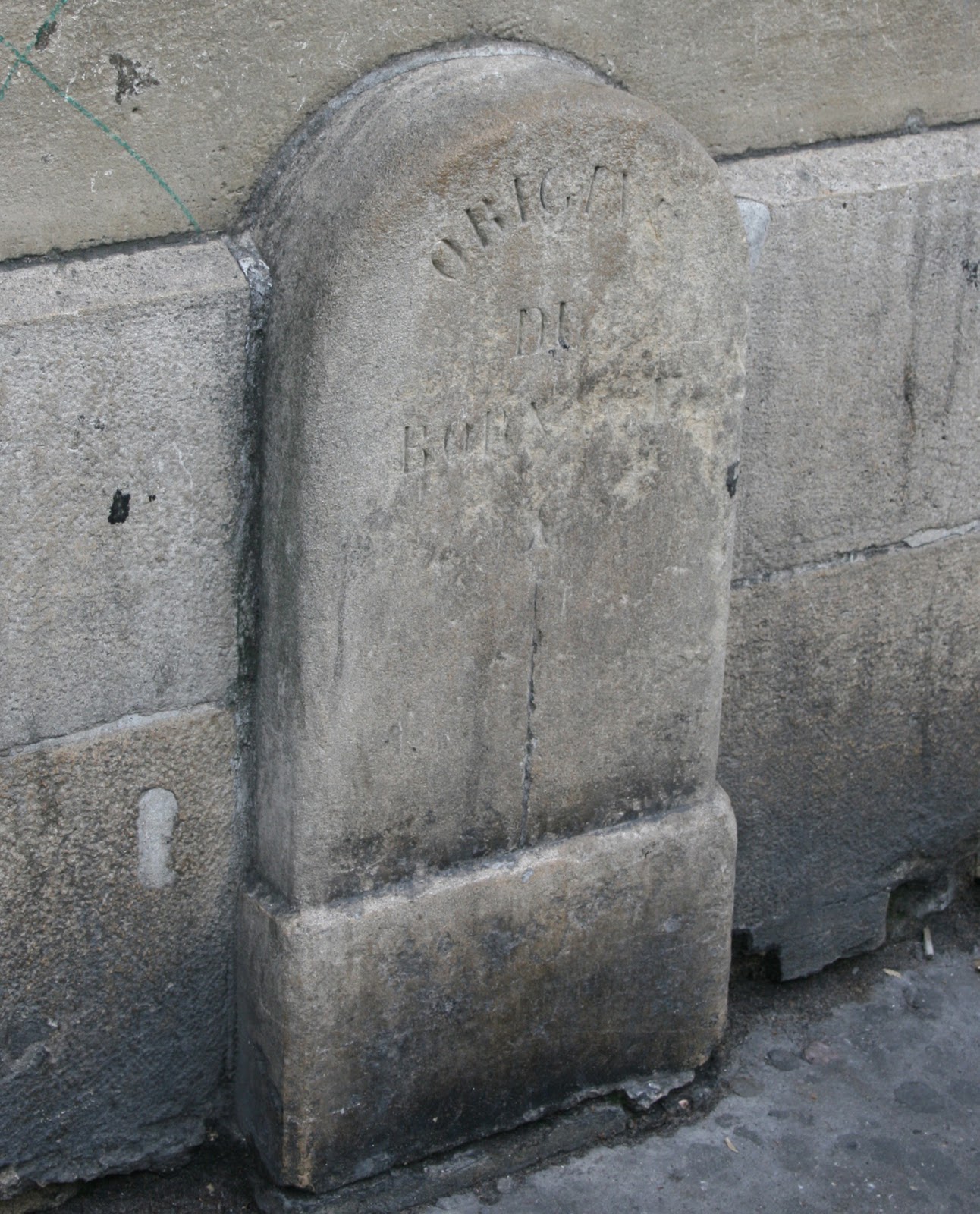
Where better to start our adventures in Bordeaux than the milestone which originally marked the geographical centre of the city and ...
Where better to start our adventures in Bordeaux than the milestone which originally marked the geographical centre of the city and designated the spot from which distances to and from other places were measured?
Today, as is now customary in all French towns and cities, the Bordeaux “kilometre zero” is the city hall, the Hôtel de Ville. But this milestone, still known locally as “la borne du kilomètre zéro” (kilometre zero marker), was positioned on Place Gambetta sometime in the mid-19th century. It is a staple feature in every guide you’ll find to the more unusual sights to see in Bordeaux, and yet still sits there unnoticed and virtually ignored by passers-by, camouflaged as it is by the 1859 building that encases it.




Follow/contact