An interesting post recently published on social media included a 1970s clip of a hovercraft criss-crossing the Gironde estuary between Lam...

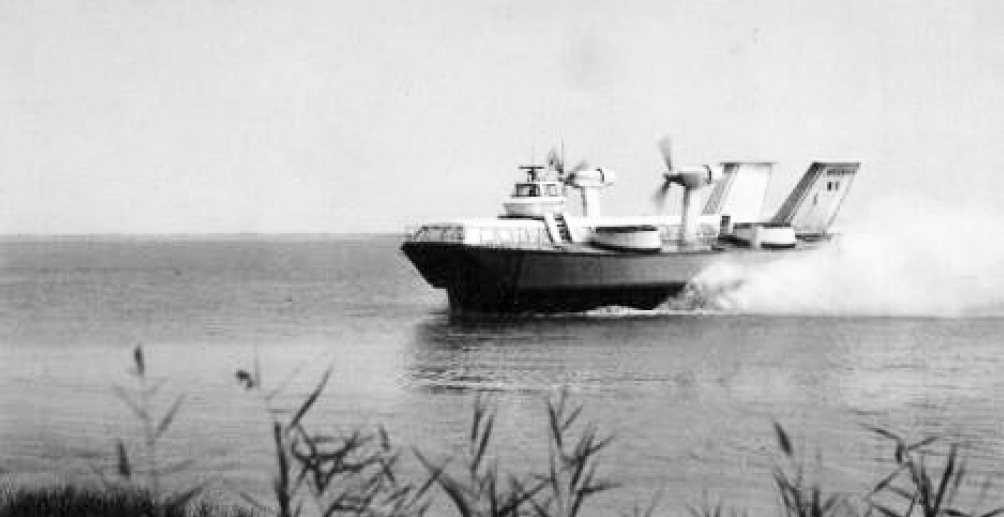
An interesting post recently published on social media included a 1970s clip of a hovercraft criss-crossing the Gironde estuary between Lamarque and Blaye, on the route that is more naturally associated with its small-scale car ferries. This was news to me, and investigating further also enabled me to uncover the significant link between hovercraft and the town of Pauillac. How was this all connected, and where shall we begin?

The natural starting point is the story of one of France’s most emblematic innovators, Jean Bertin (1917-75). Among other breakthroughs, Bertin invented the technique of thrust reversal used by many jet aircraft to slow down upon landing. He was also the man behind the famous failed experimental “Aérotrain” hovertrain concept developed between 1965 and 1977 (which at the time lost out to the TGV high-speed train concept, but is not dissimilar to the hyperloop projects that are currently taking shape).


 Jean Bertin (photo source: Aéroclub Jean Bertin) and his famous failed Aerotrain project. And a combine harvester.

As early as 1955, Bertin founded his own company, Bertin et Cie, and in time created dedicated subsidiaries for his various ventures. He set up one for the Aérotrain project and, in 1965, he formed SEDAM (Société d'Etude et de Développement des Aéroglisseurs Marins), operating out of Marignane, near Marseille, with a manufacturing facility close to Bayonne. SEDAM was similarly driven by air cushion technology, and was specifically focused on the development and production of what would become its “Naviplane” range of amphibious hovercraft.

SEDAM’s first key deliverable was the N300 30-ton hovercraft. Two units were produced, the Baie des Anges, configured to transport cargo, in 1967, with the Croisette coming the following year and designed to carry up to 90 passengers. Both entered into service on the Mediterranean coast, shuttling between Nice airport, Cannes, Saint-Tropez, Monaco and San-Remo in Italy. SEDAM also produced a much smaller model, the N102, designed to carry two crew and 12 passengers. It never achieved any significant success, despite extensive commercial trials in different situations such as in the Mediterranean resort of La Grande Motte, as a means of reaching isolated beaches.


An N300 in Nice (photo source: Reddit) and an N102 somewhere near La Grande Motte (photo source: Le Maxi-Mottain).


And the story goes that in 1971, the Baie des Anges N300 was acquired by the Gironde département and converted in order to be used in conjunction with the existing ferry for the regular Gironde estuary crossing between Blaye and Lamarque, as well as heading to Pauillac and sometimes Bordeaux (to a hoverport reportedly located just by Pont d’Aquitaine). It could carry four vehicles and 38 passengers and it took the hovercraft just five minutes to get from one bank to the other on its primary route. As such it functioned between July 1971 and December 1975, totting up 20,000 crossings and 4,000 operating hours.

Why did the council revert back to a more orthodox 100% ferry service? This is unclear, although three factors could easily be pinpointed. Firstly, the high levels of noise whenever the Naviplane arrived and departed, particularly in the densely-populated town of Blaye, was undoubtedly unpopular with residents. Secondly, the ferry alternative boasted a far greater capacity, able to carry 40 vehicles and 350 passengers. And thirdly, the Baie des Anges became synonymous with a couple of unfortunate incidents. In one, the Naviplane’s front door had not been securely closed and, upon discovering this, the fast-moving craft was brought to a sudden halt by the pilot. The door opened, water flowed in and a luxury Citroën ended up in the estuary. Happily, nobody was hurt. The other, during a night-time crossing, saw the hovercraft colliding with a stationary radar mast approaching Lamarque, causing structural damage to the craft.
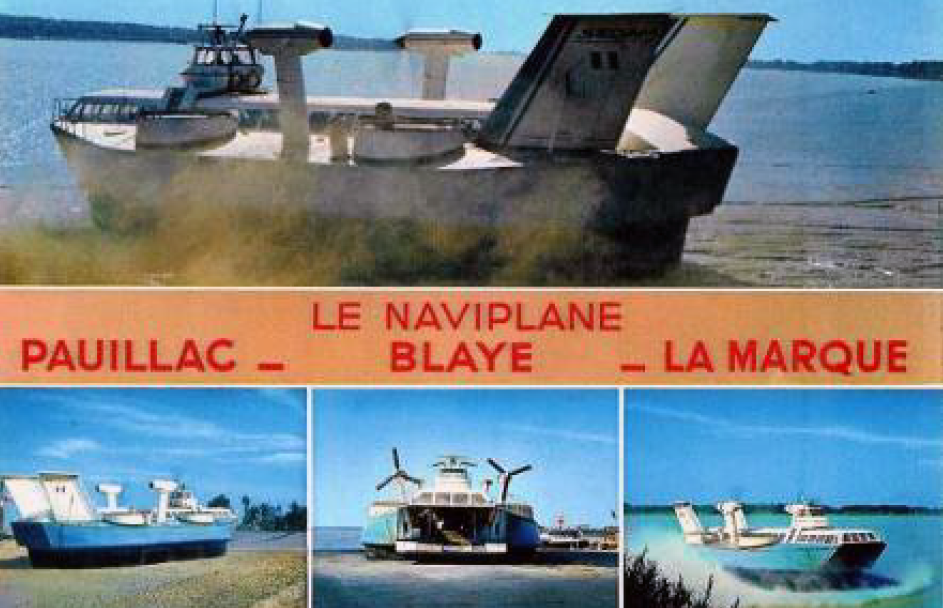

Souvenir postcard (source: Aeromed).

This is where the hovercraft landing platform was in Lamarque. It is now home to "La Paillote de Steph".
 
According to some reports, this would appear to be the approximate location towards the base of Pont d'Aquitaine suspension bridge where hovercraft would land in Bordeaux.

Meanwhile, come 1973, SEDAM was struggling to make ends meet but began working on a far more substantial, 260-ton model, the N500, the largest passenger hovercraft of its time, and which was designed to carry up to 400 people, 55 cars and five coaches at speeds of up to 70 knots (around 130 kilometres per hour). Two firm orders were secured for this more ambitious project, from the Gironde département (with a view to the craft operating the Royan-Le Verdon crossing at the mouth of the Gironde estuary), and the SNCF (to be deployed on its English Channel route). There were further commercial leads from elsewhere, such as Canada, and for the route between Nice and Corsica.

Possibly drawn to the invigorating air of the Gironde estuary, in December 1975, SEDAM relocated to Pauillac, operating from a large estuary-side warehouse just to the north of the town. And Pauillac was therefore where work on the N500 commenced, conducted by one Paul Guienne, who had also directed studies on the Aérotrain project. SEDAM began building the two inaugural Naviplanes: N500-1, for the Gironde order, became known as Côte d’Argent, while the SNCF’s N500-2 was originally to be called Côte d’Opale but was subsequently given the name Ingénieur Jean Bertin as a homage to Bertin, who passed away during that period. But it would not be plain sailing for the two N500s…  


The Côte d’Argent’s successful maiden flight took place on the estuary in April 1977, but during minor repair work (ahead of a ministerial visit) being carried out by SEDAM subcontractors the following month, a technician stepped onto a bare lightbulb, which exploded and set alight a spilt bucket of adhesive solvents. The whole craft caught fire and was totally destroyed in under an hour, all this occurring just a few days before it was set to be inaugurated by Prince Charles at a lavish ceremony. This tragic end is detailed, complete with archive photos, here.


Picture showing the aftermath as released by the investigation unit, one of many photos featured on the dedicated Naviplane website.

After an epic voyage from Pauillac to Boulogne-sur-Mer that took 25 hours with countless refueling stops along the Atlantic and Channel coasts, the Ingénieur Jean Bertin entered into service in 1978 with Seaspeed, the SNCF/British Rail joint venture, operating alongside two British SR.N4 “Mountbatten class” hovercraft, and enabling the Channel to be crossed in under 30 minutes (including a record-breaking 22’15” Dover-Calais crossing which was never officially registered because no adjudicators were present!).

In 1981 the Ingénieur Jean Bertin was transferred to Hoverspeed (the result of a merger between Seaspeed and Hoverlloyd) and was widely refurbished in response to demands issued by SNCF, re-entering service for a short period in 1983 before being decommissioned then generally left to rot and be broken up in Boulogne-sur-Mer in October 1985. (More generally, Channel hovercraft services were soon to enter a downward spiral with the opening of the Channel tunnel in 1994. The last cross-Channel hovercraft was withdrawn from service in 2000.) 

The Ingénieur Jean Bertin N500 arriving in Dover. Photo source: Wikipedia


Back in Pauillac, SEDAM was not doing well. The Gironde département had withdrawn its sole order, choosing instead to redirect finances to more urgent requirements (road infrastructure and schools). In addition, the SNCF would also not be providing any further custom, as they had come to regard the British SR.N4 as a superior craft. Towards the end of the 1970s, the company was taken over by the Dubigeon-Normandie shipbuilders, but folded completely in 1983, its final project no doubt being the refurbishment of an N102 which had been purchased many years previously by an Egyptian entrepreneur based in the United Arab Emirates.

Despite the company’s collapse, the Pauillac warehouse still contained the two retired N300 hovercraft and four N102s. An auction was held in May 1983 and a Bordeaux scrap metal merchant purchased the N102s. A restaurant owner acquired the Baie des Anges with the plan of converting it into a restaurant in Pauillac but was not authorized to do so. Plans to sell it on came to nothing so the craft stayed put in the warehouse. The Croisette was bought by a Pauillac scrap metal merchant but it too remained on site. Towards the end of 1983, both were scrapped completely and the SEDAM story came to a quiet end.

So, what remains today of the hovercraft adventures of Pauillac and SEDAM? Well, in Pauillac, the SEDAM warehouse is now used by the Baron Philippe de Rothschild wine company for storage ahead of distributing their produce worldwide. Across the road from the massive hangar and the wide space that is now a car park (where that fateful 1977 fire destroyed N500-1), a large concrete platform serves as a reminder of where the hovercraft were launched on to the estuary. The picture below was taken from that platform, looking back towards the SEDAM hangar.

 Thanks to the ever brilliant IGN Remonter le Temps website, it is possible to see how things used to be. First, here is the scene in 1976, with what appears to be two N102s stationed outside.

And here is the same view in 1977... with a single N500, in all likelihood Ingénieur Jean Bertin.

Of the N102s which ended up in the hands of a Bordeaux scrap metal merchant, in recent years two were recovered from their resting place in Villenave d’Ornon by a group of enthusiasts with a view to renovating and restoring them. That adventure is lovingly detailed here and, to cut a long story short, the two wrecks have been turned into a rejuvenated N102 Naviplane which now sits proudly on permanent display outside the Château de Savigny-lès-Beaune in the Burgundy region of France, as this Google satellite view of the area below right clearly shows!

Left picture source: hangarflying.eu

Finally, while the use of hovercraft to transport large numbers of passengers has faded over the years (although services do still operate on routes such as that connecting Portsmouth and the Isle of Wight), the technology continues to prove its worth in complex military situations or to deal with rough terrain where no other type of craft is capable of operating. And, who knows, it may one day make a comeback, including in Gironde where the subject often comes up as a potentially effective solution to connect central Bordeaux with Blaye and the tip of the estuary!


In the meantime, interest in hovercraft has anything but waned. There are many archive clips available on Youtube, there is a fantastic website dedicated to Naviplanes alone, and in this social media age you can even find a Facebook page that talks about nothing other than the Jean Bertin N500 Naviplane!

So get googling, check out naviplane.free.fr and investigate for yourself the weird and wonderful world of hovercraft, the then-futuristic whirr of which was, for a few years in the 1970s, a common sound on the banks of the Gironde estuary! 


> Find it on the Invisible Bordeaux map: Former SEDAM hovercraft factory, Pauillac; Bac Lamarque-Blaye ferry port, Lamarque; Bac Blaye-Lamarque ferry port, Blaye.
> Much of the information in this piece was found on the incredible naviplane.free.fr website, which is heavily recommended reading!
> Top photo source: Aeromed
> Cet article est également disponible en français !

Invisible Bordeaux recently picked up a series of postcards showing different stages of a funeral procession through the streets of the city...


Invisible Bordeaux recently picked up a series of postcards showing different stages of a funeral procession through the streets of the city centre in the early years of the 20th century. The event was clearly a big deal, as the pictures showed enormous crowds lining the route, with many people also peering out from windows and balconies to pay their final respects. This was in fact the city’s final goodbye to Cardinal Victor Lecot. So who was Cardinal Lecot and why was his funeral such a momentous event?

Victor Lucien Sulpice Lecot (or Lécot) was born in January 1831 in north-eastern France. Aged 24 he became a priest in Compiègne, to the north of Paris, ahead of being ordained bishop of Dijon (in 1886). Then, in June 1890, he was appointed to be archbishop of Bordeaux, at a time when the Catholic church was stronger than ever in the city, with new congregations coming together in all quarters (he consecrated Saint-Louis-des-Chartrons in 1895) and the church’s influence even seeping into the press through the publication of Le Nouvelliste de Bordeaux et du Sud-Ouest… renowned for its royalist, anti-Republican tendencies!

Lecot remained archbishop of Bordeaux until his death but was also elevated to cardinal in 1893 by Pope Leo XIII, and appointed cardinal-priest to Santa Pudenziana basilica in Rome the following year. He was one of the members of the conclave that elected Pius X, and was himself Papal Legate at celebrations held in Lourdes in 1908 to mark the fiftieth anniversary of the supposed appearances of the Virgin Mary to Bernadette Soubirous.

In France, the start of the twentieth century was a tumultuous period, with the official split between Church and State (and the start of the French Republic’s notable secular status, or “laïcité”) occurring in 1905 after 25 years of embattled debate opposing different views of the role of the Church. As you might imagine, Lecot was very much on the side of those wanting to retain close ties between Church and State, whilst also striving to do everything in his powers to avoid any form of conflict even if he was unable to prevent mass protests from being held.

And tensions were still high when Lecot died on December 19th 1908 in Chambéry, in eastern France. His funeral was held eleven days later, on December 28th, in Bordeaux. The authorities were aware that the funeral procession would draw mourners in their thousands, but also that the event could easily spark trouble.

Top - The funeral procession on Place de la Comédie. Bottom - The horse-drawn hearse carrying the coffin.

The most complete account of the event has been written by one Annie Ribette and can be read on the Cahiers d’Archives website. Ribette notes that the following day’s edition of Le Nouvelliste reported that nearly 2,000 men (soldiers and gendarmes) were in position from 7am onwards to keep the crowds under control along the route of the funeral cortege and to prevent intruders from infiltrating the procession (a special laissez-passer was required in order to join the ranks of the procession).

Ribette’s report features many archive documents, including the official laissez-passer, which records that Lecot’s corpse was scheduled to be removed from Notre-Dame church at 9am. Photographic evidence suggests that the procession then worked its way towards Place de la Comédie, along Cours de l’Intendance, down rue Vital-Carles (where the Archbishop of Bordeaux’s former official residence was located, although it had become home to Gironde’s prefect... in itself a massive source of tension), and then on to place Pey-Berland, no doubt finishing up at Saint-André cathedral, although it is unclear whether Lecot’s remains were immediately assigned to the tomb which is now his.  


Top - The funeral procession moves along Cours de l'Intendance, with many onlookers peering down from windows and balconies. Bottom - The Pontifical Swiss Guard was on hand.

It is thought that 50,000 people were present along the route to pay their final respects to Lecot, although the heavy-handed security came in for a great deal of criticism. Annie Ribette refers to the socialist union and revolutionary political newspaper La Bataille reporting on the “state of siege” in Bordeaux, adding that those people “who had travelled from all parts of the city and region were prevented from saluting the remains of the Cardinal of Bordeaux. The troops who had barricaded the city’s streets had been ordered to turn their backs to the cortege. Those honours could have been dispensed without preventing the public from attending the funeral”. That same newspaper underlined the fact that Lecot’s passing was in no way acknowledged by the French Republic, as since the “law of separation”, ecclesiastical dignitaries like Cardinal Lecot no longer enjoyed any form of official status in the eyes of the Republic.


The procession reaches Place Pey-Berland. 

Even without this Republican recognition, there was a definite sense locally of how historic the occasion was. Several requests for authorisation were submitted with a view to capturing the event on film, this being the early days of cinematography. Looking at the wide angle photographs of the procession on Place de la Comédie, it is striking how many photographers and filmmakers are present. But beyond the stills such as those featured here, how much of that movie coverage has survived, if any?


A closer look at the group of photographers and cinematographers gathered on Place de la Comédie.

And what traces remain of Cardinal Lecot himself in the city? Of course, the most symbolic and prominent memorial is none other than the cardinal’s monumental tomb inside Saint-André cathedral. His first name was also given to Saint-Victor church on rue Mouneyra in Bordeaux, founded in 1905 while Lecot was still Archbishop of Bordeaux, although the current edifice was built during the Second World War period and finally consecrated in 1947. Oh, and there is also a street named after him in Bordeaux and a "Cardinal Lecot" bus stop in Blanquefort, which is no doubt exactly what the great man would have wanted. Its location in the suburbs is not as random as it may at first seem: it is close to where the Château de Gilamon winegrowing estate once stood (later aptly known as château Larchevesque), which is the property Lecot acquired and lived in after moving out of the rue Vital-Carles residence. 

Above - Cardinal Lecot's final resting place inside Bordeaux cathedral.

Above - Saint-Victor church on rue Mouneyra. Below - The ultimate accolade: Lecot has his own posthumous bus stop in Blanquefort.

And, of course, what also remains are those incredible pictures of the city, showing scenes that Bordeaux is unlikely to see again anytime soon, and scenes that alone do not tell the full story!

> Locate Saint-Victor church on the Invisible Bordeaux map: rue Mouneyra, Bordeaux.
> Cardinal Lecot picture source: Wikipedia
> As stated throughout, the most complete account of this event can be found on the Cahiers d'Archives website
> Ce dossier est également disponible en français ! 

"From punk to funk! "  In this latest episode of the French-language Invisible Bordeaux Music podcast, we meet Martial who, with a...


"From punk to funk!" In this latest episode of the French-language Invisible Bordeaux Music podcast, we meet Martial who, with alongside colleague Babouche, runs the independent record shop Total Heaven.

He explains how running a record store has evolved in recent years, the secrets behind Total Heaven's longevity, and how the store fits into the landscape of Bordeaux's music scene. Martial also looks back on some memorable live showcase events and even reveals the story behind the famous and rather fabulous mural on the front of the store!


You can listen to the podcast below or else over on SpotifyApple PodcastsDeezerYoutubeAmazon MusicPocketCastsPodbean and RadioPublicBe sure to subscribe so that you don't miss forthcoming episodes!

Click here if player does not display on your device.

> Check out Total Heaven on Facebook, Instagram and Mastodon
> Martial mentions this year's Record Store Day which will be held on Saturday April 12th 2025. Don't miss it!


Total Heaven's famous shopfront on Rue Candale in Bordeaux.


Martial hard at work!

'Lùlù' by Lùlù !


And... introducing the Spotify Invisible Bordeaux Music playlist, featuring tracks by the artists who have taken part in the Invisible Bordeaux Music podcast... alongside various songs mentioned in passing by the interviewees!

  The Invisible Bordeaux spirit is alive and well and is once again to be found on Slowrush's new EP, The Story Starts... ! Indeed, as ...


The Invisible Bordeaux spirit is alive and well and is once again to be found on Slowrush's new EP, The Story Starts... ! Indeed, as loyal readers know, lately the musical project Slowrush has taken precedence over the Invisible Bordeaux blog in terms of time and energy. But that's not to say that the two projects don't feed off each other. In fact, three songs from the fifth collection released by our Britpop trio are directly inspired by topics covered on the blog in the past... we give you slow tourism in music!


On this new EP, the musical journey begins with the discovery of the city's “Twin City Gardens”, which are slowly crumbling away in the Barails ecological reserve north of Bordeaux. With its acoustic folk-pop mood, the track is an invitation to "voyage on the spot", providing instant changes of scenery without having to move very fat at all anywhere, as the music video on Youtube demonstrates.


The Britpop-tinged “Degrees of Separation” revisits the career of Brooklyn-born musician and songwriter Mort Shuman, who is buried in Bordeaux-Caudéran, and evokes Slowrush's pride in sharing the story of the man behind "Save The Last Dance", "Viva Las Vegas", "Papa Tango Charly" and so many other classics, as part of the musical revue we occasionally present, namely our side project The Shuman Show!

In just a few verses, “The Story Starts (With a Bass Guitar)” tells the astonishing story of Gilles Bertin, bassist with Bordeaux punk band Camera Silens in the 1980s, before he was involved in a robbery and fled to Portugal and then Spain. After 30 years on the run, Bertin sought to redeem himself and rebuild his identity from scratch, before his death from illness at the age of 58. This track, with its hypnotic bass line, is one of the most hard-hitting and ambitious in Slowrush's repertoire.

The EP closes with a much quieter song that doesn't deal with a Gironde theme, but whose title is nonetheless a nod to France: “Amie Mon Amie”. Largely instrumental, this melancholy number has a special atmosphere, thanks in particular to the presence of the voice of Olivier's wife Elise Rols, who adds an unexpected dimension to the track, whose lyrics are the work of long-time friend John Parker. The accompanying video is based on an American home movie from the 1940s.


The four songs on The Story Starts... were mixed and mastered by Sylvio Arrondo from Klarkson Mixing Studios in the south of Gironde. The cover, not that far removed from the visuals produced by Belle and Sebastian or The Smiths, is a curious 1950s photo taken on the beach at Great Yarmouth in south-east England. Holding the microphone, the very well-dressed evangelical pastor Robert Fairnie is preaching or praying for his young audience!
You can listen to the EP on Slowrush's Bandcamp page or wherever you stream your music by clicking here... or via the player below. Enjoy and be sure to catch our live shows in 2025!

Every so often the hustle and bustle of central Bordeaux can get just a little bit overpowering, wouldn’t you say? When that happens there c...

Every so often the hustle and bustle of central Bordeaux can get just a little bit overpowering, wouldn’t you say? When that happens there can surely be nothing more refreshing than taking in the delights of the city’s biggest green wall. We therefore give you Square Vinet… just a stone’s throw away from the perpetually buzzing Rue Sainte-Catherine and Place Camille-Jullian.


The tiny and quiet plane-tree-lined square, which runs between Rue du Cancéra and Rue Vinet, dates from the 1970s following on from the demolition of a row of run-down buildings. The turning point came in 2005 with the addition of its key selling point, namely the unusual – and really quite pretty – 100-metre-long (or 400-square-metre) green wall, as part of a substantial overhaul that cost €540,000. The work proved controversial at the time, but (if contemporary media coverage is to be believed) that was mainly because the old-school swings were replaced by more modern children’s activities! “Beau mais trop intello” (pretty but high-brow), headlined the local newspaper Sud Ouest!


Square Vinet in all its splendour.

But let’s get back to our green wall… then again, what exactly is a green wall? Well, Wikipedia notes that “A green wall is a vertical built structure intentionally covered by vegetation. Green walls include a vertically applied growth medium such as soil, substitute substrate, or hydroculture felt; as well as an integrated hydration and fertigation delivery system. They are also referred to as living walls or vertical gardens, and widely associated with the delivery of many beneficial ecosystem services.”


The Square Vinet green wall was initiated as part of a city-wide strategy regarding the planting of trees and vegetation led by landscape gardener Michel Desvignes. The actual conception of the wall was, according to the city’s website, “the fruit of the scientific research and artistic talent of the botanist Patrick Blanc (the man who also designed the green wall to be spotted at Paris’s Musée des Arts Premiers Quai Branly), all of which was no doubt enthusiastically rolled out by Bordeaux’s team of gardeners.


Some of the very green greenery to be spotted. 

The wall comprises a wide variety of plants whose “textures and colours are well-adapted to the fun environment of a children’s playground”. And yes, the square is still home to a small number of features (a small slide and unidentified things on springs) designed to keep the neighbourhood’s younger citizens occupied! What more could one ask for?


But even for child-free visitors the small square makes for a refreshing discovery, and the contrast between the Vinet green wall (Elie Vinet, by the way, was an eminent 16th-century Bordelais professor, historian and writer) and the limestone of the surrounding buildings is striking.


Wall to wall contrast.

Meanwhile, it might be noted that the Vinet green wall is not alone in the city, another can be enjoyed in the Mériadeck quarter, along the sides of the council meeting room of the Bordeaux Métropole building. Here, the added bonus is the surrounding fishpond and abstract bronze sculpture produced by François Cante-Pacos (and yes, there are even some lovely goldfish to be spotted!). 


The hanging gardens of Bordeaux Métropole's salle du conseil. Check out the goldfish (bottom right)! 

There have also been less successful green wall ventures in Bordeaux, notably on Cours de la Martinique where a residential building sported short-lived greenery that ran across the balconies of each apartment, once again to the designs of Patrick Blanc. Upkeep and maintenance proved difficult, and the water drainage system was ineffective; during cold spells this resulted in frost-related damage to the balconies and dangerously icy pavements at ground level. In 2012, just five years after being installed, the Cours de la Martinique’s hanging gardens were therefore already making headlines for all the wrong reasons in Sud Ouest. A few years on, the building’s balconies are now ominously smooth and free of plants!   

> Find them on the Invisible Bordeaux map: Square Vinet and Bordeaux Métropole building and green wall, Bordeaux.
> Ce dossier est également disponible en français. 
> Big thanks to Mathias Cisnal (author of Mériadeck - Parcours en ville) for his useful clarifications regarding the Mériadeck green wall! 

I’m no longer sure how this occurred, but I somehow came across a 2019 social media post announcing the installation of some new and highly ...

I’m no longer sure how this occurred, but I somehow came across a 2019 social media post announcing the installation of some new and highly unusual public bookcases (or "boîtes à livres") in various locations around the pleasant town of Eysines, as handily detailed on a map available on the municipality’s website. What makes most of the Eysines bookcases unusual is that rather than simply being angular wooden structures, each unique design reflects the surrounding area and was lovingly hand-crafted by members of the municipal technical teams. Needless to say, this clearly demanded a low-key Sunday morning cycling roadtrip!  


Of course, the basic premise of public bookcases is straightforward: come along, browse a little, ideally deposit a book and, in return, take one home with you. For the purposes of this project I adapted that rule to my roadtrip format, initially contributing a book to the Eysines collection, and then at each bookcase selecting one that I would leave at my next stop, forming a bit of a input/output book chain. To begin the process, the book I dropped off at the first public bookcase was the very Invisible Bordeaux-friendly Grandir à Bordeaux dans les Années 1940 et 1950 by Véronique Cardinal. What publication would I be taking home ten stops along the line?


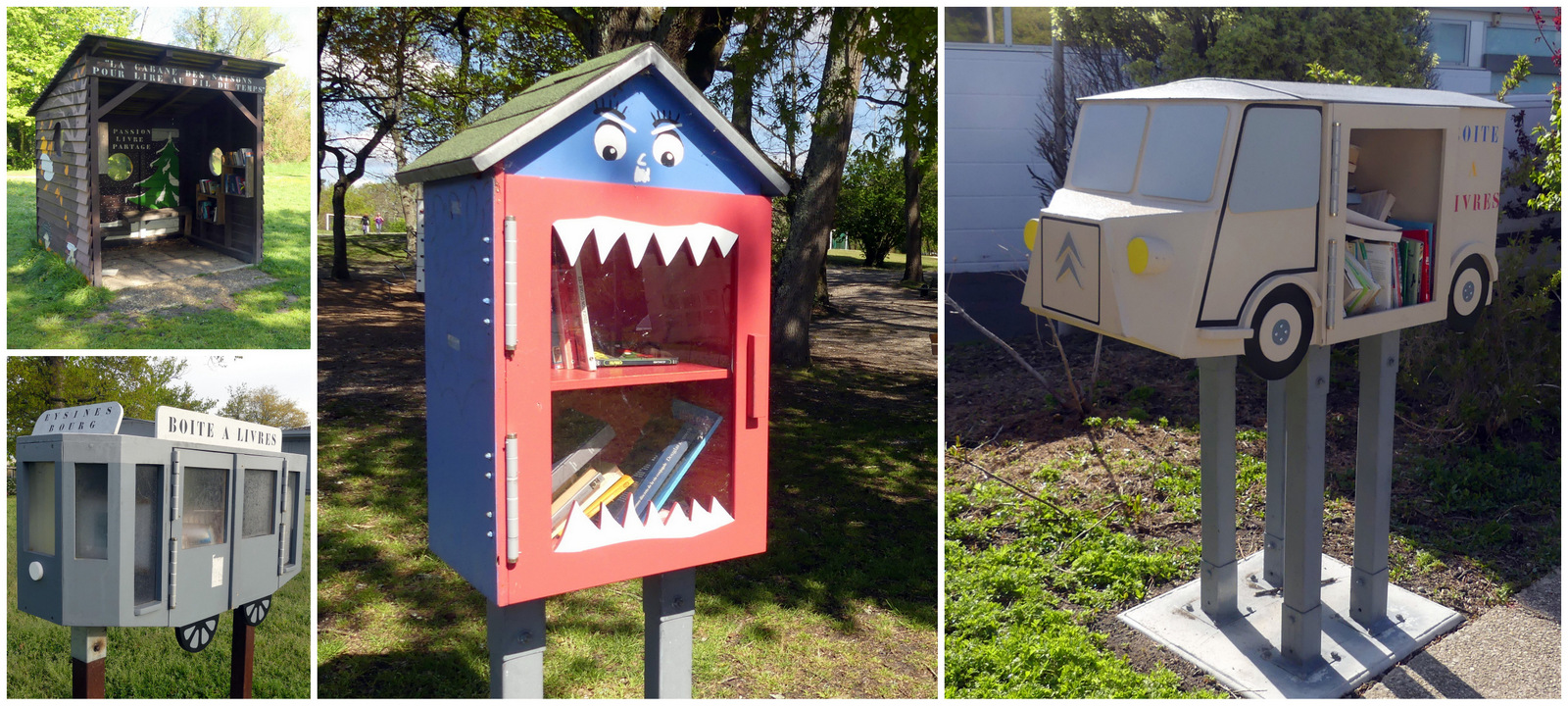
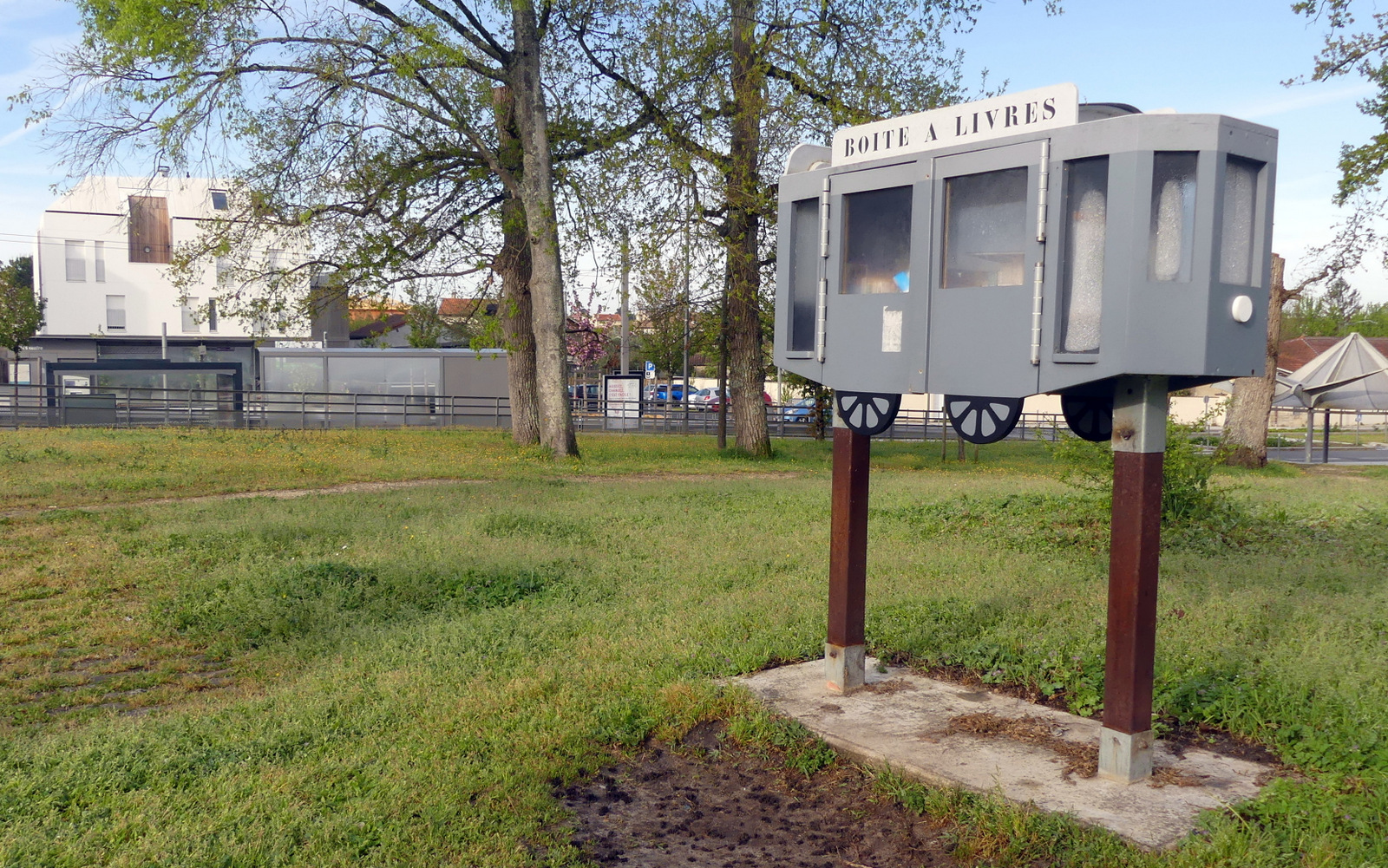
My first public bookcase was in the shape of a vintage "Eysines Bourg" tram, positioned here just slightly ahead of the neighbouring tram line D "Eysines Centre" stop entering into service. The bookcase was in good condition and offered a fair selection of books. This was also my first experience of the accomplished handiwork of Eysines’ municipal staff: I realized the hinges of the doors contained a strong spring mechanism so that when released the doors would automatically close upon themselves. Neat and clever. I swapped my Véronique Cardinal book for some classic literature that would take me back to my university years: Balzac’s Le Père Goriot


Stop number two was in the leafy Bois du Derby, the name of which may or may not be a reference to the nearby horse-racing track. In the shape of a colourful tree, the bookcase comprises two little houses to store books, one at adult height and the other at child height.


The latter was ominously empty… and the springy doors were no more. For some reason this triggered my inner politician and Le Père Goriot was replaced by Anna Cabana’s Un Fantasme Nommé Juppé.

The third boîte à livres was a little more difficult to track down, situated within the confines of a residential set of buildings (Résidence les Cottages), by the side of a children’s play area and a small-scale football pitch. 


Despite a hand-written notice requesting some communal goodwill, this bookcase was clearly in need of some tender loving care… and was conspicuously empty save for a weather-beaten children’s picture book. I opted to leave things as they were. 

Then it was on to Place Florale which, on a Sunday morning, is a hive of activity because… it’s market day! Hurrah! So I was met with crowds of people stocking up on various foodstuffs at what is known as Marché de Migron, with the smell of roast chicken in the air and all soundtracked by an amplified busker singing old Bob Dylan tunes in approximate English. The Place Florale public bookcase is a delightful beast (although it too is short of its protective doors), in the shape of an old Citroën utility van. Is this a reference to a specific Citroën van or does it simply hint at the market sellers who set up their stalls here every weekend? 


Certainly, the day I was there, there were obvious parallels with the camper van parked alongside selling tomato plants! Stopping here also served as my first chance to see a remarkable new piece of public art, a bronze sculpture by Ibai Hernandorena depicting three disabled local youths. The piece entitled "Jéremy, Germain et Olivier" and which you can read about by clicking here, possibly deserves its own Invisible Bordeaux article! I set off, now with John Gray’s Mars et Vénus Sous la Couette safely lodged in my bag. 


I was now heading to le Bois Gramond, which is a pleasant area of greenery tucked in among residential streets and flanked to the north-west by the Rocade ringroad. From what I could make out during my short stay, the park is a bit of a joggers’ and dog-walkers’ paradise. It also features arguably the most ambitious of Eysines’ public bookcases: a walk-in hut with well-stocked bookshelves on all sides and an invitation to enjoy the setting at all times of year, with each side of the hut recalling one of the four seasons.


Porthole windows on the outside world complete the picture. It really is most excellent. I swapped my sex therapy self-help book for Denis Guedj’s Le Théorème du Perroquet, simply because I liked the title and the cover.

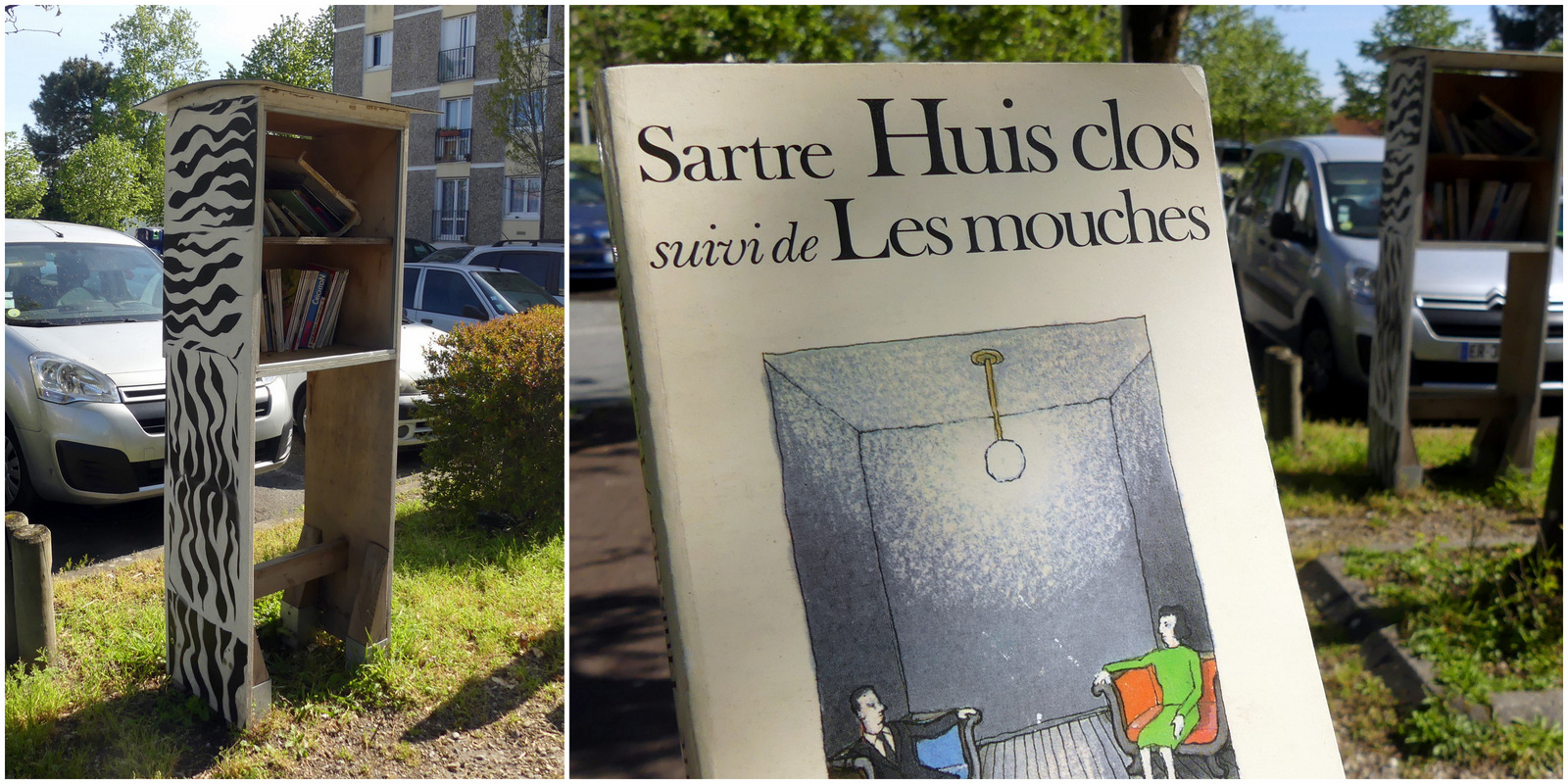
Next up was a zebra-themed bookcase which, like its les Cottages counterpart, was a touch more difficult to find, hidden away in amongst the packed car parks of the Grand Louis residential complex. Once again I chose to travel back in time to my student years, opting for Sartre’s Huis Clos.   


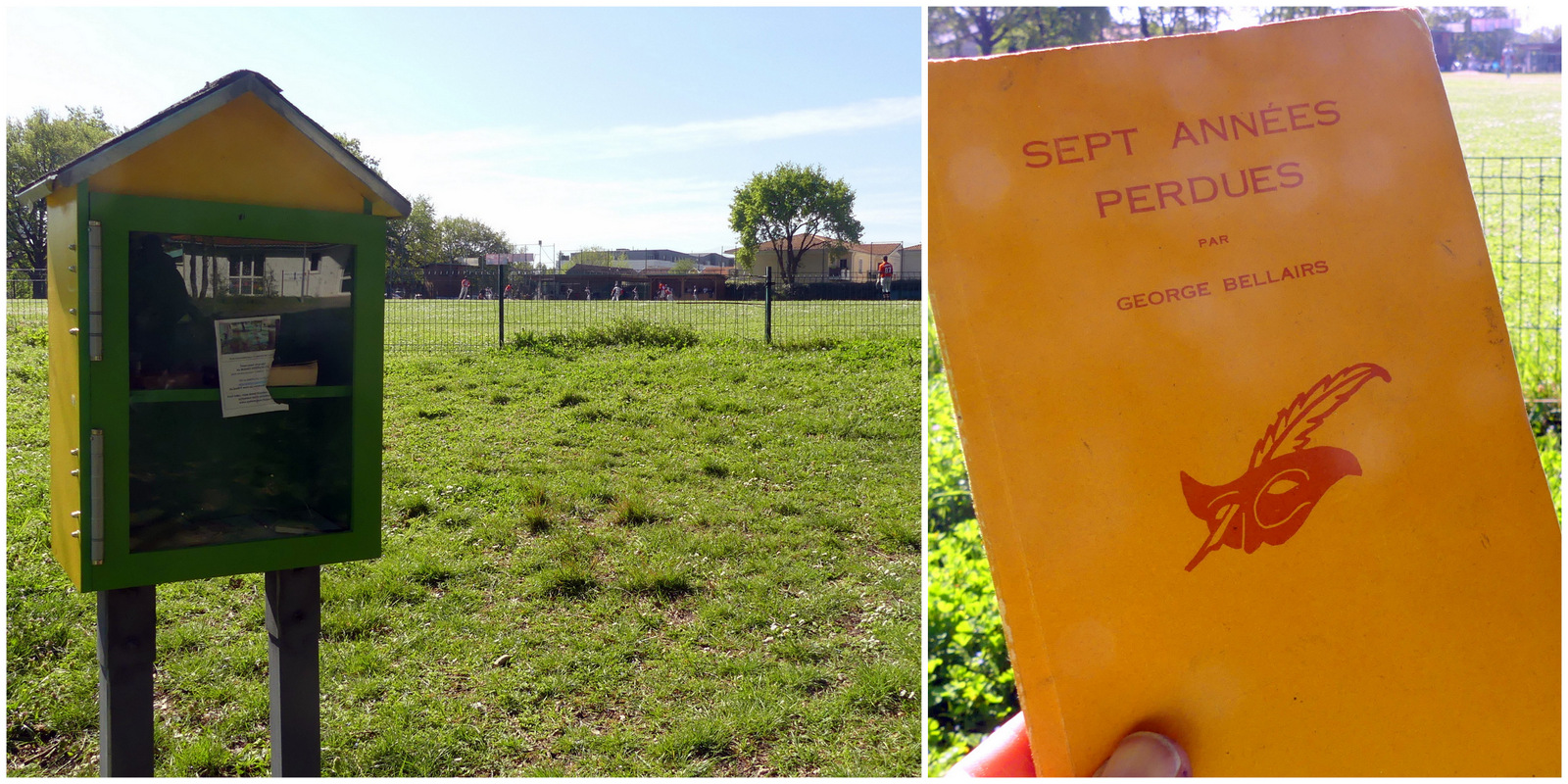
There were barely 400 or 500 metres to cover before reaching the next public bookcase, simply described on the map as being "à côté des écoles". It was actually fairly easy to locate. Its design was possibly not the most exciting but it did come with its own unexpected bonus: an unobstructed view of local baseball team les Raiders in competitive action.  


After being momentarily taken down to the ballgame I concentrated on my next item of reading material: Sept Années Perdues by George Bellairs.

I was now headed to "la Maison Guy Queyroi", which appears to be some kind of modern multi-purpose building with meeting rooms for local associations and the like. Its public bookcase, which is to be found outdoors but sheltered from the elements, is very much a conventional design, but what it lacks in originality it more than makes up for in terms of supply. This is clearly a hotspot of lending/borrowing and it was quite literally overflowing with books to choose from. I opted for some user-friendly espionage with a saucy cover: Serge Laforest’s À Bout de Patience.


Moving on, I could very easily have completely missed the entrance to my next destination, the Parc du Limancet. Cycling past the first time, the metal gate appeared not just closed but locked. It was only doubling back that I noticed there happily was a legitimate way of creeping around the gate and into this pleasant woodland area. Once in I was afraid it might be difficult to locate the bookcase but I soon spotted it, alongside a large barn. It didn’t need a character from a Serge Laforest spy novel to spot the similarity between the two, the bookcase is basically a tiny version of its functional neighbour!


The books on display were a little disappointing, I eventually chose to go for a solidly-reliable, crowd-pleasing steamy tale from the Harlequin "Série Tentation" collection of books: Lee Magner’s Vos Désirs Sont des Ordres.       

My final stop was now in sight, by the children’s play area in the wide open spaces of the Domaine du Pinsan… which has already made an appearance on the blog in one of my occasional articles about air disasters. There’s very much a child-friendly feel about the colourful design of this tenth bookcase, which features big, expressive eyes (bizarrely topped off by eyelashes that are actually positioned above the character’s eyebrows), and two sets of sharp teeth framing the two shelves of books. The bookcase seems angry, or hungry, or possibly both.  


Once again, the choice of books available wasn’t brilliant but in the ended I opted for Michel Déon’s Un Taxi Mauve, a 1973 novel set in Ireland which was later turned into a movie directed by Yves Boisset. This is the book I would be taking home!

The Eysines public bookcase roadtrip was now over, but what a rollercoaster ride it had been (well, admittedly, we’re talking quite a gentle, low-speed, low-thrills literary rollercoaster here). But mission accomplished, or what? Some of the bookcase designs really are fantastic: the tram- and van-shaped bookcases absolutely have to be seen, and the four seasons reading hut in the Bois Gramond is a genuine delight. Meanwhile, others could certainly do with a bit of a makeover (Résidence les Cottages, we’re looking at you!). And, of course, an itinerary like this is also about the other things you get to see en route: taking in a Sunday-morning market, viewing the remarkable Ibai Hernandorena sculpture on Place Florale, watching some real, live baseball, and then discovering the little-known Parc du Limancet… these are all things that came about simply because I was out hunting for some handmade bookcases.

Therefore, to the good people of Eysines (and beyond), do head out and make the most of these unusual sights, and hats off to the municipal teams who designed and manufactured the public bookcases, they really are unique and quite brilliant. Bravo!
 

To the north of Bordeaux, close to where the Aubiers high-rise estate was built in the 1970s, three features on the landscape show how much ...


To the north of Bordeaux, close to where the Aubiers high-rise estate was built in the 1970s, three features on the landscape show how much the city has evolved and continues to evolve, as well as demonstrating how some temporary solutions prove to be far more durable than initially expected. This is the tale of a bridge, some wasteland, and a flyover, i.e. the three areas highlighted above as they appeared at the time when the aerial photo was taken: 1984.
 

The bridge


The bridge in question is Pont de Cracovie (Krakow). This bridge was completed in 1967 to cater for a sudden influx of traffic entering Bordeaux from the north, as a result of the brand new Pont d’Aquitaine making it possible to cross the Garonne from Lormont, carrying road traffic arriving from the A10 motorway onto the first sections of the Rocade ring-road. 


While it made sense to open up a new way of accessing Bordeaux, there was an obstacle to overcome: a freight railway line which provided a means of connecting the docklands area of the city with Saint-Jean railway station to the south. A no-frills road bridge was therefore delivered to get from one side to the other: a big hand please for Pont de Cracovie.

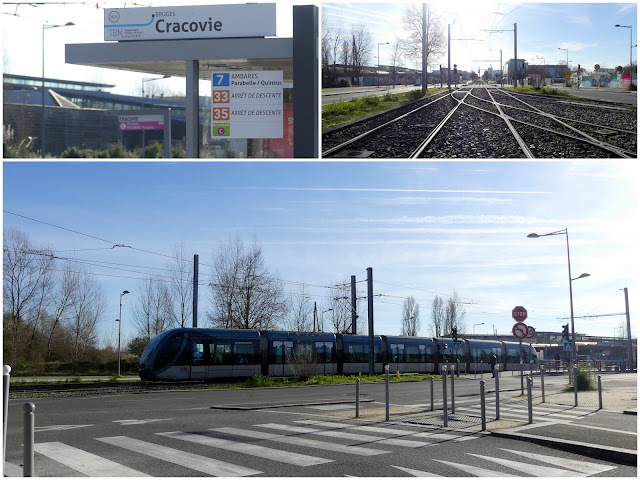
Cracovie tram stop can now be found where the bridge once stood.
Anyway, a bridge is all very well, but while it was synonymous with access for some, it became regarded as a physical barrier for others. For the first residents of the Aubiers estate, the bridge added to the sense of isolation ahead of further developments taking shape. They were physically cut off from the rest of the city, with just a single bus line providing any form of connection. Miss that last bus home, and there was no alternative other than to walk, head under the bridge, clamber across the railway line, and venture through a dangerous and inhospitable environment. 


The bridge was eventually demolished in 2006 to make way for the new tram network, which was installed at ground level, with the use of the freight railway line having ceased in the interim period. Aptly, the resulting tram stop has also been given the name ‘Cracovie’. The bridge coming down was a revelation to some. In a video which looks over the history of the Aubiers estate, one witness compared the bridge to “a frontier. As soon as it came down, as if by chance, we noticed Bruges was just next door, along with the Grand Parc estate… It’s strange, the bridge caused problems… it left its mark on us.”

The bridge being demolished in 2006. Source of this picture and the one of the bridge further up the page: Bordeaux Ma Ville on Dailymotion.

These aerial shots (to be found on the IGN Remonter Le Temps website) date from 1961, 1965, 1976 and 2012. Cracovie bridge can be seen in the 1965 picture, but was not yet in service. The Aubiers estate is visible in the 1970s shot. By the 2012 picture, the bridge had made way for the tram network. See also the video compilation of these and further photos at the end of the article!

The wasteland


What was also keeping the Aubiers residents trapped were the extensive railway sidings that stretched alongside their buildings. The aerial photos above suggest that the rails were removed for good sometime around 2010, but nothing immediately took their place on this land which officially comprises two plots; one of which belongs to Bordeaux Métropole, the other being under the ownership of Bordeaux Port Authority. 


In recent years, the land gradually became a migrant shantytown made up of makeshift accommodation hand-crafted by Romanian and Bulgarian Roms. By early 2021, it is though that up to 400 people were living on site, and over time tension mounted between the shantytown’s inhabitants and their Aubiers neighbours. Reports suggest that this was mainly due to music and noise at all hours, but also the smoke and odours caused by the plastic coating being burnt off wiring to recover copper.


Late in 2021, the shantytown was cleared for good although subsequent to a series of fires resulting from conflicts between migrants and locals. At the time of writing, the amount of debris that remains is incredible: cars and vans that have been gutted, caravans, shopping trolleys, random items of furniture, etc. But there are also official signs of what is coming next (pictured above), which is said to be two office blocks and a car park. The new premises will reportedly be home to the Gironde Social Security offices and a circus arts school. 


The flyover


Towards the eastern tip of the soon-to-be-former wasteland is a sight that has never, ever featured on a list of things to see in Bordeaux, and yet its resilience certainly deserves to be rewarded with a few paragraphs on the Invisible Bordeaux blog. We give you l’Autopont de Latule or, if you prefer, the Latule flyover. 


This too was a by-product of Bordeaux’s development to the north, and the early-1970s need to facilitate the movement of automobile traffic between central Bordeaux, its “boulevards”, and the Rocade, or indeed the nascent Bordeaux-Lac business, exhibition and hotel complexes. At this strategic point where a number of thoroughfares meet, this then-futuristic flyover was installed in 1973 (it opened on Saturday November 10th 1973 according to Frederick Llorens's excellent 'L'automobile à Bordeaux')… which means it is now coming up to 50 years of age!


The single-lane metallic structure is 254 metres long, 3.5 metres wide, and is made up of 13 sections which vary in length between 12 and 30 metres. As it was initially designed to be used for a short period, by putting in so much overtime it also has to undergo regular maintenance work – which keeps the flyover in the news given that closures result in substantial tailbacks (and affect the travel plans of the passengers of the 13,000 cars who use the flyover each day). It was also fully overhauled in 1984 and 1996.

But possibly the most remarkable thing is simply that the flyover is still in position and doing its job. There has been talk of the junction being turned into a massive roundabout, or else of automobile traffic being entirely diverted to free up the space, which would then be handed over to pedestrians and cyclists. But it’s still there, looking slightly out of place, like it should be in some vast American metropolis, a remnant of a bygone but not-so-distant era when urban infrastructure choices were fully focused on cars. Given the current climate and the essential shift to alternative means of urban transport, will we still be talking about the Latule flyover 50 years from now?  

And now, enjoy a timelapse video showing how much the area has evolved between 1924 and the present day! 

Click here if video does not display properly on your device.


> Find them on the Invisible Bordeaux map: site of former Pont de Cracovie, Cracovie wasteland, Latule flyover.

> Ce dossier est également disponible en français !