

The usual Invisible Bordeaux catchment area is in and around Bordeaux and Gironde, but every now and then the blog does spread its wings a little further! (There was, after all, a full article about a sight in Québec City last year…) So it makes sense that I should recount the weekend spent with my wife Muriel cycling along the rather scenic Canal de Garonne from Castets-en-Dorthe to Agen.
The canal, which is officially known as Canal Latéral à la Garonne, is actually far more popular with foreign visitors to France than it is with locals (perhaps it’s not exotic enough, or else is too close to home for most Girondins!). In all it stretches over 193 kilometres, hooking up with the Canal du Midi in Toulouse, the two combining to form a non-stop waterway connection between the Atlantic and the Mediterranean.
It was built in stages: work began in 1838 on the stretch from Toulouse to Montauban, which opened in 1844; it was extended as far as Buzet-sur-Baïse in 1853 and the canal was fully operational in 1856. In spite of tough competition from the rail and road transport networks, until the 1970s most of the canal traffic was merchant shipping. Now the waterway is mainly the scene of gentle leisure travel. In all, around 450 boats and barges are based on the canal, which in turn accounts for around 500 jobs.
The canal, which is officially known as Canal Latéral à la Garonne, is actually far more popular with foreign visitors to France than it is with locals (perhaps it’s not exotic enough, or else is too close to home for most Girondins!). In all it stretches over 193 kilometres, hooking up with the Canal du Midi in Toulouse, the two combining to form a non-stop waterway connection between the Atlantic and the Mediterranean.
It was built in stages: work began in 1838 on the stretch from Toulouse to Montauban, which opened in 1844; it was extended as far as Buzet-sur-Baïse in 1853 and the canal was fully operational in 1856. In spite of tough competition from the rail and road transport networks, until the 1970s most of the canal traffic was merchant shipping. Now the waterway is mainly the scene of gentle leisure travel. In all, around 450 boats and barges are based on the canal, which in turn accounts for around 500 jobs.
 |
| The point in Castets where the canal links up with the Garonne. Note the iron road bridge in the background. |
After the 60-kilometre drive from Bordeaux, Muriel and I park our car and hop on our bikes in Castets at the end-point (or starting point) where the canal meets the Garonne, at the foot of an Eiffel-inspired early 20th-century single-lane iron road bridge. We embark on the towpath and the initial kilometres are a succession of locks, narrow bridges and waterside cafés, while our fellow inhabitants of the canal are fishermen and dog-walkers (generally with very well-trained dogs that are clearly used to encountering cyclists). The backdrop is formed by cornfields, the occasional rows of vines, and extensive sunflower patches which, sadly, are just past their glorious prime at this stage late in August.
Reaching Fontet, barely ten kilometres into our ride, we encounter what will be the strangest sight on the whole trek, the concisely-named “Musée d’artisanat, de monuments en allumettes et sciences naturelles”. Given the all-encompassing name, we had to venture inside and… it truly proved to be one of the most bizarre places we’ve ever visited.
Reaching Fontet, barely ten kilometres into our ride, we encounter what will be the strangest sight on the whole trek, the concisely-named “Musée d’artisanat, de monuments en allumettes et sciences naturelles”. Given the all-encompassing name, we had to venture inside and… it truly proved to be one of the most bizarre places we’ve ever visited.

The museum is overseen by volunteers who first take you round a barn filled floor to ceiling with a seemingly random selection of exhibits: taxidermied animals, farming implements, gadgets from bygone times and pieces by local artists. Visitors are then ferried into another building which is the personal kingdom of one Gérard Gergerès, who is present on site to provide the full background story.
This disabled pensioner has taken it upon himself to build model replicas of French landmarks… out of matchsticks. The models are impressive, spectacular and just a little bit eerie too, particularly when pre-programmed son-et-lumière and waterworks features kick in. His take on the palace of Versailles covers much of the floorspace and almost dwarves his version of Reims cathedral, which earned him a mention in the Guinness Book of Records (not quite sure what the precise category was). Anyway, the whole experience was all very peculiar and kind of has to be seen to be believed, although it is most definitely not for the faint-hearted. All of the above can be yours for a 5-euro admission fee.
This disabled pensioner has taken it upon himself to build model replicas of French landmarks… out of matchsticks. The models are impressive, spectacular and just a little bit eerie too, particularly when pre-programmed son-et-lumière and waterworks features kick in. His take on the palace of Versailles covers much of the floorspace and almost dwarves his version of Reims cathedral, which earned him a mention in the Guinness Book of Records (not quite sure what the precise category was). Anyway, the whole experience was all very peculiar and kind of has to be seen to be believed, although it is most definitely not for the faint-hearted. All of the above can be yours for a 5-euro admission fee.
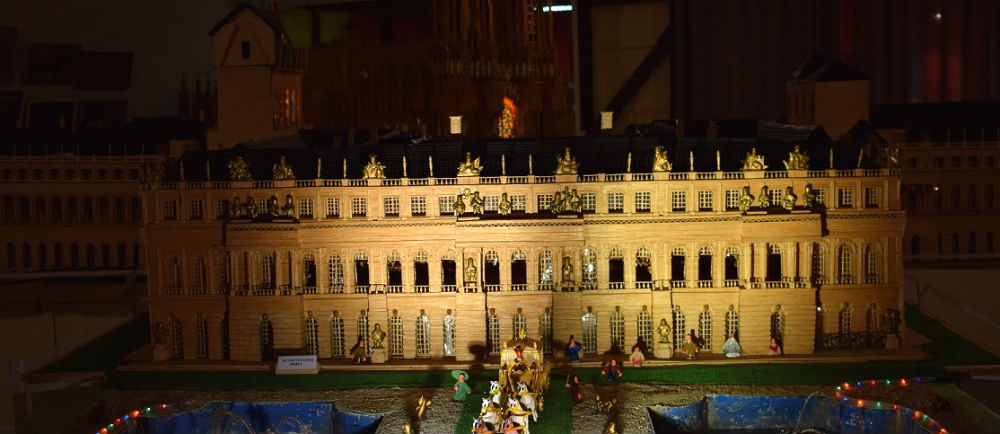 |
| Photography was one of many things that were prohibited inside the museum, so this picture of the miniature Versailles palace (built out of 450,000 matches over a 14-year period) has been naughtily lifted from the museum website: http://museeallumettes.com |
Moving on to one of the stretches where the canal is within easy reach of the Garonne, we stop by one of the canal’s prettiest locks and admire a watermill built in 1880, le Moulin de l’Auriole. It no longer appears to be grinding out flour though.

A long and especially pleasant plane tree-lined section follows, taking us cyclists out of la Gironde and into le Lot-et-Garonne. As if on cue, we immediately spot some melon patches upon entering the département, which is renowned for its fruit production. We keep our heads down and pass Marmande, which lies somewhere over to our left, and stop in one of the most scenic perched villages on the route: Mas d’Agenais.
A steep road leads us up to the central square and a covered marketplace, which is just a short walk from the village church, Église Saint-Vincent, which we enter in search of Mas d’Agenais’s most valuable possession: a crucifixion scene painted by the Dutch master Rembrandt. The story goes that the piece had ended up in the possession of a family, the Duffours, who were originally from Mas d’Agenais but had moved to Dunkerque in northern France. As a gesture of their attachment to their hometown, they donated the picture to the parish in 1804. The gift must initially have gone virtually unnoticed; it was only really unearthed in the sacristy in 1850! Speculation (very) slowly escalated as to who the artist was and, in 1960 (i.e. 110 years later), infrared analysis revealed Rembrandt’s signature and the date 1631.
A steep road leads us up to the central square and a covered marketplace, which is just a short walk from the village church, Église Saint-Vincent, which we enter in search of Mas d’Agenais’s most valuable possession: a crucifixion scene painted by the Dutch master Rembrandt. The story goes that the piece had ended up in the possession of a family, the Duffours, who were originally from Mas d’Agenais but had moved to Dunkerque in northern France. As a gesture of their attachment to their hometown, they donated the picture to the parish in 1804. The gift must initially have gone virtually unnoticed; it was only really unearthed in the sacristy in 1850! Speculation (very) slowly escalated as to who the artist was and, in 1960 (i.e. 110 years later), infrared analysis revealed Rembrandt’s signature and the date 1631.
 |
| The delightful Mas d'Agenais. |
Sadly though, our pre-trip research hasn’t been up to scratch: the painting is conspicuously absent from the church because it is currently in… Bordeaux, where it can be viewed at Cathédrale Saint-André on Wednesdays, Saturdays and Sundays! This is a temporary measure while the display case used to showcase the painting in Mas d’Agenais undergoes repairs (a crack in its joints had meant it had become a health and safety hazard for visitors). Once the painting returns, it will be on show to the general public in “improved security and presentation conditions” according to the message that is currently displayed where the painting should be.
 |
| A Sud Ouest cutting is currently standing in for the Rembrandt masterpiece. |
Back on our bikes, we rejoin the canal and make our way past Mas d’Agenais’s magnificent suspension bridge, which has provided a means of crossing the Garonne here since 1840, no less!
 |
| Looking down on the suspension bridge. The canal can be seen in the foreground while the Garonne can be spotted in the background. |
We continue to make good progress, cycling through the canal port village of Villetong, where the quayside has been given the name of the “humanitarian sailor” Pierre Ribes. A panel explains that Ribes would depart from that spot every year in September for Royan, prior to heading for Africa, sailing alone on his yacht “Le Sphinx” and carrying medication which he delivered to the needy upon arrival. Nicknamed “Dr Bateau”, Ribes’s 24th such venture, aged 75 in 2004, was to be his last. He remains lost at sea.
Nearby is a warehouse with a number of old tractors and other farm vehicles parked outside, for this is the “Musée des Amis de la Mémoire Paysanne”, where the information panel outside promises “a collection of machines and tools that retrace the history of agriculture and its mechanization”. It appears to be closed though, so we only alight long enough to take this photo.
Nearby is a warehouse with a number of old tractors and other farm vehicles parked outside, for this is the “Musée des Amis de la Mémoire Paysanne”, where the information panel outside promises “a collection of machines and tools that retrace the history of agriculture and its mechanization”. It appears to be closed though, so we only alight long enough to take this photo.

Our next stops are the charming bastide town of Damazan and the wine-growing town of Buzet-sur-Baïse, beyond which the canal loses a bit of its scenic value, certainly once we have passed the curious double lock system that links the canal with the river Baïse. The sound of the busy A63 motorway - connecting Bordeaux and Toulouse - edges ever closer. But this is almost forgotten when crossing a remarkable aqueduct over the Baïse; the structure is undoubtedly one of the most impressive sights on the trip.

The accompanying landscape now moves on to apples and kiwi fruit, and ever so gradually the cycling population ceases to be solely populated by overseas visitors weighed down by bags, given the influx of increasing numbers of more leisurely, urban cyclists… for we are nearing our final destination, Agen. But before we enter the town proper, the canal has one more surprise in store: the unusual Pont-Canal d’Agen. The 539-metre-long, 12.5-metre-wide and 10-metre-high structure enables the canal to cross its older, more energetic cousin, the Garonne river. Completed in 1847 and operational from 1849 onwards, the bridge was built to the designs of engineers Jean-Baptiste de Baudre and Jean Gratien de Job. Needless to say, it is one of Agen’s most renowned and popular landmarks.
 |
| The immensely photogenic and slightly mad Pont-Canal d'Agen. |
After treating ourselved to a whistle-stop tour of the town centre (which is buzzing on this late August Saturday afternoon), Muriel and I make our way back out to the quiet village of Brax where we enjoy a deserved rest and meal (washed down with a bottle of Buzet), recharging our batteries before the return trip the next day.
So, what are the lasting impressions of the 180-kilometre round-trip? Well, on the minus side, one thing to bear in mind is that the surface is not quite as smooth as in the movies. Along the section we cycled there are plenty of tree roots playing havoc with the tarmac, making for a sometimes bumpy ride. But reliable sources have stated that the Canal de Garonne boasts a far more pleasant and well-maintained towpath than the Canal du Midi, for instance.
One thing I found striking was that cycling a route like this serves as a gentle reminder that much of France remains farming territory, with agricultural plots as far as the eye can see.
So, what are the lasting impressions of the 180-kilometre round-trip? Well, on the minus side, one thing to bear in mind is that the surface is not quite as smooth as in the movies. Along the section we cycled there are plenty of tree roots playing havoc with the tarmac, making for a sometimes bumpy ride. But reliable sources have stated that the Canal de Garonne boasts a far more pleasant and well-maintained towpath than the Canal du Midi, for instance.
One thing I found striking was that cycling a route like this serves as a gentle reminder that much of France remains farming territory, with agricultural plots as far as the eye can see.
 |
| Apples. |
 |
| Kiwi fruit. |
 |
| Melons. |
 |
| Corn. |
Another aspect that I enjoyed about this ride was that you’re in a warm and fluffy environment where fellow cyclists all greet each other, and that when you spot someone on a boat, communication is far more likely and animated than with people on dry land. Then again, the same can no doubt be said about most waterway cycling expeditions.
But generally the overall feeling is that this really as good as it gets as far as cross-country cycling is concerned: much of the time it really does feel like you’re gliding through a postcard view of France and witnessing the kind of scenery you could easily imaging gracing the cover of a tourist brochure. Cycling along this canal is not just a case of being parallel to the Garonne, much of the time it almost feels like being in a parallel world.
But generally the overall feeling is that this really as good as it gets as far as cross-country cycling is concerned: much of the time it really does feel like you’re gliding through a postcard view of France and witnessing the kind of scenery you could easily imaging gracing the cover of a tourist brochure. Cycling along this canal is not just a case of being parallel to the Garonne, much of the time it almost feels like being in a parallel world.

> If, rather than cycling, you're considering cruising the canal by boat or barge, the excellent French Waterways website includes exhaustive practical and navigation information: www.french-waterways.com/waterways/south-west/canal-garonne/
> Ce récit est également disponible en français !




Follow/contact