It was now 6:30pm and we had driven some 485 kilometres by the time we parked our car in the shade of the pines at la Salie Sud beach, on the Atlantic coast more or less mid-way between Arcachon and Biscarrosse. Venturing out onto the sandy pathway over the dunes to the sea we gained a little height and enjoyed our first view of La Salie’s distinctive – and controversial – landmark: “le Wharf”.
In the first part of this travelogue recounting an attempt to visit Gironde’s four cardinal points over the course of a single day, Bor...
In the first part of this travelogue recounting an attempt to visit Gironde’s four cardinal points over the course of a single day, Bordeaux 2066’s Vincent and I successfully conquered Le Verdon and its countless memorials, followed by Saint-Avit-Saint-Nazaire and its nothingness. From there we headed to the département’s southernmost point, Captieux.
We arrived in a part of Captieux known as “Le Poteau” at around 4pm, 380 kilometres on from our starting point. Looking south we were gazing into neighbouring département Les Landes. A large milestone was in position at the border between the two administrative areas although Vincent soon spotted an anomaly: beneath the painted inscription correctly identifying the road as being the D932 were traces of the milestone’s previous location on the Nationale 10. Isn’t it great to know that milestones don’t die, they’re just recycled and turn up elsewhere!
"D 932" painted over the section which used to read "Route N 10"
Moving a little northwards along the road, Vincent was determined to check out the remains of Gironde’s southernmost building, to establish whether it could be connected with what is one of the most unusual, surprising and sordid tales to be told: that of the brothels and prostitutes of Captieux.
The story goes back to 1950 when the US military set up an ammunition depot which spread out over no less than 100 square kilometres in the Le Poteau area. The structure remained there until 1967, by which time President De Gaulle had called an end to US military bases in France. But, in the meantime, the substantial presence of military personnel had also resulted in the influx of prostitutes who would operate out of hastily-built brothels along the départementale road.
After the US military departed, the brothels remained, despite having been outlawed by the “Loi Marthe Richard” way earlier, in 1946. Business continued to flourish throughout the 1970s and well into the 1980s, the prostitutes reportedly selling their services to young men seeking their first taste of sexual healing, rugby teams in celebratory mood, travelling salesmen, truck drivers who would engineer a detour through Captieux, and other miscellaneous visitors from all over who knew exactly what they would find in Captieux. There were many shady dealings surrounding this obscure subculture, and it is said that relations between pimps would often turn nasty.
As we are about to find out, this used to be a brothel.
The most astonishing thing is that the authorities turned a blind eye to what was going on, although one reliable source has since told us that Captieux was regarded as a convenient arrangement: “there was an unwritten deal with the Bordeaux milieu: the city itself remained clean and the whores were out there in the country for Sunday night escapades and troisième mi-temps adventures.” (The raucous rugby equivalent of the nineteenth hole!)
That remained the state of affairs until everything came to a head in 1987 with a massive police raid on the area, which resulted in around 100 arrests and the 14 remaining establishments being closed overnight. Many of the makeshift structures were dismantled or more or less disintegrated. Lengthy trials followed and led to even lengthier prison sentences for those judged to have been responsible. Subsequently, Captieux slowly picked itself up and evolved back into being the quiet and peaceful country village it had presumably been until the 1950s!
Back to 2016 though and our roadside ruins! Vincent and I sliced our way through overgrown greenery to the walls of the building, made our way through what appeared to be the main entrance, and came up against what resembled the counter of what must have been a reception area. We were most definitely inside a former brothel. To our left was the door to a room where there were even remains of carpet pasted to the wall. Over to our right was another room which enjoyed the added bonus of an en-suite shower cubicle. We continued exploring but took great care as everywhere we looked there were tiles that hung precariously from what was left of the roof.
Inside the former brothel, including what we think was the reception area (picture on the left).
Back outside we made our way along the side of the building and inspected the walls. At one end we spotted faded hand-painted depictions of female faces, and letters that appeared to spell out “La B“. Had other letters disappeared completely over time? Were we misreading what we saw and was the establishment either “le Bambi” or “le Bilitis”, both of which are referred to on this page? With that enigma in mind, we left the brothel behind and drove into Captieux itself, a few kilometres to the north.
"La B" (?) and its alluring female figures.
We stopped off in a café for a refreshing fruit juice, and quizzed the landlord about Captieux’s dark past. He certainly didn’t appear to be too perturbed by our question, which suggested the subject was anything but taboo. The landlord, who emphasized the fact that he only moved to Captieux 15 years ago, in turn asked another customer about his memories of the establishments (the customer recalled there being two to three girls in each brothel) before calling a correspondent to try to find out the name of the mysterious “La B” building we had found ourselves in; he promised to get back to us with the answer. [Much later, a piece in local newspaper Sud Ouest featured pictures of “our” brothel and we were able to establish that its name had in fact been “La Baraque”.]
As we were paying for our drinks, he shared the tale of an acquaintance who, back in the day, was one of a group of youths who didn’t have much money. Every Saturday night, they would each throw some cash into a kitty, and each person’s name would go into a hat. Whoever’s name got pulled out of the hat was treated to a jointly-funded session with one of the Captieux ladies.
And it is with that image in mind that we departed, with one further destination to reach in our four corners challenge: we were aiming for La Salie on the Atlantic coast, Gironde’s westernmost point.
What is there to see at the extreme western point of the Gironde département? Find out in the final episode of this travelogue! The Invisible Bordeaux/Bordeaux Four Corners roadtrip is also available as a motion picture. Enjoy!
> 2019 update: Sud Ouest released a fine long-read feature about Captieux and its brothels (a subscribers-only article available here), which included this incredible eye-witness account of the area as it used to be:
Loyal readers will remember past adventures in the company of Bordeaux2066 ’s Vincent Bart, which include travelling to the point in ...
Loyal readers will remember past adventures in the company of Bordeaux2066’s Vincent Bart, which include travelling to the point in Puynormand where the Greenwich Meridian converges with the 45th Parallel, and cycling the full length of the Eau Bourde river.
Meeting up once again, the challenge we set ourselves this time was to set out on a day-long road-trip that would take us to the extreme northern, eastern, southern and western points of the Gironde (mainland France’s vastest département), secretly hoping that something interesting might happen somewhere along the way. To achieve this, we plotted our route and set out early on a Sunday morning from Saint-Aubin-de-Médoc, knowing full well that we were about to drive almost 600 kilometres together, i.e. the equivalent of travelling to Paris.
“Bordeaux Safari” is a distinctive yellow guidebook which can be spotted in bookshops in and around the city. Its publishers, Deux Degrés...
“Bordeaux Safari” is a distinctive yellow guidebook which can be spotted in bookshops in and around the city. Its publishers, Deux Degrés, recently got in touch with me to find out whether I would feature the book on the blog. Of course, I don’t simply produce book reviews upon request, but in this instance I did think that, by putting the book to the test, I would be able to get some interesting results.
Bordeaux Safari’s tagline is that it is “le guide dont vous êtes le héros”, in other words the reader is the central character and the book serves as an interactive roleplaying device that moves the aforementioned hero from point to point throughout Bordeaux, seeing and experiencing the different facets of the city. And so it was that early on a sunny Sunday morning, I set off on my bicycle without knowing where exactly I was headed.
The annual European heritage days take place on September 17th and 18th. Hurrah! As always, there are hundreds of options available, mak...
The annual European heritage days take place on September 17th and 18th. Hurrah! As always, there are hundreds of options available, making it difficult to know where to start.
So, to make things easier for you, Invisible Bordeaux has once again been looking closely at what’s on offer and here is a small selection of some of the more unusual and eye-catching visits... although this year’s choices come with a twist: all of these activities lie outside Bordeaux. Meanwhile, the full list of venues and visits - in Bordeaux and beyond - can be found on the official event website.
During a recent family stay in Québec City, Canada, I was able to witness a little piece of Bordeaux history which is now on permanent di...
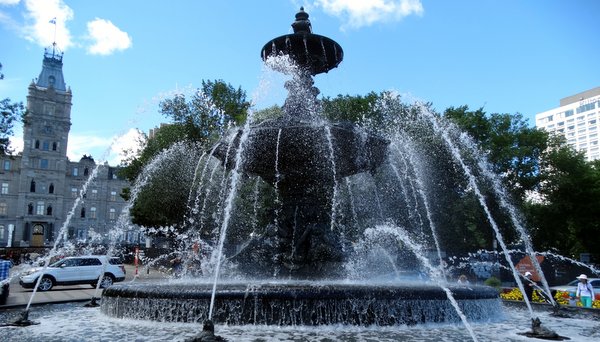
During a recent family stay in Québec City, Canada, I was able to witness a little piece of Bordeaux history which is now on permanent display outside the Québec province’s parliamentary building on Avenue Honoré-Mercier: the Fontaine de Tourny.
The fountain has already featured on the blog, as part of the investigation into the Léon Gambetta monument which was the centrepiece of the Allées de Tourny throughout much of the 20th century. At the time, the Allées were bookended by two ornate fountains which were first installed there in 1857. Just like the Gambetta monument, the fountains were removed during the 1960s overhaul of the esplanade (the main aim of which was to install an underground car park). As their upkeep was considered too costly, the fountains would never return.
A few weeks ago Invisible Bordeaux reported on the new spaceship which has been installed at the ovniport (UFO landing pad) in Arès , a...
A friend of mine had spotted the previous Arès spaceship on the car park of trailer company Sud Ouest Remorques in Saint Jean-d’Illac. I stopped there to get the full story and found out that two employees, Luc Albingre and Thierry Rouzade, were behind the design and manufacture of the new spaceship. I arranged to meet Luc and Thierry to find out more, and this is what they told me:
Loyal readers will remember that, in 2012, Invisible Bordeaux reported on one of the most bizarre attractions in the area : the designa...
I was recently disconcerted to see that the flying saucer which had been positioned there had disappeared, but lately found out that in June of this year a brand new UFO had landed. In part 2 of this feature, I will be meeting the people who conceived and built the new spaceship (and no, they aren't aliens) and finding out what happened to the previous spaceship, but for now let's revisit the story behind the UFO landing pad.
People visiting Bordeaux recently have no doubt found their stay in the city has been made easier and more enjoyable thanks to Le Map, a...
People visiting Bordeaux recently have no doubt found their stay in the city has been made easier and more enjoyable thanks to Le Map, a new free city guide that combines maps with tips, useful information and even a bit of local history.
To find out more about the publication, I arranged to meet Matt Mann, one of Le Map’s creators, for a coffee and chocolatine (that’s a pain au chocolat for non-Bordelais readers). The full story goes something like this:
Rue d’Alzon is a small side-street off Rue Judaïque where one of Bordeaux’s most iconic music and entertainment venues once stood: l’...
Rue d’Alzon is a small side-street off Rue Judaïque where one of Bordeaux’s most iconic music and entertainment venues once stood: l’Alhambra. Today, the façade remains but the theatre itself is long gone.
The Alhambra story began in the early 1870s when a tree nursery made way for a permanent circus structure, le Cirque-National, which in turn became a “café-concert” in 1878. Soon after the turn of the century, local architect Tournier conceived a veritable entertainment complex that comprised a 1,500-seater theatre, an 800-capacity “summer casino” and, peculiarly, a rollerskating rink (the city’s 21st-century “roller parks” are therefore nothing new).
Europe's biggest "skating-ring" showcased on an old postcard, source: delcampe.net.
The Alhambra went on to become a multi-purpose unit, putting on concerts, revues and plays, early films ahead of purpose-built cinemas being built in the city (trading as Alhambra Cinéma Gaumont) but also hosting boxing, wrestling, dances, school fêtes, corporate Christmas parties, conferences, debates and political rallies. Its significance as a backdrop to political action peaked from September to December 1914, when it became the temporary wartime home of French members of Parliament who had relocated to Bordeaux: the Alhambra deputized as the country’s Chambre des Députés while the upper house, le Sénat, moved into the Apollo-Théâtre over near Place Gambetta.
1914: The theatre becomes
a parliamentary house.
Source: cahierdarchives.fr
According to a report which featured in L’Intransigeant dated September 19th 1914, MPs had to make do with far less comfort than in their usual environment at Palais-Bourbon; for some time they had to find their way between boxes and crates, and endured the constant noise of carpenters hammering together planks of wood to build a platform which resembled a wine-merchant’s counter, and a stage for the chairman and secretaries to sit on. The writer noted that all this was not especially “engaging”. (“Nos parlementaires sont loin de jouir, à l’Alhambra, du confortable auquel ils sont habitués au Palais-Bourbon […] Il faut circuler au milieu des caisses et des paniers, entendre le bruit des marteaux des ouvriers qui, après avoir installée sur la scène du théâtre une tribune qui ressemble à un comptoir de marchand de vins, montent maintenant une estrade pour y placer le bureau du président et ceux des secrétaires. Tout cela n'est pas très engageant.”)
The Alhambra was also the setting for rallies led by local political figures Jacques Chaban-Delmas, disgraced 1930s and wartime mayor Adrien Marquet (who died just after a meeting held at the Alhambra in 1955) and, in 1969, Georges Pompidou, shortly before he was elected president of France.
The view from the stage during a 1950 Confédération Générale de l'Agriculture congress. Source: Sud Ouest.
Chuck Berry on stage at
the Alhambra, February 9th 1966.
Picture courtesy of the photographer,
Christian Perez.
For many in Bordeaux, the fondest memories of the Alhambra are as the
place where they saw variety shows put on by the Tichadel company, a
touring unit founded by the Bordelais Pierre Tichadel that combined
music, dancers and comedy sketches. Above all, the Alhambra became the go-to venue to witness live performances of some of the true greats of the 20th century: during the period when the venue was managed by one Paul Chevenot, the renowned singer Luis Mariano made his first breakthrough performances here. Artists who graced the Alhambra stage in the 1950s alone include Charles Trénet (1951), Louis Armstrong (1952 and 1955), Yves Montand (1953), Lionel Hampton (1956), Count Basie (1957), Georges Brassens (1956), Jacques Brel (1957), Edith Piaf (1958) and Charles Aznavour (1958). The 1960s were bookended by the inevitable Johnny Hallyday (1961), the chanteuse Barbara (whose 1969 set has become a much sought-after recording) and UK band Pink Floyd (1969), who performed in front of 300 people as part of the Sigma arts festival. When the Roger Waters-less band returned to the city in 1994, 40,000 turned out on the Esplanade des Quinconces...
Poster promoting the 1969
appearance of les Pink Floyd
and their "light shaw".
Source: capc-bordeaux.fr
After years under private ownership (most notably that of local businessman Éric Bocké), the Alhambra was acquired by the city in 1970, but within a decade – in spite of renovation work – the venue had become a precarious structure that was prone to flooding and considered to be a fire hazard. In 1978 the “casino d’été” annex was demolished and the main hall was not set to last much longer. It closed permanently in 1984, mayor Chaban-Delmas citing those safety issues as the main factor, although the decision was also triggered by the 1981 completion of the Patinoire, a skating rink in the revamped Mériadeck quarter, which Chaban-Delmas now regarded as the primary venue for A-list artists passing through the city.
In 1987, the building was sold on to property developers. The theatre was demolished although the listed façade was retained by the Bordeaux architects Brochet/Lajus/Pueyo who designed the apartment complex which now stands where the Alhambra once was.
This France 3 report ran in 1982 shortly ahead of the Alhambra closing for good:
It is impossible to rewrite history but we can perpetually revise our understanding and interpretation of what happened in the past. A notable example of this can be found on a plaque in Mérignac that marks the area where Beaudésert internment camp was once located.
Invisible Bordeaux published a full investigation into the WW2 camp back in 2013. Initially set up as a detention centre for “undesirable foreigners” in 1940, it evolved into a camp for political prisoners. It went on to hold other communities such as Jews, Spanish Republicans, members of the Résistance, black market traffickers and prostitutes, along with individuals who refused to comply with the Nazis’ forced labour policy (STO: Service du travail obligatoire). For many who were held there, it was a penultimate stop before being sent to concentration camps or ahead of execution at the nearby Camp de Souge.
Reader Nathan Turner, a former Bordeaux resident, recently got in touch with me about a building that he used to ride past on his bicycl...
Reader Nathan Turner, a former Bordeaux resident, recently got in touch with me about a building that he used to ride past on his bicycle when he lived in the city. By linking through to Google Streetview evidence, it was easy to see that Nathan had a point; the house definitely deserved a visit!
I headed over to the unusual “hôtel particulier”, which is located on a corner at the junction between Rues Cotrel and Jean Soula, in the neighbourhood that lies between Saint-Seurin basilica and the boulevards. Technically it is number 1, Rue Cotrel, the street named after Raphaël Cotrel, the gentleman who owned the surrounding land until it was split into individual plots and sold on.
The eventful month of May 1968 will forever be regarded as a turning point in the recent history of France. The focal point throughout ...
The eventful month of May 1968 will forever be regarded as a turning point in the recent history of France. The focal point throughout the troubled period was Paris but the unrest quickly spread throughout France. In Bordeaux the agitation culminated on the night of Saturday May 25th with a series of street battles that formed the city’s own “nuit des barricades”.
With the generous help of Sud Ouest journalist Marjorie Michel, who enabled me to view the newspaper’s coverage of that momentous night, I sought to reconstruct events as they unfolded and returned to the city’s hotspots and riot scenes… only to find them much quieter these days!
When, back in the 1960s, Simon & Garfunkel sang the line “Hello lamp post, what'cha knowing?” , little did they realise that com...
When, back in the 1960s, Simon & Garfunkel sang the line “Hello lamp post, what'cha knowing?”, little did they realise that come 2016 they might even get a response from the lamp post itself. For that is precisely the system that has been rolled out in Bordeaux for this year’s “Semaine Digitale” festivities, and which will be extended throughout April and into early May.
The system is called, appropriately enough, “Hello Lamp Post” and provides a means of interacting with all kinds of street furniture around the city including trams, monuments and bollards. Getting started is simple: pick an item of street furniture with a serial code on it, send a message in this format “Hello object #code” to 0644606055 (or “Salut” if you prefer communicating in French), and then see where the conversation with the inanimate object takes you.
Creator Ben Barker in Bordeaux.
The system was developed by the UK agency Pan Studio, and creator Ben Barker was in Bordeaux to introduce local journalists and bloggers to the joys of conversing with street furniture. He explained that “it’s a fun feature that can transform a city into an environment where people can play. The street furniture was already there, the serial numbers too, we haven’t added anything.” But by tapping into those little features, people are able to access a new, smart, playable dimension to the city which didn’t previously exist.
After first being rolled out in Bordeaux twin city Bristol in 2013, Hello Lamp Post has also been deployed in cities like Austin and Singapore. Ben says that “it’s been well-received everywhere, which is particularly rewarding for what is essentially an interactive urban experiment, a large-scale art installation. It is amusing to see how much people open up and confide in the objects. Usage also varies according to the surrounding culture. In Singapore, where people seem especially attached to inanimate objects, people often end up having recurring conversations with street furniture, talking to the same lamp post every day!”
Trying out the system I had a couple of short conversations with lamp posts and responded to questions about my useless talents, my ideal pet and what Bordeaux people do better than anyone else. The system magically cross-referenced with other people’s responses and weaved it all into an exchange. It was amusing although it did also soon feel like I was glued to my telephone screen rather than taking in the surrounding view and admiring the lamp-posts themselves.
But there is definitely a neat idea in there. Wouldn’t it be great if street furniture really did have tales to tell about the things that happened in the vicinity, or could share stories passed on by people who have experienced something unusual nearby, whether trivial or life-defining? That sort of interaction with our environment could actually be the future of visiting cities and recording the history of our urban environments, as experienced by the people themselves, whether they live there or are just passing through. Hello Lamp Post might just be a first step in that direction.
This unusual bronze statue can be found on the raised terrace that runs along the southern flank of the Jardin Public in central Bordeaux. It depicts the artist Carle Vernet, but who was Vernet and what was his connection with the city?
Carle Vernet was born Antoine Charles Horace Vernet on August 14th 1758 in Bordeaux. He was the son of the renowned painter Joseph Vernet (1714-1789) who had been commissioned by King Louis XV to deliver a series of pictures of France's seaports (*see footnote). This resulted in a number of extended stays in coastal cities around the country. And so it was that the Vernet clan momentarily set up shop in Bordeaux, residing for two years at what is now number 22, Cours du Chapeau-Rouge.
A few months ago I published an item featuring photographs of old postcards manually overlaid on the same environments today. I had a l...
A few months ago I published an item featuring photographs of old postcards manually overlaid on the same environments today. I had a lot of fun producing those shots, and one of the pictures even came top in a competition to celebrate the Jetée Thiers pier in Arcachon.
After picking up another batch of postcards at a collectors' fair, I headed out once again with my camera in one hand and a new set of old pictures in the other. Here are the end-products!
Perched high above the city, in the hilly right-bank suburb of Floirac, is the Observatory of Bordeaux, one of the most significant scie...
Perched high above the city, in the hilly right-bank suburb of Floirac, is the Observatory of Bordeaux, one of the most significant scientific sites in the area, and one for which a new chapter will open later in 2016.
The observatory was founded in 1878 by the Bordeaux-born astronomer Georges Rayet (whose name was to be given to his joint discovery, so-called Wolf-Rayet stars) and has, over the years, become a renowned establishment initially excelling in the fields of celestial mechanics (calculation of the motion and trajectory of celestial objects) and astrometry (measurement of the positions and movements of celestial objects). From the 1970s onwards, the observatory’s focus extended to include studies in radio waves and research into the Earth’s atmosphere.
When I recently compiled the names of independent hairdressing salons in and around Bordeaux , I asked readers to vote for the salon w...
Le Haillan’s Infini’tif cruised to victory, and so that is where I headed, packaging myself as the prize in my own competition. Things couldn’t have worked out more sweetly: Infini’tif offers a particularly warm welcome in a pleasant setting (including massage chairs), and the team are clearly highly-skilled craftspeople. Before my hair wax had even begun to set, I took some time out with the salon’s director, the most excellent Jérôme, and put a few questions to him.




Follow/contact