Pictured above is a familiar sight in garden centres and DIY stores throughout France: rows of packs of powder used to produce the bes...


Pictured above is a familiar sight in garden centres and DIY stores throughout France: rows of packs of powder used to produce the best-selling fungicide Bouillie Bordelaise, or “Bordeaux Mixture”. As my knowledge of Bouillie Bordelaise was very slim (I knew that it was blue, but that was about all), I decided to investigate!

First things first, what is Bouillie Bordelaise? As so often, Wikipedia was my first port of call: the introductory paragraph states that the fungicide is “a mixture of copper (II) sulfate (CuSO4) and slaked lime (Ca(OH)2) used in vineyards, fruit-farms and gardens to prevent infestations of downy mildew, powdery mildew and other fungi”. The “preventative” aspect is important as the Wikipedia entry adds that “its mode of action is ineffective after a fungus has become established”. In other words, you have to treat the plants before they fall sick.
Alexis Millardet
(source: baladesnaturalistes).
That is all very well and interesting, but what is the connection with Bordeaux? To find out we need to rewind to the late 19th century and the many outbreaks of vine diseases throughout France caused by pests carried on vines brought to Europe as botanical specimens of American origin: vineyards had to fight back against pests such as Phylloxera vastatrix, but also mildew and other diseases caused by fungi.

Scientists began looking seriously into the matter. One of the most prominent was the ampelographer (vine expert) and botanist Alexis Millardet (1838-1902), a Bordeaux university professor who, in 1882, was out and about in the Médoc wine-growing area when he noticed some distinctly healthy-looking vines in Saint-Julien-Beychevelle, on the grounds of Château Ducru-Beaucaillou. Stopping to enquire, the person who oversaw the land, one Ernest David, explained that Médoc vine-owners had developed the practice of spraying a mixture of copper sulfate and slaked lime on roadside vines to dissuade passers-by from helping themselves to grapes. It got Millardet thinking about the potentially protective properties of the solution.

The vines and grounds of Château Ducru-Beaucaillou, where the Bouillie Bordelaise story began.
With the help of a fellow researcher, the Chemistry professor Ulysse Gayon, Millardet conducted experiments on a number of home-grown vines. Initial results were encouraging and the scientists were given the go-ahead to roll out large-scale trials on the vines back at Ducru-Beaucaillou and further south at Château Dauzac in Labarde, which belonged to the same landlord, Nathaniel Johnston, and was also run by Ernest David. The trials, which ran from 1883 to 1885, led to the local eradication of mildew by 1886 (similar breakthroughs were also achieved by other people in Bourgogne region of France at the time), and enabled the men to gradually perfect the mixture which would come to be known as Bouillie Bordelaise, the formula of which has evolved little over the ensuing 130 years.

That recipe remains in the public domain and is as follows (based on the information found here), if you’d like to produce 10 litres of the stuff from scratch rather than purchasing an off-the-shelf pack of readymade powder. First, be sure to stock up on the following equipment and ingredients: a pair of sturdy gloves, one 10-litre bucket, one 15-litre plastic bucket, 300g of slaked lime, 200g of copper sulphate and 10 litres of water.
> Step 1: put on those sturdy workgloves.

> Step 2: using the 10-litre bucket, dissolve 300g of slaked lime in 6 litres of water and stir the mixture with a stick to produce lime slurry.

> Step 3: in a 15-litre plastic bucket, dissolve 200g of copper sulfate in 4 litres of water.

> Step 4: slowly add the lime slurry to the copper sulfate solution.

> Step 5: stir like there’s no tomorrow.

> Step 6: let the solution rest for 24 hours.

> Step 7: pulverize on the desired plants.

Of course, given the chemistry at work here, handling Bouillie Bordelaise is not without risk. It can cause general skin complaints (hence the gloves) or conjunctivitis if it enters into contact with the user’s eyes. The issues don’t stop there as even mild ingestion of the product can lead to nasal irritation and respiratory problems. The fungicide has also been identified as having triggered a deadly occupational disease among Portuguese vineyard workers: "Vineyard sprayer's lung". According to www.ncbi.nlm.nih.gov, “the radiographic picture resembles that of silicosis with micronodular disease in the early stages and progressive massive fibrosis in later stages, eventually resulting in endstage lung disease. The patients have a downhill course due to respiratory failure.” Don’t say I didn’t warn you.

A Ducru-Beaucaillou vine leaf.
In the meantime, Bouillie Bordelaise continues to be a staple product stored in the sheds of amateur and professional gardeners alike. Back in the Médoc wine-growing area, when inspecting the vines at Château Ducru-Beaucaillou, where the Bordeaux Mixture story really took shape all those years ago, I spotted traces of a white-coloured fungicide on some leaves – whether this was the “colourless” variant of Bouillie Bordelaise was unclear, but whatever the product used, the vines still appeared to be in rude health. 

> Find it on the Invisible Bordeaux map: Château Ducru-Beaucaillou, Saint-Julien-Beychevelle
> Cet article est également disponible en français !

The play room in our family home has often been the scene of large and sometimes elaborate temporary installations made out of small pie...


The play room in our family home has often been the scene of large and sometimes elaborate temporary installations made out of small pieces of wood. Football stadiums, railway bridges, Formula 1 circuits, high-rise buildings… you name it, scale-model replicas have all been produced (and then ceremoniously demolished).

And the raw material used by my children is the wooden building block game, Kapla, manufactured and distributed out of a facility in Saint-Louis-de-Montferrand, 17 kilometres to the north of Bordeaux.

What, then, is Kapla? Kapla is a wooden block construction toy made up of identically-sized and shaped pieces of pinewood, with dimensions in the ratio of 1:3:15 (1 unit high, 3 units wide and 15 units long). The vital statistics of the blocks are in fact 117mm in length, 23.4mm wide and 7.8mm thick. The end-product is sold in boxes of 40, 100, 200, 280 and 1,000 and is available in natural pine colour, as well as a small variety of other colours.

Housing, retail and industry seem to be gradually taking over every available square metre in the north-western suburb of Le Haillan. It...


Housing, retail and industry seem to be gradually taking over every available square metre in the north-western suburb of Le Haillan. It was therefore good to hear about a project recently deployed by the municipality to reclaim some land alongside a stream and convert it into a pleasant so-called “linear park”: le Parc du Ruisseau.

The park was officially opened in late 2013 and forms a unique evergreen 2.7-kilometre-long “corridor” that splits through the town, following the course of the stream, Ruisseau du Haillan, which in bygone years was the lifeblood of those who lived nearby, providing the water needed for everything from the production of vegetables to washing clothes. (Indeed, one section of the stream was once known as “Ruisseau des Blanchisseuses”.)

During the recent media coverage to mark the second anniversary of the BatCub ferry service on the Garonne in central Bordeaux, I realis...


During the recent media coverage to mark the second anniversary of the BatCub ferry service on the Garonne in central Bordeaux, I realised it was about time that I myself hopped on one of the boats to see what it was all about.

Hirondelle and La Gondole are the names of the two BatCub boats (Bat for “bateau”, and “CUB” for Communauté Urbaine de Bordeaux, which has since been renamed Bordeaux Métropole rendering the “Cub” reference somewhat obsolete). The ferries were designed and manufactured by local companies, and were first launched on May 2nd 2013. The service is run by boating company Gens d’Estuaire for the public transport network operator Keolis.
During weekday rush-hour periods, the boats, which can carry up to 65 passengers and six bicycles, shuttle between stops on either side of the Garonne, with departures every fifteen minutes. At other times and over the weekend, the boats each connect three of the four stops (Lormont Bas, Les Hangars, Quinconces, Stalingrad) and, by linking up at one of the overlap stops in the middle, the full circuit lasts 40 minutes.

The official map showing the two routes, which overlap in the middle (source: infotbc.com)
It is estimated that work commutes account for 60% of journeys while the remainder are simple boat trips, with people more than willing to pay €1.50 for the pleasure of being out on the water. And passenger figures are up: after 110,000 trips being registered during the first twelve months, the second year that figure soared to 210,000, a little over the 200,000 that was initially targeted.

Success was anything but instant though. Soon after the service was launched, faulty engines on one of the boats resulted in both being taken out of service until the problem was fixed. Substitute boats were used in the interim. Then, in July 2013, the engine of one of the BatCubs broke down and the drifting boat hit the Pont de Pierre before becoming stranded under one of the arches of the bridge. Happily, the 38 passengers were quickly evacuated to safety.

Pictured on the left is a BatCub in all its splendour, not to confused with the Batmobile or Batboat (pictured right, sources Hammacher Schlemmer and Daily Mail/Getty)
From then on, things could only get better, and generally they did… at least until April 2015, when human error caused one of the boats to hit the Burdigala river cruise barge. And prior to that, the BatCubs had courted controversy, with other Garonne boats-people filing a petition against the relative high speed of the BatCubs that causes unwanted waves on the surface of the water.

This all made me rather curious and impatient to board one of the boats for myself, which I finally managed on a hot, sunny Sunday morning, departing from Lormont with a handful of other passengers at 10am. There was a pleasant atmosphere about the boat and people roamed freely around the deck taking in the sights.

The scene on board.
This included an impressive full-on panoramic view of Pont d’Aquitaine, which seemed strangely tranquil, possibly because it was closed to traffic on that Sunday morning. We then sailed close to the mysterious rig-with-no-name which was the subject of a recent feature on the blog. Nearing the left bank, we were able to inspect the work in progress on the spectacular Cité des Civilisations du Vin which is taking shape in the Bacalan district.


Then, surprisingly, the skipper switched off the BatCub’s engines. A large cruise ship was due to depart from central Bordeaux and to accommodate this, the central section of the Pont Chaban-Delmas lift bridge was to be raised. The procedure takes around 15 minutes, so there was little we could do other than float on the spot and observe. But it wasn’t all bad news as it meant we then had the enviable pleasure of travelling under the bridge when it was in its spectacular raised position, making for some unusual mid-Garonne photo opportunities.


As the Batcub was now running late, the skipper announced that its first stop, “Les Hangars”, would also be its last, and that passengers would have to switch to the next boat in order to travel further. The wait wouldn’t be too long though as the boat, “La Mouette”, could already be seen some way further upstream. 

La Mouette? Not Hirondelle or La Gondole ? In fact, as I was about to find out, the sister BatCub boat was undergoing emergency repair work on its electronics system and a substitute boat was being used. But, just as I was about to embark with my yellow bicycle, I was informed that bikes were not allowed on La Mouette. My BatCub experience was therefore coming to a premature end and I hadn’t even reached Les Quinconces, let alone the southernmost terminus, Stalingrad. Reluctantly, I made an about turn and headed home, with a definite feeling of unfinished business.

The stunning silhouette of La Mouette, the substitute BatCub (no bikes allowed).
So what was the verdict? Well, a BatCub ride is possibly the most pleasant way possible of spending €1.50 on the public transport network in Bordeaux, and out on the water it really does feel like you’re taking in a whole new view of the city. However, as my experience showed, the boats do seem to be prone to technical issues and unforeseen changes. The plans I had made on the basis of the timetables available online had to be totally dropped. Additionally, it would have been good to know that the substitute boat didn’t accept bikes before preparing to board. So, in short, enjoy your BatCub voyage with its laid-back ambience and marvellous views, but also be prepared to be flexible as it’s clearly not always plain sailing!

We are in Bègles, not far from the Rives d’Arcins shopping emporium and next to the tiny Port Garonne marina. Unusually, ultra-modern ...


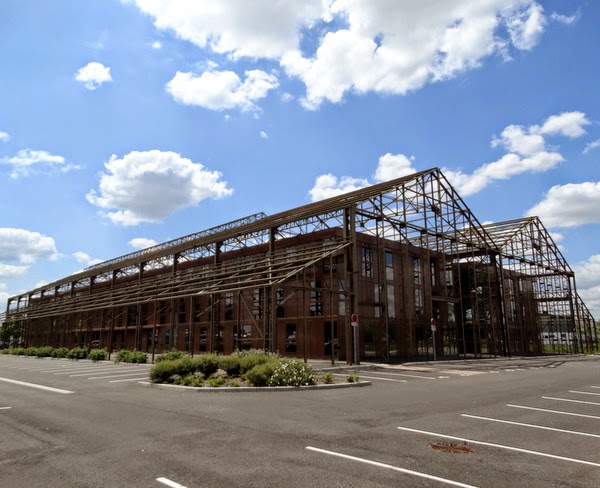
We are in Bègles, not far from the Rives d’Arcins shopping emporium and next to the tiny Port Garonne marina. Unusually, ultra-modern office space has been created inside a metallic cage-like structure. And, tellingly, the new office complex has been given the name “Ateliers Louis Blériot”, a reference to the history of the metal framework, which previously housed workshops founded by aviation pioneer Louis Blériot. What’s the story?

Frenchman Louis Blériot (1872-1936) was an engineer and inventor whose first commercial breakthrough was a patented headlamp for trucks. He ploughed much of his earnings into developing and building aircraft and, in 1909, achieved worldwide fame as the first aviator to fly across the English Channel in a heavier than air aircraft. In 1910 he was registered as France’s first licenced pilot (the official paperwork does indeed feature “N°1”), and continued to achieve success at the head of his company Blériot Aéronautique, later also branching out into the production of motorcycles.

Last year the blog ran a number of pictures that merged old photos with pictures taken from the same spot today, using the expert Photos...


Last year the blog ran a number of pictures that merged old photos with pictures taken from the same spot today, using the expert Photoshop know-how of friend Anthony Poulachon. This time though I have taken a literally hands-on approach to combining old and new, by manually overlaying old postcards onto the modern-day view, i.e. simply holding them in front of the camera lens.

This technique has been used masterfully by photographers such as Julien Knez whose pictures incorporating wartime Paris are particularly effective. The following selection is nowhere near as spectacular, but I hope you'll enjoy the views!

You’ve got to feel sorry for Pont Saint-Jean. In the unwritten hierarchy of Bordeaux’s road bridges, it comes very much at the bottom of...


You’ve got to feel sorry for Pont Saint-Jean. In the unwritten hierarchy of Bordeaux’s road bridges, it comes very much at the bottom of the table, far behind the elegant Pont de Pierre, the slick Chaban-Delmas lift bridge, the wondrous Pont d’Aquitaine suspension bridge and the minimalist Pont Mitterrand. In the otherwise flawless “Dictionnaire de Bordeaux” it doesn’t even get an entry. Let’s face it, if Pont Saint-Jean were one of the Beatles, it would be Pete Best.

The unloved edifice was the result of a relatively short process which began in 1962 with an initial call for tenders to deliver a bridge to connect Quai de Paludate (near Saint-Jean railway station on the left bank) with Quai Deschamps in the right-bank Bastide quarter. Campenon Bernard, a company which is now part of the Vinci group, were selected and they teamed up with the architect Jean-Louis Fayeton (1908-1968). Construction work began in April 1963.

As part of the series of conferences held by the prestigious Mémoire de Bordeaux association, I will be giving a talk in the auditorium o...

As part of the series of conferences held by the prestigious Mémoire de Bordeaux association, I will be giving a talk in the auditorium of the legendary Musée d’Aquitaine on Thursday June 25th at 6pm.

During the hour-long conference I will be looking back over some of the sights, sounds, stories and people that I have researched and documented since launching the Invisible Bordeaux website in 2011.

There’ll be exclusive anecdotes, exciting photos, spectacular videos and possibly even indoor fireworks if I obtain the relevant paperwork from the local authorities. Bordeaux will never be the same again.

I hope to see you there!

The vital statistics:
  • Invisible Bordeaux conference, Thursday June 25th 2015 at 6pm
  • Musée d’Aquitaine auditorium, 20 cours Pasteur, Bordeaux
  • Admission entirely free of charge
  • Facebook event page

It was my Invisible Paris counterpart Adam who spotted this 1973 Paris Match cover in a museum display case. Headline news alongside Ja...


It was my Invisible Paris counterpart Adam who spotted this 1973 Paris Match cover in a museum display case. Headline news alongside Jacques-Yves Cousteau, the blue jean phenomenon and racism in France was the enigmatic announcement of a “Scandale à Bordeaux”. What scandal could this possibly be referring to? The answer is “Winegate”!

The story began at 124 Quai des Chartrons which, at the time, was the waterfront home of the prestigious wine trading and export company Cruse. On Thursday June 28th 1973, inspectors from the State tax department’s Brigade de Surveillance des Services Fiscaux descended on Cruse, possibly as the result of a tip-off, with the intention of carrying out a full audit and inventory.

They were forcibly ejected from the premises by director, Lionel Cruse, who claimed that the time was not right. He argued that the company was behind schedule on a number of orders and, with the holiday period coming up, they still had a lot of catching up to do. Instead, the inspectors considered that the establishment had something to hide but nevertheless retreated, noting that their operation had been hindered, filing a report marked “opposition à fonction”. They would return...

It's more peaceful today at 124, Quai des Chartrons.
More or less simultaneously, colleagues from another branch of the tax department, la Brigade Spéciale des Contributions Indirectes, uncovered a case of serious fraud. They had found out that a négociant (wine trader) from Saint-Germain-de-Graves, to the south-east of Bordeaux, had been purchasing wine in bulk from the Languedoc region, along with large amounts of cheap Bordeaux, before storing it in his casks, doctoring the associated paperwork, and selling it on under more expensive “appellation contrôlée” names such as Saint-Émilion, Pomerol and Médoc to distribution and export companies including Cruse.

Details began to emerge about the négociant at the heart of the affair, one Pierre Bert, who had a track record of shady dealings and failed business ventures. This time around he was looking to capitalise on the booming Bordeaux market by pocketing some handsome illicit profits from this act of peddling some 3 million bottles of mislabelled wine (at the time around 60 million bottles were shipped from Bordeaux each year). Was he acting alone, in which case he was deceiving his wine trade customers, or were the shipping companies aware of the fraud and playing along with it?

Lionel Cruse, the self-proclaimed
"Nixon of Bordeaux". Source: larvf.com
The response was swift: Lionel Cruse was adamant that he was innocent, going on to publicly compare his fate to that of Richard Nixon and referring to the scandal as “Winegate”. Nixon’s downfall was just around the corner… how would Cruse fare?

As suspicion continued to fill the Bordeaux air, investigative journalists also unearthed the use of illicit practices to upgrade stock wines, such as excessive sweetening, various undisclosed blends and the use of artificial colouring. Bert, who had already acknowledged his wine-switching acts, responded to the allegations by claiming that “90% of traders and 50% of producers behave fraudulently”, adding that there was no way he could be an isolated case: “200,000 or 300,000 hectolitres of Languedoc wine are delivered to Bordeaux every year, so it must end up somewhere!”

The story broke in late August 1973 with articles including a double-page spread in the Nouvel Observateur, followed by Le Canard Enchainé whose front-page headline was “All-out fraud in Bordeaux”. Le Canard Enchainé added a political dimension to the scandal: this was all good news for then-Finance minister Valéry Giscard d’Estaing, whose main fellow Right-Wing political rival for the 1976 presidential election was none other than Jacques Chaban-Delmas, mayor of Bordeaux and a long-term friend and ally of the disgraced Chartrons wine community. The Canard Enchainé piece signed off saying “Another point for Giscard! Poor Jacques!” And the satirical weekly was right: upon the April 1974 death of president Georges Pompidou, the election was brought forward to May of that year and Chaban-Delmas was easily brushed aside in the first round of voting, Giscard then edging past François Mitterrand to become president.

Le Nouvel Observateur, August 27th 1973 (available online here and here).
The Winegate court case opened in October 1974 and was widely covered as far afield as the UK, Canada, US and Japan. In the dock were no less than 18 defendants, including three members of the Cruse family and the infamous Pierre Bert, all on charges of illegal use of chemicals to upgrade products and mislabelling the wines. The trial went on for almost two months, resulting in a 240-page verdict and eight convictions.

Pierre Bert, who again in court admitted tampering with the wines, got the harshest sentence – a year’s imprisonment. He remained unrepentant though, even claiming that his blends were very similar to the taste of Bordeaux: “During all the time the fraud went on, I never received a complaint from a client on the quality”.  Lionel Cruse and his fellow director, cousin Yvan, were given a suspended sentence of one year plus a fine and three years’ probation. But they confessed to nothing worse than not tasting Bert’s wine carefully enough. 

Although the case was now closed, the fallout had only just begun. Prices tumbled across the region and exports slowed. US demand for Bordeaux wine dropped back to 1969 levels and only really recovered from 1982 onwards. Many château producers, who had played no part in the scandal but suffered the consequences, stopped dealing with négociants, most reverting to direct sales methods.

Perhaps the most notable effects of the scandal were the implementation of tighter regulations and the extra importance given to the phrase “mis en bouteille au château”, suggesting minimal intermediary involvement. (At the root of the scandal was the previous widespread practice of wine from small vineyards being sold in bulk to shippers who aged, bottled and distributed it.) However, many traders were drafted in-house to help with production as many châteaux lacked the knowledge and capital to handle in-house winemaking and bottling.

La Maison Cruse did slowly rebuild its reputation and today owns Château Laujac and Château d’Issan. Their renowned property Château Pontet-Canet did however have to be sold following the scandal, which is undoubtedly still an inconvenient chapter in the establishment’s past. So inconvenient, in fact, that it even appears to have been airbrushed out of history whenever possible.

For instance, I was surprised to see no mention of the scandal in Sud Ouest’s April 2013 obituary of Lionel Cruse. There is now little or no trace of what happened to Pierre Bert. The most complete accounts of the scandal I found were, bizarrely, in US newspaper archives. Finally, this was the first time that some of my searches have been met with the message “En réponse à une demande légale adressée à Google, nous avons retiré xx résultat(s) de cette page”.

But I do think the story deserved to be told, even though I don’t think Invisible Bordeaux will be getting a Christmas card from la Maison Cruse this year… I'll console myself by drinking a glass of wine from the Languedoc.

Find it on the Invisible Bordeaux mapformer Cruse headquarters, 124 Quai des Chartrons, Bordeaux.
> Ce dossier est également disponible en français.

In 2012 and again in 2014 I reported on the Stade Bordeaux-Atlantique construction project. The subject started out as an suitably “inv...

In 2012 and again in 2014 I reported on the Stade Bordeaux-Atlantique construction project. The subject started out as an suitably “invisible” topic, but has developed into something which will be on full view for the general public from May 23rd onwards.

During an enjoyable case of work commitments and personal interests converging, I was recently given a sneak preview of the nearly-completed stadium, and visited the venue in the company of two delightful members of the “SBA” staff. I thought the outing deserved a blog entry, so here it is!

As so often, this article began with an old postcard, specifically this 1960s “ vue des grands blocs ” of Cité Pinçon in the Bastide quarte...

As so often, this article began with an old postcard, specifically this 1960s “vue des grands blocs” of Cité Pinçon in the Bastide quarter of Bordeaux, the kind of high-rise view which is far removed from the customary sight of the city’s 18th-century façades.

 
Cité Pinçon and its sister estate Cité Blanche together form Cité de la Benauge (sometimes even referred to as “Cité-Jardin de la Benauge”), which at the time of writing comprises just under 1,200 homes. Until the 1950s, the area was vast marshland that belonged to one Jules Pinçon, hence the name given to the first development which included these two massive 10-storey blocks and six smaller-scale five-storey buildings.  

Invisible Bordeaux first encountered the sculptor François Didier in 2014 when researching the three bronze plans-reliefs which have bee...

Invisible Bordeaux first encountered the sculptor François Didier in 2014 when researching the three bronze plans-reliefs which have been positioned in central Bordeaux. At the time, the investigation took the blog to the village of Bages to see further 3-D maps, and down to Lugos, at the northern tip of les Landes, to visit the artist’s workshop and gardens.

This time, the François Didier trail led me to the renowned Musée Georges de Sonneville in Gradignan, to visit an elaborate exhibition that is currently showcasing his work (it runs until April 12th), entitled “Neanysa, ville antique”. The concept is simple but the execution is both surprising and impressive in its scale: François Didier has created his own imaginary ancient city, Neanysa, and the exhibition enables visitors to discover the city-that-never-was by viewing a whole host of items and documents that pay testimony to how things were, or might have been!

During my recent early-morning trip to Soulac-sur-Mer , I made a point of staying put until sunrise to be able to visit a number of sight...

During my recent early-morning trip to Soulac-sur-Mer, I made a point of staying put until sunrise to be able to visit a number of sights which I thought deserved coverage on the blog, and which show that there is much more to this Médocain seaside resort than its characteristic red-brick houses, and its doomed ocean-front residence Le Signal

Some of the sights have direct ties with past blog subjects, such as this first landmark, one of the world’s many replicas of the Statue of Liberty. An explanatory text at the base of the statue explains that it was commissioned by the town in 1980 and manufactured by the Paris ateliers of Arthus-Bertrand, using the original mould designed by sculptor Auguste Bartholdi. However, an urban legend also suggests that the statue is the very one which was located on Place Picard in Bordeaux from 1888 until its disappearance at the hands of the Germans in 1941. Which version is true?

It was a very early start on Saturday March 21st 2015. I woke up, fell out of bed, dragged a comb across my head and drove 85 kilometres ...

It was a very early start on Saturday March 21st 2015. I woke up, fell out of bed, dragged a comb across my head and drove 85 kilometres from my home near Bordeaux to Soulac-sur-Mer, with the sole aim of being on the ocean-front at 5:15AM to view a one-off son et lumière performance that made use of the façade of a doomed apartment block, Le Signal.

Le Signal has long been an angular eyesore for some, but was a much-loved home and holiday residence for others and was initially set to be just the first of a number of such buildings in Soulac. Importantly, when it was built, between 1965 and 1970, the ocean was a good 200 metres away. But over the ensuing years, the Atlantic has literally gained ground on this lone apartment block, at a rate of between four and eight metres per year.

Old postcards have often proved to be the starting point for Invisible Bordeaux investigations. But recent acquisitions have also added a...

Old postcards have often proved to be the starting point for Invisible Bordeaux investigations. But recent acquisitions have also added an extra dimension to subjects which have already been covered in the past. Here are some examples!

We start our journey on Allées de Tourny, on April 25th 1905, at the official unveiling of a grand monument celebrating the achievements of 19th-century statesman Léon Gambetta. Leading the tributes that day was French president Émile Loubet, although this picture shows the undoubtedly stirring rendition of La Marseillaise by renowned baritone Francisque Delmas.

“Lapébie” is a name which is familiar to cyclists who use the velodrome in Bordeaux or travel along the 54-kilometre cycle path which run...

“Lapébie” is a name which is familiar to cyclists who use the velodrome in Bordeaux or travel along the 54-kilometre cycle path which runs between the city and Sauveterre-de-Guyenne. But who were the Lapébies?

They were two brothers. Roger was born in Bayonne in 1911, Guy following suit in the Landes town of Saint-Geours-de-Maremne in 1916. Over the subsequent years, the family base shifted to Pessac, where their father managed the Médoquine freight station, although their mother reportedly soon moved to Neuilly-sur-Seine, in the suburbs of Paris.

You may remember that the blog recently ran an article about Stade des Chartrons, the Girondins' "lost" football stadium. ...


You may remember that the blog recently ran an article about Stade des Chartrons, the Girondins' "lost" football stadium. After generating a healthy amount of interest, local newspaper Sud Ouest got in touch to get the full story on the stadium and the findings of the research carried out with fellow blogger Antoine Puentès (also known as MystickTroy). 

The interview resulted in a nice spread in the February 28th 2015 edition of Sud Ouest, which was also available online. 

Do note there is a factual error in the piece which is entirely of my own making: I got my "B" suburbs muddled up and stated that the topsoil for the football pitch had been brought in from Bègles when it was in fact Bruges (as correctly specified in the original blog articles). Apologies to readers! 

Big thanks to writer Tristan Baudenaille-Pessotto for getting in touch and for bringing this little-known story to the masses! 

One of the most illustrious permanent residents of Cimetière des Pins Francs , in the Caudéran district of Bordeaux, is none other than t...

One of the most illustrious permanent residents of Cimetière des Pins Francs, in the Caudéran district of Bordeaux, is none other than the legendary songwriter, pianist, singer and sometime actor Mort Shuman, the man who penned the melodies of some of the most famous songs of the 20th century.

Mortimer Shuman was born in Brooklyn in 1938, the son of Polish Jewish immigrants. The young Mort began studying philosophy at the New York City College but was expelled after a year because he spent too much time playing rhythm and blues piano in local bars, putting to productive use the piano tuition previously dispensed to him by the Julliard School of Music. He switched academic paths and went on to study music at the New York Conservatory, and began writing songs at the age of 18.