It was a very early start on Saturday March 21st 2015. I woke up, fell out of bed, dragged a comb across my head and drove 85 kilometres ...
It was a very early start on Saturday March 21st 2015. I woke up, fell out of bed, dragged a comb across my head and drove 85 kilometres from my home near Bordeaux to Soulac-sur-Mer, with the sole aim of being on the ocean-front at 5:15AM to view a one-off son et lumière performance that made use of the façade of a doomed apartment block, Le Signal.
Le Signal has long been an angular eyesore for some, but was a much-loved home and holiday residence for others and was initially set to be just the first of a number of such buildings in Soulac. Importantly, when it was built, between 1965 and 1970, the ocean was a good 200 metres away. But over the ensuing years, the Atlantic has literally gained ground on this lone apartment block, at a rate of between four and eight metres per year.
Old postcards have often proved to be the starting point for Invisible Bordeaux investigations. But recent acquisitions have also added a...
Old postcards have often proved to be the starting point for Invisible Bordeaux investigations. But recent acquisitions have also added an extra dimension to subjects which have already been covered in the past. Here are some examples!
We start our journey on Allées de Tourny, on April 25th 1905, at the official unveiling of a grand monument celebrating the achievements of 19th-century statesman Léon Gambetta. Leading the tributes that day was French president Émile Loubet, although this picture shows the undoubtedly stirring rendition of
La Marseillaise by renowned baritone
Francisque Delmas.
“Lapébie” is a name which is familiar to cyclists who use the velodrome in Bordeaux or travel along the 54-kilometre cycle path which run...
“Lapébie” is a name which is familiar to cyclists who use the velodrome in Bordeaux or travel along the 54-kilometre cycle path which runs between the city and Sauveterre-de-Guyenne. But who were the Lapébies?
They were two brothers. Roger was born in Bayonne in 1911, Guy following suit in the Landes town of Saint-Geours-de-Maremne in 1916. Over the subsequent years, the family base shifted to Pessac, where their father managed the Médoquine freight station, although their mother reportedly soon moved to Neuilly-sur-Seine, in the suburbs of Paris.
You may remember that the blog recently ran an article about Stade des Chartrons, the Girondins' "lost" football stadium. ...
You may remember that the blog recently ran an article about Stade des Chartrons, the Girondins' "lost" football stadium. After generating a healthy amount of interest, local newspaper Sud Ouest got in touch to get the full story on the stadium and the findings of the research carried out with fellow blogger Antoine Puentès (also known as MystickTroy).
The interview resulted in a nice spread in the February 28th 2015 edition of Sud Ouest, which was also available online.
Do note there is a factual error in the piece which is entirely of my own making: I got my "B" suburbs muddled up and stated that the topsoil for the football pitch had been brought in from Bègles when it was in fact Bruges (as correctly specified in the original blog articles). Apologies to readers!
Big thanks to writer Tristan Baudenaille-Pessotto for getting in touch and for bringing this little-known story to the masses!
One of the most illustrious permanent residents of Cimetière des Pins Francs , in the Caudéran district of Bordeaux, is none other than t...
One of the most illustrious permanent residents of Cimetière des Pins Francs, in the Caudéran district of Bordeaux, is none other than the legendary songwriter, pianist, singer and sometime actor Mort Shuman, the man who penned the melodies of some of the most famous songs of the 20th century.
Mortimer Shuman was born in Brooklyn in 1938, the son of Polish Jewish immigrants. The young Mort began studying philosophy at the New York City College but was expelled after a year because he spent too much time playing rhythm and blues piano in local bars, putting to productive use the piano tuition previously dispensed to him by the Julliard School of Music. He switched academic paths and went on to study music at the New York Conservatory, and began writing songs at the age of 18.
Long-time readers may remember my attempt to visit Bordeaux using the local edition of the board game Monopoly as my roadmap. I tho...
I thought the adventure deserved to be turned into a video, and so here is a GoPro view of an early-morning non-stop bike ride through the city. Starting out in the Le Lac district to the north of the city and finishing up at Bordeaux Airport in the western suburb of Mérignac, the adventure takes in a wide variety of the city's streets, squares, neighbourhoods and landmarks.
The Salinières fountain, also known as Fontaine de la Grave , is one of the landmarks in the city of Bordeaux which people see but rarely...
The Salinières fountain, also known as Fontaine de la Grave, is one of the landmarks in the city of Bordeaux which people see but rarely stop to look at. That was certainly my case until I recently made a point of inspecting this unusual sight, on the left-bank waterfront more or less in line with the spire of Saint-Michel church.
The fountain was the work of the then chief city architect
Richard-François Bonfin and was first installed here around 1787-1788. It was initially fed by the “
Font de l’Or”, a spring captured on nearby Rue Carpenteyre and which had previously been channelled to a more rudimentary fountain a little further down the quayside near Porte de la Monnaie.
We are at the grave of Henri Salmide in the Cimetière Protestant of Bordeaux. According to the inscription, he “singlehandedly and on hi...
We are at the grave of Henri Salmide in the Cimetière Protestant of Bordeaux. According to the inscription, he “singlehandedly and on his own initiative saved the port of Bordeaux on August 22nd 1944”. So who was this local hero?
The local hero was in fact a German, born Heinz Stahlschmidt in Dortmund on November 13th 1919. His father, a plumber, died in 1937. His elder brother had taken up studies but the family couldn’t afford to bankroll a second student, so with the outbreak of war in 1939 Heinz volunteered for the German navy. His military career got off to a bad start though: in April 1940, he was on board the battleship
Blücher when it sank off Oslo in Norway. In June 1940, a fishing boat he was on which had been converted into a coastal patrol vessel also sank. And in September 1940, he was on a frigate carrying troops which was torpedoed between Denmark and Norway. Stahlschmidt managed to swim back to the coast but 560 men died.
After writing an article about the Wallace fountains of Bordeaux sometime ago for the blog, I thought it might be interesting to film ...
So here is the ultimate 3'46" video guide to these elegant cast-iron drinking fountains, their history and their locations throughout the city. Enjoy!
Local top-flight football (soccer) team Girondins de Bordeaux will soon be leaving Stade Chaban-Delmas and moving to their new purpose...
Local top-flight football (soccer) team Girondins de Bordeaux will soon be leaving Stade Chaban-Delmas and moving to their new purpose-built stadium in the Lac district of the city. But did you know that in the early years of the club, les Girondins in fact alternated between two stadiums: Parc Lescure (now Chaban-Delmas) and Stade des Chartrons, aptly enough in the Chartrons quarter.
To get the full story, Invisible Bordeaux teamed up with fellow blogger Antoine Puentès, also known as
MyStickTroy, who had suggested the subject as a potentially interesting one to pursue together. To add an extra layer, a request had also come through from David Ledru, the webmaster behind the marvellous
Scapulaire.com site (the definitive online database and guide to the history of the Girondins de Bordeaux), who wanted to track down information about the buildings which had taken the stadium’s place, on behalf of the descendants of Olivier Lhoste-Clos, a former chairman of the club.
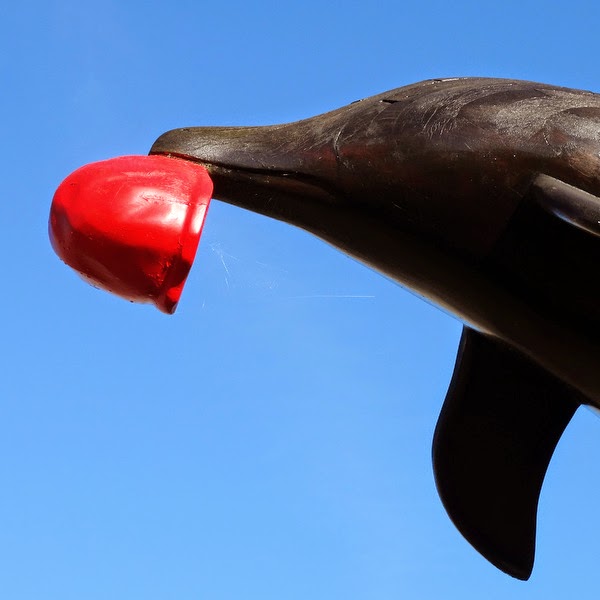
Yes, this is a wooden dolphin, and in its beak (sorry, its rostrum) the dolphin is holding a red hat reminiscent of the knit cap famously...
Yes, this is a wooden dolphin, and in its beak (sorry, its rostrum) the dolphin is holding a red hat reminiscent of the knit cap famously worn by the underwater explorer and filmmaker Jacques(-Yves) Cousteau. And the wooden dolphin is to be found in Saint-André-de-Cubzac, the town to the north of Bordeaux where Commandant Cousteau was born in 1910 and buried in 1997.
His birthplace, celebrated by a plaque, was a room above the pharmacie ran by his maternal grandfather Ronan Duranthon, from a long line of illustrious local land-owners and wine-growers. Cousteau’s father, Daniel, was from a similarly wealthy background and was heir to the legacy of a merchant-shipping dynasty. He had become a reputable lawyer who had followed in the footsteps of his own father, a notaire. After graduating from Law School in Paris, Daniel returned to Saint-André where he practiced for three years.
A few months ago I published a couple of items about some of the sights in Saint-Aubin-de-Médoc , and the story of the Diamant A roundab...
I recently went back and this time filmed the evidence, which you can view in this brand new Youtube clip. Hold on to your hats, it's pretty spectacular.
In every city there are secret and often surprising places hidden behind closed doors. Bordeaux is no exception and a few weeks ago Invis...

In every city there are secret and often surprising places hidden behind closed doors. Bordeaux is no exception and a few weeks ago Invisible Bordeaux again joined forces with the guys behind the Bordeaux 2066 blog (the French-language version of this article can be found on their website here). Together we enjoyed a private tour of one such gem, to be found at the end of a tiny alleyway just off Cours de la Marne, the busy street that connects Place de la Victoire and Saint-Jean Railway Station. For it is here that lies, behind a door that is usually locked, the 18th-century Portuguese Jewish cemetery of Bordeaux.
The person providing the tour (and the key to the door) was none other than writer, journalist and broadcaster
Michel Cardoze, known to many as a former TF1 weatherman but best-known to myself and my Bordeaux 2066 friends as the man who delivers “
l’histoire du jour” every morning at 7:55am on Radio France Bleu Gironde. In his short monologues, Cardoze glides effortlessly through some of the most amazing tales from Bordeaux and beyond.
All the subjects covered by the website over the past twelve months have once again been a delight to compile and research. But here ar...
All the subjects covered by the website over the past twelve months have once again been a delight to compile and research. But here are five subjects which proved particularly interesting when peeling the layers away. Click on the titles or associated pictures to read the items!
The time has come to finish off the calendar year with a couple of items that look back on some of the features that ran on Invisible Bor...
The time has come to finish off the calendar year with a couple of items that look back on some of the features that ran on Invisible Bordeaux over the past twelve months. This first set compiles the five most-read articles. Click on the titles or associated pictures to read the full items!
The latest issue of Voyage , the official Liverpool John Lennon airport magazine, features a double-page feature about Bordeaux. The que...
The latest issue of Voyage, the official Liverpool John Lennon airport magazine, features a double-page feature about Bordeaux. The question-and-answer session is part of a regular series of interviews with bloggers who have gained inside knowledge of their city and, yes, for the Bordeaux piece they looked to... me!
You can therefore read what I say about the best places in and around Bordeaux to get a sense of history, to take in an unforgettable view, to be surprised, to take in a concert... and even where to go if you're in a romantic mood. Loyal readers will be pleased to see that I also squeezed in a reference to
Cacolac (though sadly not in the paragraph about getting romantic).
This bronze statue, which can be found on Place Montaud in the heart of the Bastide quarter, depicts one Joseph Marie Edouard Chabrely (1...
This bronze statue, which can be found on Place Montaud in the heart of the Bastide quarter, depicts one Joseph Marie Edouard Chabrely (1835-1895), a doctor who was a cornerstone of this right-bank community in the 19th century.
For 39 years, Dr Edouard Chabrely provided the local working classes with medical care, paying close attention to each individual’s ailments and, according to the plaque in front of the statue, “knew the right remedy to heal each wound”. Chabrely was also a member of the local council until his death. By then he had earned not only plaudits but also various titles and honours, much to the embarrassment of this naturally humble man.
To celebrate the blog’s third anniversary, Invisible Bordeaux teamed up with Mollat, the city’s most famous independent bookstore… enabl...
To celebrate the blog’s third anniversary, Invisible Bordeaux teamed up with Mollat, the city’s most famous independent bookstore… enabling one lucky reader to win a copy of the marvellous “Nouveau Viographe de Bordeaux”!
Here then is the prize draw in all its glory, including cameo appearances from Bono and the official Invisible Bordeaux cat.
Click here if video does not display properly on your device.
About the prize: Kindly donated by the good people of Mollat, Robert Coustet’s “
Nouveau Viographe de Bordeaux”
is an authoritative 560-page encyclopedic guide to the stories behind
every one of the city’s streets and squares. Packed with fascinating
historical insight and often surprising architectural information, the
book is an invaluable resource for anyone seeking to get under the
city’s skin.
Click here for further information.
And of course,
massive thanks to bookstore Mollat for partnering with Invisible Bordeaux for this competition! You can of course visit them on the internet (
www.mollat.com) and hook up with them via various social networks… I particularly recommend their fantastic
Instagram account!




Follow/contact