|| PART OF A TWIN FEATURE PUBLISHED WITH INVISIBLE PARIS! || For more than a thousand years, pilgrims have followed routes from differ...


For more than a thousand years, pilgrims have followed routes from different parts of Europe to the cathedral of Santiago de Compostela in north-western Spain, where it is believed that the remains of the apostle Saint James are buried. The pilgrimage is what the Spaniards know as “el Camino de Santiago”, the French as “les Chemins de Saint-Jacques-de-Compostelle”, and what English-speakers call “the Way of Saint James”.

Bordeaux trams have become such an integral part of the landscape in the city that they even feature on postcards. The 21st-century ...


Bordeaux trams have become such an integral part of the landscape in the city that they even feature on postcards. The 21st-century transport infrastructure could have been very different though because, for many years, the plan was to build a light railway network which would have looked something like the artist’s impression pictured above.

Trams in Bordeaux are nothing new. Horse-drawn trams were introduced in 1880, followed 20 years later by the city’s first electrically-powered trams. The network went from strength to strength over the following decades, and by 1938 160,000 people were travelling daily on the 38 different lines, which covered a cumulative distance of 200 kilometres – many lines extended beyond the city itself to suburbs such as Créon, Cestas and Saint-Médard-en-Jalles.
The central Bordeaux tram and bus network in 1940 as featured in "l'Histoire des Tramways et omnibus à Bordeaux" and previously published by in Mysticktroy's Blogpaper.
Come the late 1940s, the network was in a bad shape and the trams were ageing. A new era was dawning and buses and private cars were set to reign over the streets of Bordeaux, as elsewhere. Mayor Jacques Chaban-Delmas (elected in 1947) and his municipal council decided to pull the plug on the tram network, and lines gradually folded until just two remained in service. These ceased operating on December 8th 1958, in ceremonial scenes that were caught on camera.


By the 1970s, the uglier side of the age of the automobile was only too plain to see, and Bordeaux drivers and commuters regularly had to contend with gridlocked roads and boulevards. At the time an underground transport system was considered but the project was soon dropped because drilling through the city’s swampy terrain would have had disastrous consequences below the surface and at ground level.

Tentative plans were aired in 1981 for a new-generation tram system, championed by Michel Sainte-Marie, then mayor of Mérignac and chairman of the greater Bordeaux council (Communauté Urbaine de Bordeaux or "CUB", now Bordeaux Métropole). The following year, the city’s urban planning agency presented a full project, featuring a network that was similar in shape to the one in place today.

Work was scheduled to begin in 1984… except that in 1983, the man who replaced Sainte-Marie at the helm of the CUB was none other than Jacques Chaban-Delmas, the man who had phased out the first tram network 30 years earlier and who made his position clear: he had no intention of reintroducing into the city this form of transport, which he considered outmoded.

Instead, Chaban-Delmas’s vision was that of a VAL (Véhicule Automatique Léger) light railway/metro system, like the one in Lille which was big news at the time, having rolled out in 1983 (in fact, VAL originally stood for Villeneuve-d'Ascq - Lille, after the first line). The underground option had become a legitimate solution given that technical advances meant it was now possible to drill underground without upsetting the groundwater table. The company Matra was commissioned to conceive the system.

How the VAL network would have looked.
(Source: “De la ville à la métropole, 40 ans d’urbanisme à Bordeaux”)

With the exception of the Communist representatives, the project was initially supported by all parties and the Chamber of Trade and Industry. But as the plans began to take shape, cracks began to show. Members of the general public (some of whom joined forces to form the association Trans'Cub) were also increasingly vocal about their reservations, favouring a shift back to trams. 

The main issues were the high costs involved in delivering a network (initially estimated at 4 billion francs, 600 million euros) that would be made up of just two lines covering a lowly 11 kilometres in all, and solely within central Bordeaux despite funding being provided by all the local councils making up the CUB. (A second phase was planned but lack of finances meant it was impossible to say when it would roll out.) Secondly, unlike tram stops, metro stations were expensive beasts and a frustratingly small number were planned. Finally, in order to cross the Garonne, the VAL would have to travel at depths of at least 25 metres. At the nearest planned station, passengers would be faced with a hike back to ground level that was equivalent to that of ascending an eight-storey building.

Costly studies on the VAL continued until 1994. In January of that year, members of the CUB voted for the implementation of the project which was now well on course for delivery in 2001. However, a final vote was held in July 1994 with a view to finalising the proposed concession agreement. This was narrowly rejected, in turn delaying the project launch. An additional sub-plot was the upcoming retirement of the then 80-year-old Jacques Chaban-Delmas from political duties. His successor, come 1995, was Alain Juppé.

Juppé later related* that when passing on the baton, Chaban-Delmas said to him “Dear friend, you’ll build my metro” (Cher camarade, vous ferez mon metro). In response, Juppé remained silent. He had other plans, soon backed up by existing studies and formalised in a 1996 report (le Schéma directeur des déplacements urbains communautaires). This publication was the final nail in the coffin of the VAL project, and was the first of a succession of green lights for the large-scale new-generation tram network, the first three lines of which were delivered in 2005.

* In his foreword to the book “De la ville à la métropole, 40 ans d’urbanisme à Bordeaux”
> Further information about VAL light-railway networks, which are operational in Lille, Toulouse, Rennes and at Paris Orly and Roissy airports.
> Additional 1988 news report on progress, worth viewing until the end if only to briefly see the newsreader's massive shoulder pads.
> Excellent piece about this subject on Mysticktroy's Blogpaper.

In this internet age there is an active online community of people who track down ghost signs, those faded hand-painted advertisements an...

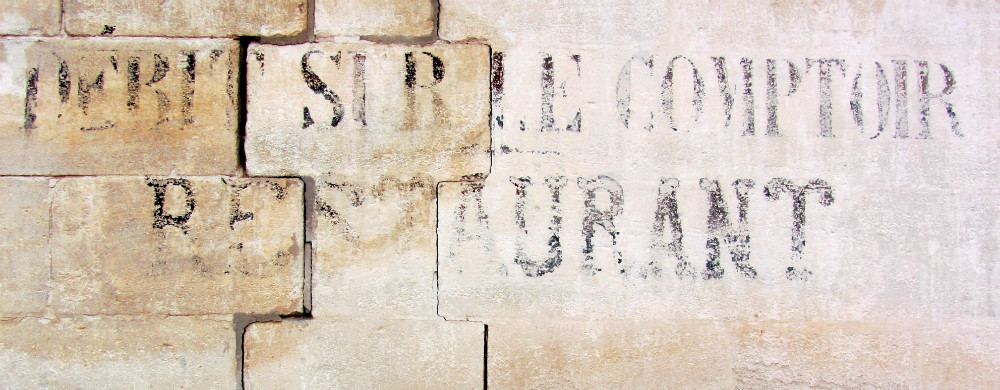
In this internet age there is an active online community of people who track down ghost signs, those faded hand-painted advertisements and signage from bygone years which have somehow survived this far into the 21st century.

In France, particularly rural France, ghost signs (such as the one above to be found in Saint-Aubin-de-Médoc) remain a fairly common sight. With a little help from real-world friends and Twittersphere acquaintances, here is a first selection of a few such adverts and signs to be spotted in and around Bordeaux. A dedicated GoogleMap (which has also been added to the right-hand menu) will help you locate them all. There will be many more to come in other posts further down the line!

A fourth self-guided walking tour of Bordeaux is now available to download and run on different iDevices. The latest addition to this ran...

A fourth self-guided walking tour of Bordeaux is now available to download and run on different iDevices. The latest addition to this range of lovingly handcrafted tours will take you on a meandering walk through the most elegant parts of the city.

Setting out from Esplanade des Quinconces, the two-hour Elegant Bordeaux Tour trek takes in the fine architecture, picturesque streets, peaceful market squares and magnificent churches of the Chartrons and Saint-Seurin districts.

A few months ago, as part of a twin Invisible Bordeaux / Invisible Paris feature, we reviewed the formative years spent in France by ...


A few months ago, as part of a twin Invisible Bordeaux/Invisible Paris feature, we reviewed the formative years spent in France by Mitt Romney, the unsuccessful Republican candidate in the 2012 US presidential elections. During the six months he spent as a Church of Jesus Christ of Latter-Day Saints missionary in Bordeaux in 1968, the apartment he called home was on Place du Maucaillou in the Capucins district. Meanwhile, the centre of gravity of his missionary activities was this Mormon chapel on Rue Pierre-Romain in Talence.

This was the first Mormon church to be built in France (there are now 110 serving 36,500 members). The land, in a quiet residential part of the suburb, had been purchased by the Church in 1963 and the architectural project was initially overseen by the movement’s Thor Leifson. At the time the ward numbered around 35 members and, ahead of the chapel being built, they congregated in an abandoned villa situated within the grounds.

The foundation stone of the chapel was laid on June 8th of that year, some time before the building permit was delivered; the project was rubberstamped by authorities the following October. Construction work could begin in earnest and was wholly handled by missionaries – including a 16-year-old who had travelled down especially from the Breton city of Rennes – and volunteers. At times, there were 50 people working on the site. Church members who couldn’t help with construction work per se contributed by washing and ironing the missionaries’ clothes and by bringing them home-cooked meals. Members also helped with funds by symbolically purchasing bricks of the future chapel, each one costing 1 franc.


Meanwhile, demolition work on the villa was reportedly carried out by a company called Navarro, whose manager had been unwilling to take on the project until he discovered it had been commissioned by the Mormons. It turns out Navarro was a literal Bible believer who had recently returned from an expedition searching for the remains of Noah’s Ark on Mount Ararat in Eastern Turkey. He had come back with pieces of petrified wood that carbon dating showed were 4,400 years old… whether they were bits of the Ark is another story! 

Throughout the transitional phase, the congregation would meet in prefabricated premises. But by the summer of 1964, the exterior was complete, and attentions turned to the interior which was more or less finished by mid-1965, when the chapel was used to hold sessions of a nationwide youth conference. A few finishing touches later, the chapel was officially inaugurated on December 10th 1965 by Mormon “apostle” Howard W. Hunter (who later went on to serve as president of the movement over a brief nine-month period between 1994 and his death in 1995). The chapel’s consecration followed in March 1967. 


Howard W. Hunter obviously paid a return visit in 1968. In a feature published by The Boston Globe in 2008, photos credited to Marie-Blanche and Jean Causse show Romney alongside Hunter both outside and inside the chapel in Talence. In the top photo Romney is standing fourth from the left, Hunter ninth. Bottom right is the same backdrop 44 years later!
Although precise figures are hard to come by, the Talence ward went from strength to strength over the following ten years, with activities including schooling for 35 children, scout troops, public-speaking and drama clubs, dance lessons, not to mention couscous soirées and fancy-dress parties with a recurrent Wild West theme.

The chapel apparently continues to enjoy a healthy working relationship with the municipality and no doubt continues to serve as a meeting point for new generations of missionaries. Will any of the current crop go on to become prominent political players in the future? 

> Find it on the Invisible Bordeaux map: Mormon chapel, 10 Rue Pierre-Romain, Talence 
> The account of Romney's time in Bordeaux and Paris  
> Detailed history of the Church of Jesus Christ of Latter-Day Saints in France
> Ce dossier est également disponible en français !

This statue of Charles-Michel Lespée, or Abbé de l’Épée, and his supporting cast of young girls are looking out over the grand main entr...


This statue of Charles-Michel Lespée, or Abbé de l’Épée, and his supporting cast of young girls are looking out over the grand main entrance of a building known as “Castéja” and named, like a neighbouring road, after Pierre Castéja, mayor of Bordeaux between 1860 and 1863.

At the time of writing, Castéja is a massive empty shell and set to become a residential complex led by Gironde Habitat, comprising 180 apartments, an underground car park and a pre-schoo maternelle. The building’s glory years as "L'Institution nationale des sourdes-muettes", an educational institute for deaf and dumb girls from all over France, are therefore long gone.

Invisible Bordeaux first crossed the path of architect Hector Loubatié when researching the Ciné-Théâtre Girondin near Barrière de Pess...


Invisible Bordeaux first crossed the path of architect Hector Loubatié when researching the Ciné-Théâtre Girondin near Barrière de Pessac. It soon emerged that there were many more interesting examples of the Bordeaux-born architect's eclectic vocabulary to be uncovered in and around the city and its suburbs.  

In the early years of the 20th century in France, the boom in personal hygiene and a desire to swim coincided with the rise of art deco ...


In the early years of the 20th century in France, the boom in personal hygiene and a desire to swim coincided with the rise of art deco architecture. In some cases, the phenomena combined, resulting in places like the “Piscine Les Bains” establishment to be found in Bègles.

Officially opened on December 4th 1932, the pool was the first of its kind to start operating in the Gironde département. It had been commissioned two years earlier by the town’s Socialist mayor, Alexis Capelle, and was executed to the designs of local architect Louis-Alfred Blanchard. Various specialists brought their specific expertise to the decorative mix: a painter named Bime, a sculptor named Vignal, the ceramist brothers Castiaux and the enameller Duvigneau.

Patrons would enter through the grand entrance on the street corner, and proceed either to the indoor pool on the left, or to the right which was given over to public bathing and showering facilities. In 1964, an outdoor “piscine d’été” was built to the rear of the building.


The establishment led a carefree existence for more than 60 years and in 1991 was granted listed status, registered on France’s “Inventaire supplémentaire des bâtiments historiques”. However, by then the facilities had deteriorated and, failing to meet stringent norms, in 1996 the pool was forced to close down for good. The building remained unused for almost ten years, by which time modern-era mayor Noël Mamère, one of the figureheads of France’s Green Party, initiated plans to refurbish the whole structure.

He called on the architect Patrick Bouchain, whose stated intention was not one of wanting to restore or rebuild but rather “to bring the place back to life. Many monuments are either abandoned or become museums. With regard to the swimming pool in Bègles, it was decided that the building would retain its initial function”. (Source: Batiactu.)


The new-generation establishment opened in 2006 and does a fine job of combining the old and the new. Today's changing facilities are where the public showers used to be. Other than a few interior embellishments, the cubicles look much as they did back then. The outdoor pool area has now been covered with a glass roof, through which the sun shines on the new 12.50m x 25m swimming pool, where water is maintained at a pleasant 28°C. The indoor pool has been transformed into an elaborate wooden activity and fitness course used by children, convalescent adults and senior citizens alike.

Adjacent to this is a modern hammam and sauna installation. Completing the picture is a patio garden that comprises a functional water feature, or more precisely a "phytoremediation pond" where vegetation is employed to remove chlorine from water used in the pool. The processed water is then used in the establishment’s lavatory network or to water the greenery, and also fills the cisterns of the municipality’s street-cleaning vans.


Many of the original art deco features are virtually intact, from the wacky window frames and plaster wall mouldings to the tiled floors and faux-marble benches. The dome skylights in what used to be the lobby are gone though, replaced by a more watertight design embellished with colourful glass baubles. The former lobby is now a bio-food restaurant which trades under the name “Nature et des Courgettes” (a pun on the “Nature & Découvertes” shop name). Meanwhile, the main entrance has been moved further to the centre of the building's right wing in order to accommodate a disabled access ramp.


The new-look venue also boasts its own original artwork. When bathers walk through the foot bath on their way to the pool, they can admire a mosaic conceived by the German-born Brussels-based artist Marin Kasimir, the pixel-like squares merging to create a picture of the corridor to the former showering cubicles, forming another symbolic connection between the past and present – which cohabit particularly well at “Piscine Les Bains” . 


> Find it on the Invisible Bordeaux map: Piscine Les Bains, rue Carnot, Bègles.
> The town of Bègles has published this excellent Flickr gallery of Piscine Les Bains, including some fine archive pictures.

Working on this website has provided a means of discovering some inspiring places and stories. It has also been a way of unearthing some o...

Working on this website has provided a means of discovering some inspiring places and stories. It has also been a way of unearthing some of the more horrific chapters in the recent history of Bordeaux and Gironde. The memorial to be found at the Camp de Souge military base is one such find. 

The Camp de Souge covers 7,000 acres of land to the north west of Martignas-sur-Jalle, some 20 kilometres to the west of Bordeaux. It has been a military base since 1900 and is today home to the French Army’s 13th “Régiment de dragons parachutistes”, providing accommodation and vast areas which are dedicated to training drills and manoeuvres. Souge is also a flight test centre for military and civilian unmanned aerial vehicles.

[April 2015 update: the boat is now in Arcachon] On the southern edge of Arcachon Bay, the Port du Canal in Gujan-Mestras is home to a ...

[April 2015 update: the boat is now in Arcachon]

On the southern edge of Arcachon Bay, the Port du Canal in Gujan-Mestras is home to a number of oyster farmers, fishermen and ship-builders. It is also here that a record-breaking high-speed catamaran conceived by renowned Arcachon-based sailor Yves Parlier has seemingly been left to rest in peace in full view of all-comers. What is more, at the time of writing, it can be yours for €250,000.

Originally unveiled by Parlier in 2004 after six years in the making, the boat is the “hydraplaneur”, a 60-foot (18.28m) carbon fibre “hydro-glider”. She was designed by a partnership known as Aquitaine Design Team and manufactured by Chantier Naval de Larros (CNL). The boat’s main innovations were its twin rig with a mast on each hull (unlike on trimarans where the central hull supports the mast), and the “stepped” hull design, inspired by the use of this shape on seaplanes enabling the aircraft to take off and land at high speed.

The annual Journées européennes du patrimoine take place on September 15th and 16th. A number of places previously featured on Invisibl...

The annual Journées européennes du patrimoine take place on September 15th and 16th. A number of places previously featured on Invisible Bordeaux will be open to the public, while others are on my list of things to see and write about!

Here is but a small selection of the places to see in Bordeaux itself, bearing in mind that throughout the region a whole host of fascinating venues are taking part in the event!

Perhaps the most surprising sight in the quiet residential town of Saint-Aubin-de-Médoc is a 1/5 scale model of a 1960s Diamant A rocket ...

Perhaps the most surprising sight in the quiet residential town of Saint-Aubin-de-Médoc is a 1/5 scale model of a 1960s Diamant A rocket positioned in the middle of a roundabout.

The model, which was funded by the space technology company EADS Astrium and manufactured by Matisa, was unveiled by the local mayor in November 2009. It celebrates the contributions made by engineers in the town to the Diamant A project, which formed part of President Charles de Gaulle’s plans to develop an independent nuclear defence system at the height of the Cold War.

On Rue Charles-Domercq, a side-street adjacent to Saint-Jean railway station, a 1929 building continues to reign supreme: the former Bord...

On Rue Charles-Domercq, a side-street adjacent to Saint-Jean railway station, a 1929 building continues to reign supreme: the former Bordeaux postal sorting office.

The structure was designed by the Toulouse-born architect Léon Jaussely (1875-1932), who had been appointed chief architect of the postal services in 1914 and is also famed for his extravagant “Hall de la Dépêche du Midi” in Toulouse and the “Cité Nationale de l'Histoire de l'Immigration” in Paris.

What is the connection between t he aircraft electronics specialist Thales Avionics, a flower bulb and seed company in Carbon-Blanc, and...


What is the connection between the aircraft electronics specialist Thales Avionics, a flower bulb and seed company in Carbon-Blanc, and a giant artichoke on a roundabout in Macau? The answer is the gardener Toussaint-Yves Catros.

Toussaint-Yves Catros was born in the Breton town of Saint-Brieuc in 1757 and defined himself as a “cultivateur de pépinières” (tree nursery agriculturist), an occupation which had already run in his family for a number of generations. His first big break came when he relocated to Paris and was chosen to oversee the royal tree nurseries in the 8th arrondissement (Faubourg-du-Roule quarter) and in Vincennes.

The tall steeple of Saint-Seurin church is one of the most outstanding features of the Médoc village of Lamarque, best-known as the l...


The tall steeple of Saint-Seurin church is one of the most outstanding features of the Médoc village of Lamarque, best-known as the left-bank departure and arrival point of the small ferries that criss-cross the Gironde estuary (the right-bank counterpart being the town of Blaye).

The church itself was built over a 40-year period between 1830 and 1870. Its steeple was topped off by a dome which, come 1968, was in a critical state of disrepair. The dome was dismantled and the steeple remained in its decapitated form for a number of years. 

At the turn of the millennium, the Lamarque village council launched a project to rebuild the dome. Municipal funds were boosted by subsidies from the Gironde département and a grant from the European Union, within the framework of the Leader+ programme aimed at promoting the development of rural areas.

Throughout 2003 and 2004, craftsmen from two local companies, the carpenters Pierre-Jean Juste and roofing specialists Fetis, set about delivering a new staircase and dome that would not only complete the church’s silhouette but that would also be a destination in itself, providing visitors with a unique view over the village of Lamarque, the surrounding vineyards (this is Haut-Médoc territory, wine-lovers) and countryside, and out towards the Gironde estuary.


The view has to be earned though. To reach the 39-metre-high vantage point, there are 189 wooden steps to climb. In all, seven landings break up the ascent, and each section of the staircase boasts a different shape and design. According to guide Josette Nonier, the chops and changes in the meandering and winding route of the staircase were inspired by the labyrinth scene which takes place in a library in Umberto Eco’s “The Name of the Rose”.

Cross-section of steeple and its staircase,
as featured in official leaflet.

The staircase also passes very close by to the 1-ton church bell, which is rarely in use. However if, like me, you happen to be there on the day a wedding is taking place, you will witness the bell in full flow and, believe you me, it is one loud and powerful beast. Several weeks on, I can still feel the vibrations in my bones.


The final destination is the 9-ton lead-plated dome itself, which comprises an observation deck with four oval bull’s eye windows to take in the view, complete with information panels detailing the points of interest that can be spotted.  


From that vantage point, the only way is down... but gazing back up at the dome from ground level, the dome and its windows no longer look quite the same!


> Find it on the Invisible Bordeaux map: Dôme Panoramique de Lamarque, Place de l'Église, Lamarque 
> The dome is open to the public 1.30-5.30PM Wednesdays-Sundays, admission costs 2 euros. 
> Further information on the official Lamarque website, in this introductory leaflet and in this Sud Ouest piece. 
> The Pierre-Jean Just website includes this picture gallery of the wooden frame of the dome taking shape. 

I am extremely pleased and proud to have been interviewed by Sud Ouest journalist Catherine Darfay. The resulting feature appeared in t...

I am extremely pleased and proud to have been interviewed by Sud Ouest journalist Catherine Darfay.

The resulting feature appeared in the August 10th 2012 issue of Sud Ouest (Bordeaux and greater Bordeaux editions). The article serves as a fine introduction to the story and thinking behind Invisible Bordeaux, reveals how I go about producing the pieces... and has gone some way to making my yellow bicycle a celebrity in its own right!

We are in the quiet town of Sainte-Hélène, located mid-way between Bordeaux and Lacanau. Across the road from the water tower, tucked ...


We are in the quiet town of Sainte-Hélène, located mid-way between Bordeaux and Lacanau. Across the road from the water tower, tucked in between the bakers' and the community hall, is a curious, narrow, landlocked house that was built in 1930 by one Mr A. Naturel.

In the late 1920s Mr Naturel, a pork-butcher by trade, was looking to purchase a plot of land where he could construct a building that would be both his shop and family residence. He found a spot which was centrally-located in the town but which was far too small for his plans.

The seller was keen to push things through and asserted that the neighbours were willing to part with a section of their land, which would have left the buyer with a larger area on which to build. A deal was therefore reached and Mr Naturel purchased the diminutive original plot.

However, the neighbours backed out of their promise to sell… or perhaps they never intended to do so in the first place. Naturel filed legal action but to no avail: he was stuck with his tiny plot of land.


Naturel was bitter but proceeded to build his house all the same (“quand même”). Not only that, but as a sign of his contempt (“mépris”) for his neighbours, he opted to make his house the most extravagant design ever to squeeze into such a small space. And to sum up his overriding feelings, the villa was given the name “Quand-Même et Mépris”.


The reaction of the neighbourhood is undocumented but the façade is a case study in bravura. On either side of the first-floor bow window (which features Mr Naturel’s initials) and below the pictures of vases containing bouquets of yellow and blue flowers are hunting scenes painted on tiles, showing hounds chasing down deer and wild boar. 


Naturel’s name and trade are spelled out above the ground floor (shop) entrance and window in gold lettering. The surrounding blue, green and orange mosaic pattern is repeated below the window. What may or may not be a lightning rod adds a little more height to the building which is so short on width and depth!


The building is now solely a private home and no longer a shop, but the 1930 design remains… and presumably today’s occupiers are happy to make do with the square opposite the house when they need to stretch their legs!

> Find it on the Invisible Bordeaux map: Villa Quand-Même et Mépris, Route de Castelnau, Sainte-Hélène 
> Further photos on dedicated "Petit Patrimoine" page, the content of which largely served as the basis for this item. 
Thanks to Élisa for the detailed instructions that enabled me to find the villa!

The small triangular Place Picard in the Chartrons district is home to one of the world’s many replicas of the Statue of Liberty...


The small triangular Place Picard in the Chartrons district is home to one of the world’s many replicas of the Statue of Liberty. The recently-restored resin model which can be seen today has been in position since 2000, but the presence of the statue on the square goes back much further.

Of course, the marginally better-known full-size version of the statue in New York (full name: “La Liberté éclairant le monde” or “Liberty Enlightening the World”) was executed to the designs of the French sculptor Frédéric-Auguste Bartholdi (1834-1904) and given by France to the United States in 1886 as a memorial to America’s independence.