For more than a thousand years, pilgrims have followed routes from different parts of Europe to the cathedral of Santiago de Compostela in north-western Spain, where it is believed that the remains of the apostle Saint James are buried. The pilgrimage is what the Spaniards know as “el Camino de Santiago”, the French as “les Chemins de Saint-Jacques-de-Compostelle”, and what English-speakers call “the Way of Saint James”.
|| PART OF A TWIN FEATURE PUBLISHED WITH INVISIBLE PARIS! || For more than a thousand years, pilgrims have followed routes from differ...
Tracking St James’ Way pilgrims towards Santiago de Compostela – part 1: Le Bouscat
For more than a thousand years, pilgrims have followed routes from different parts of Europe to the cathedral of Santiago de Compostela in north-western Spain, where it is believed that the remains of the apostle Saint James are buried. The pilgrimage is what the Spaniards know as “el Camino de Santiago”, the French as “les Chemins de Saint-Jacques-de-Compostelle”, and what English-speakers call “the Way of Saint James”.
Bordeaux trams have become such an integral part of the landscape in the city that they even feature on postcards. The 21st-century ...
The VAL light railway network that never happened
Bordeaux trams have become such an integral part of the landscape in the city that they even feature on postcards. The 21st-century transport infrastructure could have been very different though because, for many years, the plan was to build a light railway network which would have looked something like the artist’s impression pictured above.
![]() |
| The central Bordeaux tram and bus network in 1940 as featured in "l'Histoire des Tramways et omnibus à Bordeaux" and previously published by in Mysticktroy's Blogpaper. |
By the 1970s, the uglier side of the age of the automobile was only too plain to see, and Bordeaux drivers and commuters regularly had to contend with gridlocked roads and boulevards. At the time an underground transport system was considered but the project was soon dropped because drilling through the city’s swampy terrain would have had disastrous consequences below the surface and at ground level.
| How the VAL network would have looked. (Source: “De la ville à la métropole, 40 ans d’urbanisme à Bordeaux”) |
With the exception of the Communist representatives, the project was initially supported by all parties and the Chamber of Trade and Industry. But as the plans began to take shape, cracks began to show. Members of the general public (some of whom joined forces to form the association Trans'Cub) were also increasingly vocal about their reservations, favouring a shift back to trams.
* In his foreword to the book “De la ville à la métropole, 40 ans d’urbanisme à Bordeaux”
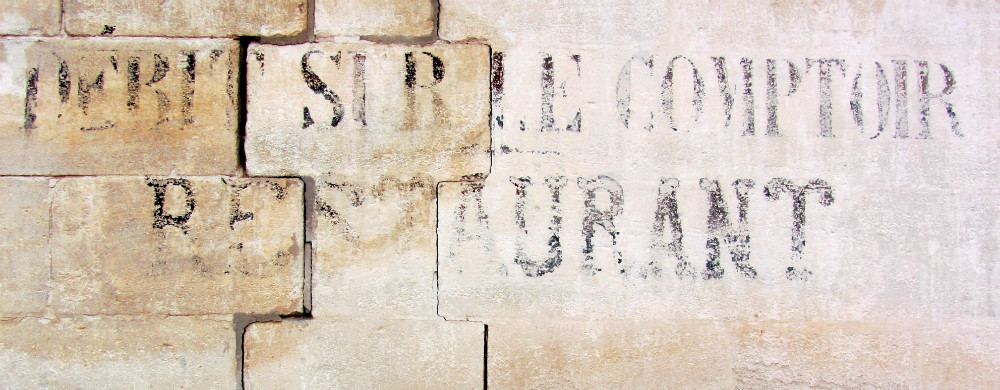
In this internet age there is an active online community of people who track down ghost signs, those faded hand-painted advertisements an...
Ghost signs: phantom letters continuing to haunt the walls (chapter 1!)
A fourth self-guided walking tour of Bordeaux is now available to download and run on different iDevices. The latest addition to this ran...
New guided walking tour now available: Elegant Bordeaux
A few months ago, as part of a twin Invisible Bordeaux / Invisible Paris feature, we reviewed the formative years spent in France by ...
Mitt Romney’s Latter-Day Saints basecamp in Talence
A few months ago, as part of a twin Invisible Bordeaux/Invisible Paris feature, we reviewed the formative years spent in France by Mitt Romney, the unsuccessful Republican candidate in the 2012 US presidential elections. During the six months he spent as a Church of Jesus Christ of Latter-Day Saints missionary in Bordeaux in 1968, the apartment he called home was on Place du Maucaillou in the Capucins district. Meanwhile, the centre of gravity of his missionary activities was this Mormon chapel on Rue Pierre-Romain in Talence.
This was the first Mormon church to be built in France (there are now 110 serving 36,500 members). The land, in a quiet residential part of the suburb, had been purchased by the Church in 1963 and the architectural project was initially overseen by the movement’s Thor Leifson. At the time the ward numbered around 35 members and, ahead of the chapel being built, they congregated in an abandoned villa situated within the grounds.
The foundation stone of the chapel was laid on June 8th of that year, some time before the building permit was delivered; the project was rubberstamped by authorities the following October. Construction work could begin in earnest and was wholly handled by missionaries – including a 16-year-old who had travelled down especially from the Breton city of Rennes – and volunteers. At times, there were 50 people working on the site. Church members who couldn’t help with construction work per se contributed by washing and ironing the missionaries’ clothes and by bringing them home-cooked meals. Members also helped with funds by symbolically purchasing bricks of the future chapel, each one costing 1 franc.
![]() |
|
Howard W. Hunter obviously paid a return visit
in 1968. In a feature published by The Boston Globe in 2008, photos credited to
Marie-Blanche and Jean Causse show Romney alongside Hunter both outside and inside the chapel in Talence. In the top photo Romney is standing fourth from the left, Hunter ninth. Bottom right is the same backdrop 44 years later!
|
The chapel apparently continues to enjoy a healthy working relationship with the municipality and no doubt continues to serve as a meeting point for new generations of missionaries. Will any of the current crop go on to become prominent political players in the future?
> Find it on the Invisible Bordeaux map: Mormon chapel, 10 Rue Pierre-Romain, Talence
> The account of Romney's time in Bordeaux and Paris
> Detailed history of the Church of Jesus Christ of Latter-Day Saints in France
> Ce dossier est également disponible en français !
This statue of Charles-Michel Lespée, or Abbé de l’Épée, and his supporting cast of young girls are looking out over the grand main entr...
Castéja: the former school for the deaf with an uncertain future
Invisible Bordeaux first crossed the path of architect Hector Loubatié when researching the Ciné-Théâtre Girondin near Barrière de Pess...
Hector Loubatié’s architectural endeavours in Bordeaux and Pessac
In the early years of the 20th century in France, the boom in personal hygiene and a desire to swim coincided with the rise of art deco ...
Bègles Piscine Les Bains: rejuvenating Gironde’s oldest swimming facilities
Officially opened on December 4th 1932, the pool was the first of its kind to start operating in the Gironde département. It had been commissioned two years earlier by the town’s Socialist mayor, Alexis Capelle, and was executed to the designs of local architect Louis-Alfred Blanchard. Various specialists brought their specific expertise to the decorative mix: a painter named Bime, a sculptor named Vignal, the ceramist brothers Castiaux and the enameller Duvigneau.
Patrons would enter through the grand entrance on the street corner, and proceed either to the indoor pool on the left, or to the right which was given over to public bathing and showering facilities. In 1964, an outdoor “piscine d’été” was built to the rear of the building.
He called on the architect Patrick Bouchain, whose stated intention was not one of wanting to restore or rebuild but rather “to bring the place back to life. Many monuments are either abandoned or become museums. With regard to the swimming pool in Bègles, it was decided that the building would retain its initial function”. (Source: Batiactu.)
Working on this website has provided a means of discovering some inspiring places and stories. It has also been a way of unearthing some o...
Camp de Souge memorial: remembering 300 wartime executions
The Camp de Souge covers 7,000 acres of land to the north west of Martignas-sur-Jalle, some 20 kilometres to the west of Bordeaux. It has been a military base since 1900 and is today home to the French Army’s 13th “Régiment de dragons parachutistes”, providing accommodation and vast areas which are dedicated to training drills and manoeuvres. Souge is also a flight test centre for military and civilian unmanned aerial vehicles.
[April 2015 update: the boat is now in Arcachon] On the southern edge of Arcachon Bay, the Port du Canal in Gujan-Mestras is home to a ...
Yves Parlier’s hydro-glider: resting in peace in Gujan-Mestras
The annual Journées européennes du patrimoine take place on September 15th and 16th. A number of places previously featured on Invisibl...
Journées du Patrimoine 2012: the Invisible Bordeaux selection!
Here is but a small selection of the places to see in Bordeaux itself, bearing in mind that throughout the region a whole host of fascinating venues are taking part in the event!
Perhaps the most surprising sight in the quiet residential town of Saint-Aubin-de-Médoc is a 1/5 scale model of a 1960s Diamant A rocket ...
Diamant A: a little bit of Space on Earth in Saint-Aubin-de-Médoc
The model, which was funded by the space technology company EADS Astrium and manufactured by Matisa, was unveiled by the local mayor in November 2009. It celebrates the contributions made by engineers in the town to the Diamant A project, which formed part of President Charles de Gaulle’s plans to develop an independent nuclear defence system at the height of the Cold War.
On Rue Charles-Domercq, a side-street adjacent to Saint-Jean railway station, a 1929 building continues to reign supreme: the former Bord...
Centre de tri postal: no longer processing rail mail
The structure was designed by the Toulouse-born architect Léon Jaussely (1875-1932), who had been appointed chief architect of the postal services in 1914 and is also famed for his extravagant “Hall de la Dépêche du Midi” in Toulouse and the “Cité Nationale de l'Histoire de l'Immigration” in Paris.
What is the connection between t he aircraft electronics specialist Thales Avionics, a flower bulb and seed company in Carbon-Blanc, and...
Toussaint-Yves Catros: the lasting legacy of a royal gardener
What is the connection between the aircraft electronics specialist Thales Avionics, a flower bulb and seed company in Carbon-Blanc, and a giant artichoke on a roundabout in Macau? The answer is the gardener Toussaint-Yves Catros.
Toussaint-Yves Catros was born in the Breton town of Saint-Brieuc in 1757 and defined himself as a “cultivateur de pépinières” (tree nursery agriculturist), an occupation which had already run in his family for a number of generations. His first big break came when he relocated to Paris and was chosen to oversee the royal tree nurseries in the 8th arrondissement (Faubourg-du-Roule quarter) and in Vincennes.
The tall steeple of Saint-Seurin church is one of the most outstanding features of the Médoc village of Lamarque, best-known as the l...
Dôme Panoramique de Lamarque: a bird’s eye view over the Médoc and Gironde estuary
At the turn of the millennium, the Lamarque village council launched a project to rebuild the dome. Municipal funds were boosted by subsidies from the Gironde département and a grant from the European Union, within the framework of the Leader+ programme aimed at promoting the development of rural areas.
![]() |
| Cross-section of steeple and its staircase, as featured in official leaflet. |
> The dome is open to the public 1.30-5.30PM Wednesdays-Sundays, admission costs 2 euros.
> Further information on the official Lamarque website, in this introductory leaflet and in this Sud Ouest piece.
> The Pierre-Jean Just website includes this picture gallery of the wooden frame of the dome taking shape.
I am extremely pleased and proud to have been interviewed by Sud Ouest journalist Catherine Darfay. The resulting feature appeared in t...
Sud Ouest feature: "The man with the yellow bike"
The resulting feature appeared in the August 10th 2012 issue of Sud Ouest (Bordeaux and greater Bordeaux editions). The article serves as a fine introduction to the story and thinking behind Invisible Bordeaux, reveals how I go about producing the pieces... and has gone some way to making my yellow bicycle a celebrity in its own right!
We are in the quiet town of Sainte-Hélène, located mid-way between Bordeaux and Lacanau. Across the road from the water tower, tucked ...
Villa Quand-Même et Mépris: contemplating contempt 90 years on!
We are in the quiet town of Sainte-Hélène, located mid-way between Bordeaux and Lacanau. Across the road from the water tower, tucked in between the bakers' and the community hall, is a curious, narrow, landlocked house that was built in 1930 by one Mr A. Naturel.
In the late 1920s Mr Naturel, a pork-butcher by trade, was looking to purchase a plot of land where he could construct a building that would be both his shop and family residence. He found a spot which was centrally-located in the town but which was far too small for his plans.
The seller was keen to push things through and asserted that the neighbours were willing to part with a section of their land, which would have left the buyer with a larger area on which to build. A deal was therefore reached and Mr Naturel purchased the diminutive original plot.
However, the neighbours backed out of their promise to sell… or perhaps they never intended to do so in the first place. Naturel filed legal action but to no avail: he was stuck with his tiny plot of land.
Naturel was bitter but proceeded to build his house all the same (“quand même”). Not only that, but as a sign of his contempt (“mépris”) for his neighbours, he opted to make his house the most extravagant design ever to squeeze into such a small space. And to sum up his overriding feelings, the villa was given the name “Quand-Même et Mépris”.
Naturel’s name and trade are spelled out above the ground floor (shop) entrance and window in gold lettering. The surrounding blue, green and orange mosaic pattern is repeated below the window. What may or may not be a lightning rod adds a little more height to the building which is so short on width and depth!
The building is now solely a private home and no longer a shop, but the 1930 design remains… and presumably today’s occupiers are happy to make do with the square opposite the house when they need to stretch their legs!
> Further photos on dedicated "Petit Patrimoine" page, the content of which largely served as the basis for this item.
The small triangular Place Picard in the Chartrons district is home to one of the world’s many replicas of the Statue of Liberty...
Statue of Liberty: enlightening the world on Place Picard
Of course, the marginally better-known full-size version of the statue in New York (full name: “La Liberté éclairant le monde” or “Liberty Enlightening the World”) was executed to the designs of the French sculptor Frédéric-Auguste Bartholdi (1834-1904) and given by France to the United States in 1886 as a memorial to America’s independence.


Follow/contact