Every day, thousands of vehicles cross Pont d'Aquitaine, the impressive suspension bridge over the Garonne river that connects Bordea...
Every day, thousands of vehicles cross Pont d'Aquitaine, the impressive suspension bridge over the Garonne river that connects Bordeaux and Lormont.
However, only cyclists enjoy the luxury of being able to take in the stunning view over the city, the river and the surrounding area. So, with public interest at heart, I have gone along to the bridge on my bike, camera in hand, and this brand Youtube clip shows what can be seen!
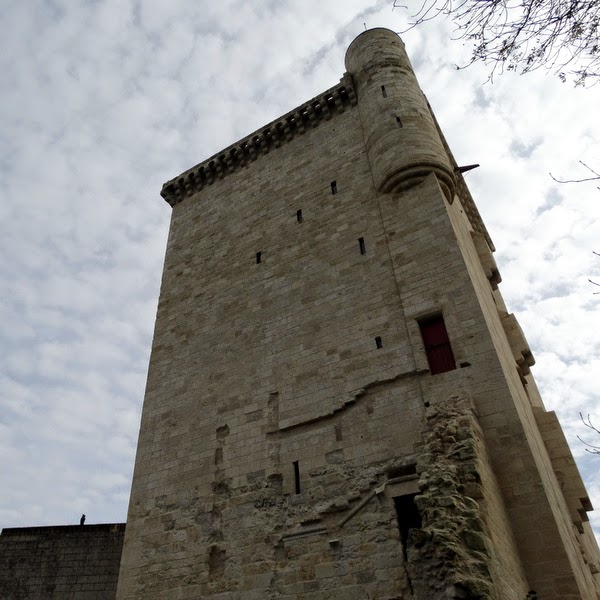
What is 30 metres high, 12 metres wide, made of stone and dates way back to the 14th century? The answer, if you happen to be 65 kilometr...
What is 30 metres high, 12 metres wide, made of stone and dates way back to the 14th century? The answer, if you happen to be 65 kilometres to the north of Bordeaux in Lesparre-Médoc, is the magnificent “Tour de l’Honneur”.
The 6-level tower (other than the ground floor, there are four levels each comprising a vaulted room, plus a rooftop terrace), is the sole surviving section of the even grander “Château de l'Honneur de Lesparre”, parts of which even predated the 14th century. The original fortified castle comprised three further towers and was a pivotal means of defence for the Médoc and Gironde Estuary, the area being of strategic importance during medieval times.
Over the years, my views of Bordeaux have been gained either riding a bike, as a pedestrian, behind the wheel of a car, or from the seat ...
Over the years, my views of Bordeaux have been gained either riding a bike, as a pedestrian, behind the wheel of a car, or from the seat of a bus or tram. It struck me that one vantage point I hadn’t really explored was that of the suburban train.
The time had therefore come to report to Blanquefort railway station and buy a €4.30 ticket for the 35-minute journey into Bordeaux’s Gare Saint-Jean. The big question before the train arrived was would I spot anything new from this rear-window vantage point? The answer was not exactly a resounding “yes” or a definite “no” but somewhere in-between: it would simply provide a sample of the city’s suburban living quarters and landscapes, some of which we’ve almost stopped noticing.
Faded hand-painted adverts and signs, so-called ghost signs, have often featured on the blog . And among the interesting subsets which re...
Here are a few examples of the Instagrammed signs that have therefore made it through the times. All are located in central Bordeaux and, other than a couple of exceptions, I think that none of these companies continue to operate - certainly not out of these outlets. But if you know otherwise or can provide information about any of the featured names, then please get in touch!
Towards the top end of Rue des Remparts, the charming, gently sloping pedestrianised street which connects Rue Porte Dijeaux and Place Pe...
Towards the top end of Rue des Remparts, the charming, gently sloping pedestrianised street which connects Rue Porte Dijeaux and Place Pey-Berland, a discreet plaque can be seen on the wall of a three-storey building.
The words are virtually illegible, given that they have been written in white on a white background. But that shouldn’t be enough to put us off deciphering the text: the plaque celebrates the birthplace of Charles Lamoureux, the illustrious violinist and conductor who did much to popularise the music of Berlioz, Wagner and Handel in France.
A few months ago I published an item about the little-known Parc Rivière , a fascinating expanse of greenery which lies between the town...
A few months ago I published an item about the little-known Parc Rivière, a fascinating expanse of greenery which lies between the townhouses of the Tivoli quarter and the high-rise apartment blocks of the Grand-Parc district.
I recently went back and this time filmed the visit, which you can view in this brand new Youtube clip:
The annual European heritage days take place on September 20th and 21st. As ever the event will provide a unique opportunity to get behin...
The annual European heritage days take place on September 20th and 21st. As ever the event will provide a unique opportunity to get behind the scenes of many fascinating places, or else stay out in the open and enjoy some fine guided walking tours.
Once again there are hundreds of options available, making it difficult to know where to start. So to make things easier, Invisible Bordeaux has been through everything on offer and here is a small selection of some of the more unusual and eye-catching visits... while the full list of venues and visits - in Bordeaux and beyond - can be found on the
official event website.
We are in the suburb of Talence and looking at a sign outside a small, carefully-tended plot of land at the end of a cul-de-sac, Rue Bahu...
We are in the suburb of Talence and looking at a sign outside a small, carefully-tended plot of land at the end of a cul-de-sac, Rue Bahus. The sign reads “Commonwealth War Graves” although a more precise description would be “Allied War Graves”.
The tiny cemetery, which is located next to Talence’s municipal graveyard, is the final resting place for 18 men: five Americans, ten Canadians and three Britons (or Australians).
Wooden crosses mark the graves of the five Americans, who died at various dates between 1918 and 1945: Edward Simacys (1918), Anton Rivas (1919), Abraham Hamde (1920), Charles Carroll (1928) and Joseph Bouchard (1945).
In central Bordeaux, three bronze orientation maps (or “ plans-reliefs ” in French) have been positioned at strategic locations. I met ...
In central Bordeaux, three bronze orientation maps (or “plans-reliefs” in French) have been positioned at strategic locations. I met up with François Didier, the sculptor behind these popular hands-on works of public art, to talk about the pieces, about a similar project rolled out near Pauillac and about his private sculpture garden at the northern tip of les Landes.
The
plans-reliefs project was initiated around 2007 by Philippe Prévôt, who is in charge of “
patrimoine historique” (heritage sites) at Bordeaux
Office de Tourisme, as well as being a renowned author of articles and
books about the city’s lesser-known stories. Prévôt had been inspired by a
3-D map in Florence, Italy, and thought his friend François Didier would be the right man for the job, as the sculptor had already produced scale models of towns in the past. The idea soon gained the support of the city council who would go on to commission the works in partnership with the
Office de Tourisme.
Some time ago I published an item about the Devèze and my attempt to track the now mostly-underground river from Mérignac airport all t...
Some time ago I published an item about the Devèze and my attempt to track the now mostly-underground river from Mérignac airport all the way into central Bordeaux.
I recently went back and this time filmed the adventure, which you can view in this brand new Youtube clip:
One of the focal points of the Right Bank botanic gardens, as featured in the previous blog item , is the bronze bust of Carl Linnaeus (1...
One of the focal points of the Right Bank botanic gardens, as featured in the previous blog item, is the bronze bust of Carl Linnaeus (1707-1778). The Swedish botanist, physician and zoologist is regarded as the father of modern taxonomy and one of the initiators of modern ecology.
To get the full story about the bust, I got in touch with Lucie Geffré, the talented Bordeaux-born, Madrid-based artist who was commissioned to produce the piece. Over to you, Lucie!
In the previous Invisible Bordeaux item , we explored the compact botanic gardens which have been located in the grounds of the Jardin Pu...
In the previous Invisible Bordeaux item, we explored the compact botanic gardens which have been located in the grounds of the Jardin Public since the 19th century. This time we are in the Bastide quarter on the Right Bank of the Garonne to visit the bigger, more ambitious and, yes, slightly crazier botanic gardens which were first opened in 2003.
Built to the designs of landscape gardener
Catherine Mosbach and architect
Françoise-Hélène Jourda, the 4-hectare gardens (that's 9 acres or 6 football pitches) are made up of a succession of distinct zones, taking visitors through a wide variety of scenery, greenery and ambiences.
Today, the city of Bordeaux boasts not one, but two botanic gardens, and the joint endeavours share a history that stretches way back to ...
Today, the city of Bordeaux boasts not one, but two botanic gardens, and the joint endeavours share a history that stretches way back to the 17th century. Today, we are braving the rain to witness the older of the two structures, which lies in the grounds of the Jardin Public.
It is said that the city’s first gardens, initially known as “Jardin des Plantes” were founded in 1629 as a formal collection of indigenous plants cultivated for medicinal, aromatic or culinary purposes. The Jardin enjoyed a number of different locations throughout the city until 1856 when it moved into the Jardin Public, the extensive parc à l’anglaise in central Bordeaux.
Unbelievable as it may seem today, in the early 1950s the city centre of Bordeaux hosted four Formula 1 Grand Prix races, attracting driv...
Unbelievable as it may seem today, in the early 1950s the city centre of Bordeaux hosted four Formula 1 Grand Prix races, attracting driving aces including Juan Manuel Fangio, Stirling Moss, Jean Behra and Maurice Trintignant.
Motor racing had grown in popularity throughout the first half of the 20th century, with a number of urban circuits holding Grand Prix events. In Gironde, the earliest races to be organised by Automobile Club du Sud Ouest (ACSO) were held in the Parc Bordelais throughout the 1920s, followed by a one-off Grand Prix in Saint-Médard-en-Jalles in 1932.
Loyal readers of the blog will know that before-and-after photos are a recurring feature. Meanwhile, there is currently a growing trend f...
Loyal readers of the blog will know that before-and-after photos are a recurring feature. Meanwhile, there is currently a growing trend for old and new views to be merged so, with the precious technical help of colleague and friend Anthony Poulachon, Invisible Bordeaux brings you this selection of pictures that mix and match old postcards with modern-day shots.
We start on Cours de l’Intendance and this attempt to bring first- and second-generation trams together! Look out for the charming selection of adverts on the wall over to the right. The moustachioed tram driver seems very focused on his job. Note the horse-drawn carts parked over to the right-hand side.
The small town of Saint-Savin, 50 kilometres to the north of Bordeaux, formed the backdrop to one of the shortest and strangest chapters...
The small town of Saint-Savin, 50 kilometres to the north of Bordeaux, formed the backdrop to one of the shortest and strangest chapters in the history of the FIFA football World Cup: the attempted kidnap of France’s team coach Michel Hidalgo.
The year is 1978 and, for the first time since 1966, France’s national squad have qualified for the World Cup finals. The tournament is to be held in Argentina which two years previously suffered a military coup, when
Isabel Perón’s government was toppled. Argentine army senior commander
Jorge Rafael Videla has since installed a merciless dictatorial regime.
Ahead of the
finals kicking off on June 1st, there is much debate among qualified nations as to whether or not they should boycott the tournament. In the end, no teams pull out although there are notable individual cases such as that of Dutch star Johan Cruyff, whose absence is widely believed to be politically motivated. (But it is much later revealed that his non-appearance is because he is reluctant to leave his family alone after
a kidnap attempt during which he and his family were threatened with a rifle.)
 |
| Hidalgo in 1978, source: INA. |
It was therefore in this uneasy context that, on Tuesday May 23rd, Michel Hidalgo left his home in Saint-Savin, heading for Bordeaux where he was to catch a train to Paris. From there the 22-man French squad and its entourage were to board an Air France Concorde bound for Buenos Aires with a stopover in Dakar, Senegal. Michel Hidalgo, accompanied by his wife, Monique, had just set off and the couple were driving along a quiet stretch of country road south of Saint-Savin (
contemporary reports mention it was in the "Les Coureaux" district of Cézac) when a car pulled up and forced them to stop. Out jumped two strangers, who threatened the Hidalgos with a weapon and ordered Michel to get out of the car.
In a TV news report broadcast that night, Hidalgo recounted: “[One of the two strangers] pointed a gun at me and ordered me to go with him into the small wood 50 metres away. Meanwhile the other person took my place in the driver’s seat of my car next to my wife. But I made a move once we had walked 15 or 20 metres, because I could feel the barrel of the gun in my back and I sensed I didn’t have long to live. My reflex was to turn and grab the barrel of the revolver, which fell to the ground. I managed to grab it first, at which point he ran away. The two strangers got back into their car and fled.” Only a few words had been exchanged throughout the ordeal: Hidalgo had asked what they wanted of him and the only response had been “
On va faire un tour dans le bois” (“I’m taking you for a walk in the woods”).
INA archive video - TF1 news report including interview with Michel Hidalgo:
Click here if video does not display properly on your device.
Hidalgo headed straight to the nearest police station and lodged an official complaint. The police examined the gun and noted it wasn’t loaded. The football coach was understandably shaken though and considered throwing in the towel: “In these circumstances you wonder what sport has got to do with it all. I especially thought about my family and decided there was no point in going [to Argentina].” However, he quickly overcame this initial reaction and “sport won out. I’ll soon be back with the players and we need to pursue our pacifistic actions that bring people together rather than driving them apart”.
 |
| The kind of scene where the attempted kidnap took place, on the D18 road out of Saint-Savin, although information uncovered since my visit would suggest the attempted kidnap took place further south in the Les Coureaux districe of Cézac, so in all likelihood on the D737 road. |
A few hours after the attempted kidnap, an anonymous caller claimed the operation was aimed at “drawing attention to the hypocritical complicity of France, which supplies Argentina with military equipment” (“
pour attirer l’attention sur l’hypocrite complicité de la France qui fournit du matériel militaire à l’Argentine”). If that was indeed the objective, then the objective had arguably been reached, as the incident was front-page news throughout the country.
It is unclear whether charges were ever pressed against anyone. It rather looks as if the case was dropped with on-the-pitch action taking precedence. But France’s World Cup campaign was short-lived: they were knocked out at the group stage after defeats to Italy and eventual winners Argentina. France went out on a minor high though, beating Hungary 3-1 in a match best-remembered for the unusual green and white stripes the French wore – there had been a mix-up and both teams had turned up at the stadium with white shirts. France had to requisition a local team’s strip!
Meanwhile, Hidalgo was slowly laying the foundations of a fine team which went on to be
semi-finalists at the 1982 World Cup in Spain ahead of winning the European Championship
on home soil two years later.
After that 1984 triumph, Hidalgo left his position with the French team, taking on managerial duties at Olympique Marseille and then becoming a radio pundit and after-dinner speaker. He also simultaneously left his home in Saint-Savin; it reportedly took a number of years to find a buyer for the centrally-located luxurious house which came complete with swimming pool and tennis court! Until his death in 2020 aged 87, Hidalgo went on to lead the quiet life of an illustrious retiree in Marseille…
> Find it on the Invisible Bordeaux map: Saint-Savin and the Hidalgo kidnap plot
> The definitive account of this incident can be found on the ever-excellent So Foot, here.
In the Saint-Genès district of Bordeaux stands a mansion house with Victorian traits which wouldn’t look out of place in the UK. Today it...
In the Saint-Genès district of Bordeaux stands a mansion house with Victorian traits which wouldn’t look out of place in the UK. Today it is the regional head office of a trade union but the building is still known to many as Hôtel Exshaw, in reference to the man who commissioned its construction: the original owner Frédérick Exshaw. And the mansion has a virtual twin in the Médoc!
The Exshaw family were wealthy traders in cognacs and “eaux de vie” spirits who had permanently relocated from their native Ireland to Bordeaux in 1805. Frédérick was born in 1826 and, around the early 1880s, he commissioned architect Louis Michel Garros (best-known in Bordeaux as the man behind the 1865 fountain on Place du Parlement) to design a mansion inspired by the houses that were all the rage in Britain during this Victorian era.
People who go googling for “free walking tours of Bordeaux” can rejoice: the four walking tours conceived by Invisible Bordeaux are now a...
People who go googling for “free walking tours of Bordeaux” can rejoice: the four walking tours conceived by Invisible Bordeaux are now available as free PDF downloads.
The tours, which were previously available as applications for iPhones and iPads, aim to provide visitors (and locals!) with interesting itineraries through the city that take in a host of sights of architectural, historical and cultural significance.




Follow/contact